Wayground logo

Free Printable Worksheets

Font size

S
M
L
XL
Worksheets

ES Semester 1 Review

Total questions: 100

Worksheet time: 4hrs 39mins

Name
Class
Date
1.

What is the best definition of a hypothesis?

a)

An description of how the world works

b)

A possible explanation or answer to a question

c)

A casual guess that you think might be right

d)

The longest side of a triangle

2.

Which of these is the metric measurement for volume?

a)

Meters

b)

Grams

c)

Liters

d)

Seconds

3.

What processes creates sedimentary rock?

a)

Melting

b)

Compaction

c)

Cementation

d)

Heat

4.

What type of sedimentary rock is made from small particles glued together?

a)

Clastic

b)

Chemical

c)

Organic

5.
Convert from meters to cm:  9 meters
a)
900 cm
b)
90 cm
c)
0.9 cm
d)
0.09 cm
6.
Convert 17 m to cm:
a)
0.17 cm
b)
0.017 cm
c)
1,700 cm
d)
170 cm
7.
Convert 300 meters to centimeters:
a)
3000 cm
b)
0.3 cm
c)
30,000 cm
d)
3 cn
8.
Convert 300 meters to centimeters:
a)
3000 cm
b)
0.3 cm
c)
30,000 cm
d)
3 cn
9.
Convert 8 kilometers to meters
a)
800 m
b)
80,000 m
c)
8,000 m
d)
.008 m
10.
Convert 5 cm to mm:
a)
5,000mm
b)
0.5 mm
c)
0.05 mm
d)
50 mm
11.
Convert 300 cm to m:
a)
3 m
b)
30 m
c)
0.3 m
d)
0.03 m
12.
1000 grams = _____ kilograms
a)
0.0001
b)
1,000,000
c)
10
d)
1
13.
7,000 g = ____ kg
a)
70
b)
700
c)
7
d)
0.07
14.
490,000 g =____ kg
a)
490
b)
49
c)
4,900
d)
0.49
15.
5,000 mg = ____ g
a)
50
b)
5
c)
500
d)
5,000
16.
Is 20 g greater than, less than, or equal to 2 kg?
a)
greater than
b)
less than
c)
equal to
17.
648 g = ____ mg
a)
6,480
b)
64,800
c)
648,000
d)
64.8
18.
285 kg = ____ g
a)
285,000
b)
285
c)
2,850
d)
28,500
19.
1 L = _______ mL
a)
1
b)
10
c)
100
d)
1000
20.
Is 4,000 mg greater than, less than, or equal to 4 g?
a)
greater than
b)
less than
c)
equal to
21.

7,000 g = ____ kg

a)

70

b)

700

c)

7

d)

0.07

22.
Is 11 g greater than, less than, or equal to 1,100 mg?
a)
greater than
b)
less than
c)
equal to
23.
1000 m = ___________ km
a)
100
b)
10
c)
1
d)
0.1
24.
3 km = ___________ mm
a)
30
b)
300
c)
3,000
d)
3,000,000
25.
How would you write 564,000,000 in scientific notation?
a)
5.64 x 10⁻⁷
b)
5.64 x 10⁶
c)
5.64 x 10⁸
d)
56.4 x 10⁷
26.
Scientific Notation is made up of two number parts. The second part is a power of base 10.
a)
True
b)
False
27.
When writing a number in scientific notation, the first number must be greater than 1, but less than 10.
a)
False
b)
True
28.
The rule of scientific notation is to write all exponents with a base of ____.
a)
50
b)
5
c)
100
d)
10
29.
How do you write
1001
in scientific notation?
a)
1.0001 x 10⁴
b)
1.01 x 10⁵
c)
1.001 x 10³
d)
10.1 x 10³
30.
Express the following in scientific notation:
.000457
a)
457 x 106
b)
457 x 10-6
c)
4.57 x10⁴
d)
4.57 x 10⁻⁴
31.
What is scientific notation?
a)
A long way to write really short  numbers
b)
A short way to write really long numbers
c)
I don't know...
d)
None of the above
32.
UNDERSTANDING
If the exponent is a positive number...
a)
you will get a large number
b)
you will get a smaller number
33.
Which of the following is correct scientific notation?
a)
20.35 x 10⁴
b)
.2035 x 104
c)
2035 4
d)
2.035 x10⁴
34.
Express the following in scientific notation:
.000457
a)
457 x 106
b)
457 x 10-6
c)
4.57 x10⁴
d)
4.57 x 10⁻⁴
35.
When your exponent is negative, you move your decimal....
a)
to the right
b)
to the left
c)
to both sides
d)
nowhere.... the decimal goes nowhere
36.
UNDERSTANDING
If the exponent is a negative number...
a)
you will get a large number
b)
you will get a small number
37.
Express the following in scientific notation:
1010.10
a)
1.01010  x 103
b)
1.01010 x 10⁵
c)
1.01010 x 10⁻³
d)
1.01010 x 10⁻⁵
38.
ANY number raised to a power of 0 will be....
a)
10
b)
itself
c)
1
d)
0
39.
What is this tool to get volume?
a)
triple beam balance
b)
ruler
c)
thermometer
d)
graduate cylinder
40.
What is this tool to get mass?
a)
triple beam balance
b)
ruler
c)
thermometer
d)
graduate cylinder
41.
True or False:  The density of a specific type of material never changes.  
a)
True
b)
False
42.
Put the liquids in order from most dense to least dense?
a)
4, 3, 2, 1
b)
1, 2, 3, 4
c)
3, 4, 2, 1, 
d)
4, 3, 1, 2
43.
Why does ice float?
a)
Liquid water is less dense than solid water.
b)
Solid water is less dense than liquid water.
c)
Gaseous water is less dense than solid water.
d)
Liquid water is less dense than gaseous water.
44.
What do we know about the density of lamp oil, rubbing alcohol, and vegetable oil?  
a)
The density is greater than 1.0 g/mL
b)
The density is less than 1.0 g/mL
c)
The density is equal to 1.0 g/mL
d)
The density can not be determined
45.
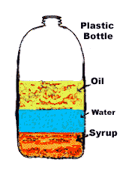
Which liquid is the least dense?
a)
oil
b)
water
c)
syrup 
d)
plastic bottle
46.
What is the formula for density?
a)
density = mass x volume
b)
density = mass / volume
c)
density = mass + volume
d)
density = mass - volume
47.
Jack has a rock. The rock has a mass of 14 g and a volume of 2 cm3. What is the density of the rock?
a)
7 mL
b)
7 g/cm3
c)
28 g/cm3
d)
1/7 g/cm3
48.
Frank has an eraser. It has a mass of 4 g, and a volume of 2 cm3. What is its density?
a)
8 g/cm3
b)
2 g/cm3
c)
1/2 g/cm3
d)
24 g/cm3
49.
Frank has a liquid. It has a mass of 6 g and a volume of 9 mL. What is its density?
a)
3 g/mL
b)
.66 g/mL
c)
1.33 g/mL
d)
54 g/mL
50.
Calculate the density of the cube.
a)
2 g/cm3
b)
4 g/cm3
c)
6 g/cm3
d)
8 g/cm3
51.
Calculate the density of the cube.
a)
2 g/cm3
b)
4 g/cm3
c)
6 g/cm3
d)
8 g/cm3
52.
Calculate the density of the cube.
a)
.33 g/cm3
b)
.4 g/cm3
c)
.6 g/cm3
d)
.5 g/cm3
53.
Calculate the density of the cube.
a)
3 g/cm3
b)
4 g/cm3
c)
2 g/cm3
d)
5 g/cm3
54.
If this substance takes up 6 ml of space, what is its mass?
a)
 6 ml
b)
6 grams
c)
0 grams
d)
4 grams 
55.
Which substance is the MOST dense?  ** Use the key
a)
A
b)
B
c)
C
d)
Cannot be determined by the data provided.
56.
The following liquids are poured together in a beaker: alcohol (density=0.79), corn syrup (density=1.38), water (density=1.0), and cooking oil (density=0.93).  Which of these liquids will sink to the bottom of the beaker?
a)
alcohol
b)
corn syrup
c)
water
d)
cooking oil
57.
What is the density of water?
a)
0 g/ml
b)
1 g/ml
c)
10 g/ml
d)
100 g/ml
58.
The process in which dissolved minerals crystallize and glue sediment together.
a)
cementation
b)
deposition
c)
organic rock
59.
What sized sediment makes shale?
a)
Sand
b)
Clay
c)
Cobble
60.
Which is smaller?
Clay or Silt
a)
Clay
b)
Silt
61.
How is sediment classified/grouped?
a)
By color
b)
By hardness
c)
By size
62.
What does clastic mean?
a)
Compacted sediment
b)
Magma made the rock
c)
The rock has crystals 
63.
How is sediment formed?
a)
Weathering and Erosion
b)
Melting
c)
Pressure
64.
Fossils are made by
a)
Plants dying
b)
Animals or plants are imprinted on a layer of sedimentary rock
c)
Breaking down of rocks
65.
What is deposition?
a)
Pieces of sediment come to rest on a surface
b)
Movement of sediment
c)
Breaking down of sediment 
66.
What is molten rock that has formed deep within the Earth?
a)
Hot Spot
b)
Magma
c)
Lava
d)
Volcano
67.
What is molten rock that has reached the Earth's surface?
a)
Aa
b)
Lava
c)
Magma
d)
Pahoehoe
68.
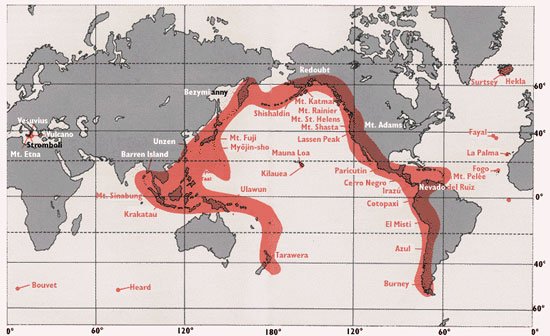
This is the name for the chain of volcanos around the edge of the Pacific Plate.
a)
Circle of Fire
b)
Ring of Lava
c)
Ring of Fire
d)
Circle of Magma
69.
What are the two types of earthquake waves?
a)
P and S waves
b)
Surface and Underground waves
c)
Fast and Slow waves
70.
The place where an earthquake originates inside the Earth's surface is called...
a)
Epicenter
b)
Hypocenter (focus)
c)
Underground
d)
Crust
71.
What are the three types of plate boundaries?
a)
Transform, Convergent, Divergent
b)
Apart, Together, Slide
c)
Slide, Pull away, Push together
72.
What is the instrument used to measure earthquakes?
a)
Seismograph
b)
Seisologist
c)
Scale
73.
What is the outermost layer of the Earth called?
a)
Core
b)
Mantle
c)
Crust
74.
The central or inner most part of the earth, made of 2 layers.  
a)
Mantle 
b)
Crust
c)
Core
75.
What two layers make up the core?  
a)
Mesosphere and 
Asthenosphere 
b)
Inner and Outer core
c)
Lithosphere and Outer Core
d)
Inner core and Mesosphere
76.
Middle part of the mantle that is partially molten rock, or putty like, or semisolid.
a)
Asthenosphere
b)
Mesosphere
c)
Lithosphere
d)
Crust
77.
Includes the crust and upper mantle that is divided into several constant moving plates of solid rock that floats on the layer below it. 
a)
Asthenosphere 
b)
Mesosphere
c)
Lithosphere 
d)
Crust
78.
Thickest layer of the Earth that is mostly solid, except for the semi solid upper part. Made of three mechanical layers.
a)
Mantle
b)
Crust 
c)
Core
79.

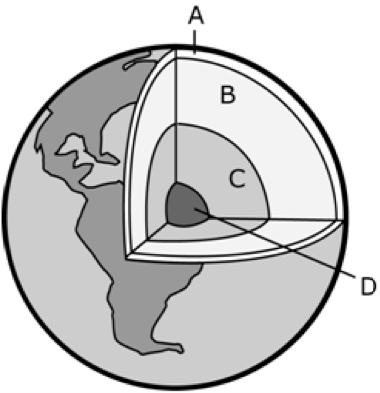
Which letter in the diagram identifies the layer of Earth made up of solid nickel and iron?

a)

layer A

b)

layer B

c)

layer C

d)

layer D

80.

Which of the following correctly lists the layers from innermost to outermost?

a)

inner core, outer core, lower mantle, upper mantle, crust

b)

lower mantle, upper mantle, crust, inner core, outer core

c)

lower mantle, inner core, upper mantle, outer core, crust

d)

crust, inner core, lower mantle, upper mantle, outer core

81.

A tectonic plate division of the lithosphere that includes the continental crust of Greenland, North America, Siberia, and the surrounding oceanic crust.

a)

tectonic plates

b)

African Plate

c)

North American Plate

d)

South American Plate

82.

A tectonic plate division of the lithosphere, including most of the landmasses of Europe and Asia.

a)

South American Plate

b)

North American Plate

c)

Eurasian Plate

d)

African Plate

83.

A tectonic plate division of the lithosphere that is composed entirely of oceanic crust and lies beneath the Pacific Ocean

a)

Antarctic Plate

b)

Indo-Australian Plate

c)

Pacific Plate

d)

Atlantic Plate

84.

A tectonic plate division of the lithosphere that includes the continental crust of Antarctica and the surrounding oceanic crust.

a)

Indo-Australian Plate

b)

Antarctic Plate

c)

African Plate

d)

Pacific Plate

85.

Occurs when two tectonic plates move toward each other and collide

a)

convergent boundary

b)

subduction

c)

volcanic eruptions

d)

divergent boundary

86.

the process in which a denser plate is pushed downward beneath a less dense plate when plates converge; occurs at continental to oceanic boundaries and oceanic to oceanic boundaries

a)

divergent boundaries

b)

volcanic eruptions

c)

subduction

d)

convergent boundary

87.

Occurs when two tectonic plates slide past each other

a)

Transform Boundary

b)

Ocean Basin

c)

Divergent Boundary

d)

Spreading ridges

88.
The lithospheric plates move an average of ____.
a)
5 inches/year
b)
5 cm/year
c)
3 cm/year
d)
5 feet/year
89.
The Himalayas in South Asia are an example of what type of plate boundary?
a)
continental-oceanic convergent
b)
continental-continental convergent
c)
oceanic-oceanic convergent
d)
continental-continental divergent
90.
The formation of the Hawaiian Islands is associated with ____.
a)
a transform boundary
b)
hot spots
c)
convergent boundaries
d)
divergent boundaries
91.
What results when divergence occurs between two oceanic plates?
a)
a subduction zone
b)
seafloor spreading
c)
an ocean trench
d)
a volcanic island arc
92.
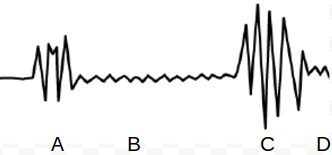
Which letter represents the movement created by the P Wave?  
a)
A
b)
B
c)
C
93.
What is the lag time?  
a)
30 sec
b)
86 sec
c)
56 sec
d)
140 sec
94.
Which city is closest to the epicenter?  
a)
A
b)
B
c)
C
95.
Which seismogram represents a city that is far from the epicenter of an earthquake?  
a)
New York, NY
b)
Nome, Alaska
c)
Guadalajara, Mexico
96.
Which scale measures the intensity of the ground movement?
a)
Mercalli Scale
b)
Richter Scale
c)
Seismogram Scale
d)
Bernoulli Scale
97.
Where are the P-waves located on this seismogram?
a)
A
b)
B
c)
C
d)
D
98.
Where is the epicenter for this earthquake located based on triangulation?
a)
A
b)
B
c)
C
d)
D
99.
Where are the S-waves located on this seismogram?
a)
A
b)
B
c)
C
d)
D
100.
Where is the epicenter located?
a)
A
b)
B
c)
C
d)
There is no epicenter