wayground logo

Free Printable Worksheets

NEW

Font size

S
M
L
XL
Worksheets

4th 3rd Weeks Exam Adaptations Part 2

Total questions: 44

Worksheet time: 42mins

Name
Class
Date
1.
The purpose of selective breeding is to 
a)
Get bigger animals
b)
get smaller animals
c)
create animals with desirable traits
d)
create animals with bad traits
2.
Which is another term for selective breeding?
a)
Artificial selection
b)
Natural Selection
c)
Intelligent selection
3.
Where humans have bred organisms together based on traits we like.
a)
Evolution
b)
Natural Selection
c)
Extinction 
d)
Artificial Selection
4.
The evolution of dogs from wolves is due to:
a)
Natural Selection
b)
Sexual Selection
c)
Artificial Selection
d)
Vestigial Structures
5.
A farmer has bred his pineapple plants from the sweetest pineapples from his last harvest to get even sweeter pineapple plants. What is this an example of?
a)
Selective breeding
b)
Natural selection
c)
Extinction
d)
Mutagenesis
6.
Evidence shows that the wolf is the ancestor to all of the breeds of dogs shown below. How did this variation arise in a relatively short period of time?
a)
A.  Genetic manipulation
b)
Natural selection
c)
Random chance
d)
Selective breeding
7.
Problems with selective breeding include
a)
Better animals
b)
More Meat
c)
Animals can have bad health problems
d)
more diversity
8.
It is very common for yellow labs to have bad hips. This is because owners want purebred yellow labs who are good hunting dogs.  This is an example of 
a)
Natural Selection
b)
Selective breeding
c)
Mitosis
d)
Fossil Record
9.

The figure below shows four different species of finches found on the Galapagos Islands. Each of these finches evolved from a common ancestor through natural selection. Which of these finches is best suited to pick small insects off a cactus?

a)
b)
c)
d)
10.

A green rat snake that lives in the grass and a brown rat snake that lives in the desert is a form of _______________.

a)

Human Genetic Modification

b)

Selective Breeding

c)

Natural Selection

d)

Artificial Breeding

11.

Which is not a result of selective breeding?

a)

Large seedless watermelons that consumer demand

b)

Bright oranges that are all about the same size

c)

An insect that matches the color of the environment

d)

A dog that has been bred to have short hair

12.
Scientists genetically engineer corn to be immune to corn diseases. This is BENEFICIAL because
a)
This causes corn to be less likely to reproduce
b)
This causes corn to be less likely to survive
c)
This causes corn to be smaller
d)
This allows increased production of corn
13.
A clone can be BEST thought of as a(n)  _____ created in the lab. 
a)
identical twin
b)
GMO
c)
science fiction experiment
14.

Problems with animals that are selectively bred include:

a)

Being more disease resistant

b)

Producing more meat

c)

Being more likely to suffer from genetic disease

d)

Being more genetically diverse

15.

To breed a cow that produces a lot of milk a farmer would breed:

a)

Two cows that produce a lot of milk

b)

A cow and a bull that produce a lot of milk

c)

A cow who produces a lot of milk and a bull who's mother produced a lot of milk

d)

The biggest cow and the biggest bull

16.

What is Inbreeding

a)

When two closely related animals are bred together

b)

When two none related animals are bred together

c)

When animals are allowed to chose their own mates

d)

When humans choose which animals will mate together

17.
1.  Modern horses developed their traits through natural selection.  What occurs during the process of natural selection?
a)
only the fittest organisms survive and reproduce
b)
organisms choose mates from other species
c)
breeders cross organisms with desirable traits.
d)
organisms remain exactly the same over many generations.
18.
Which of these would be considered an adaptation of an animal that lives in the snowy tundra?
a)
a thick coat
b)
green colored skin
c)
large, flat leaves
d)
webbed feet
19.
In which scenario could natural selection occur?
a)
a wolf with a heavy fur coat survives harsh winters better than other wolves and passes the trait on
b)
a woodpecker learnes how to eat a new type of beetle.
c)
a shark receives a neutral mutation
d)
a mother passes a deadly mutation on to her child.
20.
A spider may produce hundreds of eggs, only a few  of which may survive.  This is an example of 
a)
overproduction
b)
specialization
c)
genetic change
d)
division
21.
Which of the following is an example of selective breeding?
a)
populations of lizards that have a certain trait become more numerous after a change in climate
b)
a population of insects develops resistance to a pesticide after farmers repeatedly use the same pesticide to kill the insects
c)
a population of bacteria develops resistance to an antibiotic
d)
farmers allow only sheep that produces the best wool to breed.
22.

What word describes a trait that helps an organism survive in its environment?

a)

natural selection

b)

mutation

c)

camouflage

d)

adaptation

23.
The differences among a species, like different bird beaks, are called
a)
genes.
b)
variations.
c)
traits.
d)
theories.
24.

Selective breeding is where ___________ decides which traits should be passed on

a)

Nature

b)

A human

c)

Mrs. Yezak

d)

The illuminati

25.

All these birds are finches but they have developed different beaks due to the type of foods available to them, this is because of

a)

Natural Selection

b)

Selective Breeding

26.

What process is being shown in this image?

a)

Selective Breeding

b)

Natural Selection

27.
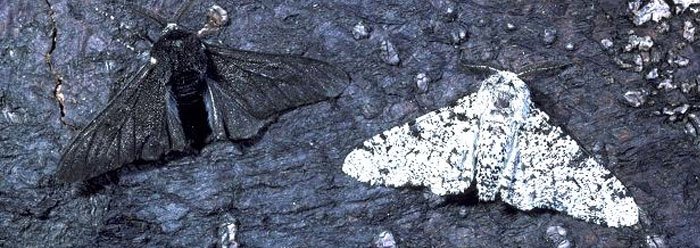
The trees these moths used to live on were white, but have been covered in soot from coal factories. Which moth will be more successful in this environment?
a)
Dark moth
b)
Light moth
c)
Both will be equally successful
d)
Neither will be successful
28.

The evolution of domestic dogs from wolves is due to:

a)

Natural Selection

b)

Sexual Selection

c)

Artificial Selection

d)

Vestigial Structures

29.
1.  Darwin observed 13 species of finches on the Galapagos Islands.  What did Darwin conclude about the finches?
a)
a.  They evolved from a common ancestor.
b)
They all came from different continents.
c)
they evolved from 13 different types of birds.
d)
they developed from other types of organisms.
30.
1.  Which statement best describes the process of evolution?
a)
Populations can survive in different locations.
b)
Populations grow when resources are plentiful
c)
Conditions limit the number of species on earth.
d)
The characteristics of a species can change over time.
31.
1.  Why did the population of peppered moths in England change from light to dark after the Industrial Revolution?
a)
Light moths were killed by soot.
b)
Dark moths were produces by industrial processes.
c)
The birds that ate the dark moths were killed by the soot.
d)
Light moths were more obvious against the soot-stained trees.
32.
1.  Which is a condition required for natural selection to occur in birds?
a)
Humans must interfere with the breeding of organisms.
b)
Species must produce more offspring than can survive.
c)
Resources must be unlimited in the natural environments.
d)
All organisms of the same species must have the same genetic material.
33.
Which is the best description of a physical adaptation?
a)
a way an animal acts that helps it to survive in its environment.
b)
a basic need that an animal must have from its environment.
c)
a part of an animal's body that helps it to survive in its environment.
d)
none of the above
34.
Some animals look like dangerous animals, even though they might not be dangerous!  This adaptation is called _______.
a)
camouflage
b)
mimicry
c)
venom
d)
poison
35.
Baby elephants can walk from nearly the moment they are born.  Which of these terms best describes this ability?
a)
instinct
b)
learned behavior
c)
gene
d)
physical trait
36.
How does natural selection lead to the spread of an adaptation?
a)
adaptations can be taught to offspring
b)
better adapted organisms live longer and have more offspring than other organism
c)
better adapted organisms kill competing organisms off
d)
adaptations can be traded between organisms.
37.
The most obvious difference in Darwin's finches was the variation in 
a)
wingspan
b)
beak size and shape
c)
eye color.
d)
size
38.
A characteristic that improves an organism's ability to survive is a (n)
a)
adaptation
b)
inherited variation
c)
reproduction
d)
breeding
39.
A group of herbivores are separated from their population.  In the new environment, the only edible vegetation grows at the top of tall trees.  Which of the following is a likely physical adaptation that may develop?
a)
striped fur
b)
a tendency to mate during the summer
c)
the ability to swim
d)
a long neck
40.

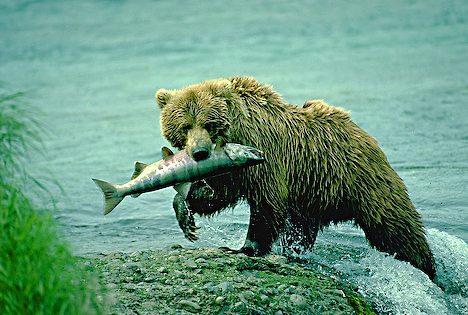
A grizzly bear survives because he is well-adapted to his environment. When he reproduces he passes on those traits to his offspring. this process is called

a)

Natural Selection

b)

Selective Breeding

c)

Random mutations

d)

Variations in a species

41.

The peppered moth's color camouflaged it on the light colored tree bark. It's color was an example of a/n

a)

Variation

b)

Dominant trait

c)

Recessive trait

d)

Adaptation

42.

What animal is camouflaged in this picture?

a)

Skunk

b)

Squirrel

c)

Owl

d)

Snake

43.

Another term for Natural Selection is:

a)

Breeding

b)

Commensulism

c)

Communism

d)

Survival of the fittest

44.

Which beak is probably best suited to crack open nuts?

a)

1

b)

2

c)

3

d)

4