wayground logo

Free Printable Worksheets

Font size

S
M
L
XL
Worksheets

Plate Tectonics Review - 2020

Total questions: 52

Worksheet time: 1hrs 28mins

Name
Class
Date
1.
Mountains form from....
a)
Tectonic plates sliding past one another
b)
Collision of tectonic plates
c)
Tectonic plates moving away from each other
d)
Tectonic plates disappearing
2.
What was the name given to all the continents when they were joined as one super continent?
a)
Supreme Continent
b)
Eurasia
c)
Plate tectonics
d)
Pangea
3.
Plate movement is caused by _____
a)
The rotation of the Earth
b)
Ocean tides
c)
Convection currents in the mantle
d)
The moon's gravity
4.
This image represents this type of boundary
a)
Divergent
b)
Transform
c)
Convergent
d)
Subduction
5.
This is the driving force behind the movement of tectonic plates.
a)
Mantle convection currents
b)
Oceanic convection currents
c)
Atmospheric convection currents
d)
Solar convection currents
6.
At a divergent boundary, tectonic plates move in what way? 
a)
Tectonic plates move towards each other
b)
Tectonic plates slide past each other
c)
Tectonic plates move up and down
d)
Tectonic plates move away from each other
7.
 A land feature that is produced at a convergent boundary is
a)
a valley
b)
an ocean
c)
a canyon
d)
a volcano
8.
What is a tectonic plate?
a)
A piece of the Earth's crust
b)
A piece of Earth's mantle
c)
A piece of Earth's core
d)
A piece of Earth's Moon
9.
Which type of plate boundary would cause mountains to form
a)
Transform
b)
Convergent
c)
Divergent
d)
Reform
10.
What is the name of the area where one crust slides underneath another
a)
Transform zone
b)
subduction zone
c)
Divergent zone
d)
School zone
11.
Name the boundary
a)
convergent
b)
transform
c)
divergent
d)
subduction
12.
Transform boundaries are most likely to produce what phenomenon?
a)
volcanoes
b)
deep sea trenches
c)
underwater mountain ranges
d)
earthquakes
13.
Which of the following is NOT a tectonic boundary?
a)
Convergent
b)
Divergent
c)
Observant
d)
Transform
14.
A divergent boundary occurs when plates ....
a)
Move away from each other
b)
Come together
c)
Slide past each other
d)
Slide beneath one another
15.
When two tectonic plates interact, what can be caused?
a)
Beach erosion and Tornadoes
b)
Tsunamis and storms
c)
Earthquakes and volcanoes
d)
Tornadoes and Hurricanes
16.

In some areas of the world, like California and Japan, earthquakes are a common occurrence. How can this best be explained?

a)

The strong ocean currents are undermining both areas causing earthquakes.

b)

Both areas are located near the edge of the Pacific Ocean, the unstable sand causes earthquakes.

c)

Both areas are subjected to strong ocean wind and waves that causes earthquakes.

d)

Both areas are on the boundary of active plates, the motion of the plates causes earthquakes.
17.
There are three types of plate boundaries. Which choice is NOT a type of plate boundary?
a)
convergent
b)
thrust
c)
divergent
d)
transform
18.

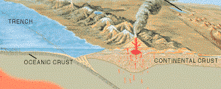
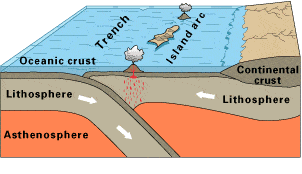
Observe this diagram of a plate boundary. One statement BEST describes what is happening. It is that

a)

the oceanic crust is melting.

b)

the denser ceanic crust is subducting under the less dense oceanic crust

c)

volcanic islands are forming.

d)

the tectonic plates are moving away from each other.
19.

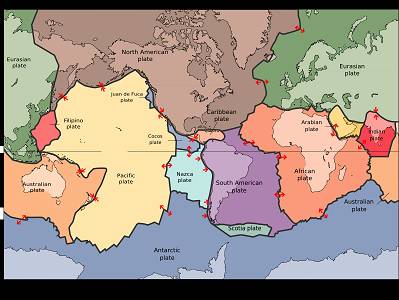
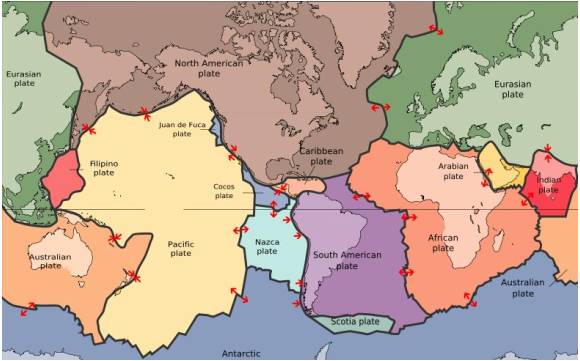
The map in the picture shows tectonic plate boundaries. This map would be useful in predicting the location of future

a)

droughts

b)

hurricanes

c)

earthquakes

d)

tornadoes

20.
What geological forces might be responsible for this range of mountains?
a)
diverging tectonic plates
b)
erosion of the land by the ocean
c)
converging tectonic plates
d)
deposition of sediments by the ocean
21.

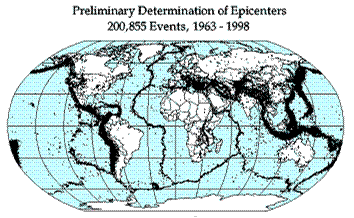
Earthquake epicenters (center of where the earthquakes started) were mapped for a 35 year period in the diagram above. The black dots indicate these epicenters. The black dots appear along what feature on Earth?

a)

hot spots

b)

plate boundaries

c)

rift zones

d)

sea floor spreading

22.
The Earth’s surface is not a solid surface but is divided into
a)
several oceanic plates.
b)
continental and crustal plates.
c)
seven continental plates.
d)
continental and oceanic plates.
23.
Geologists have long recognized that earthquakes are not randomly distributed on Earth but occur in concentrated areas that coincide with __________ and provide evidence for the theory of ___________ .
a)
mountain ranges; fault zones.
b)
continental borders; supercontinents.
c)
plate boundaries; plate tectonics
d)
areas of liquid magma; sea floor spreading.
24.
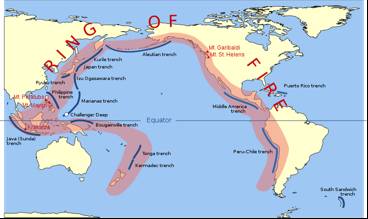
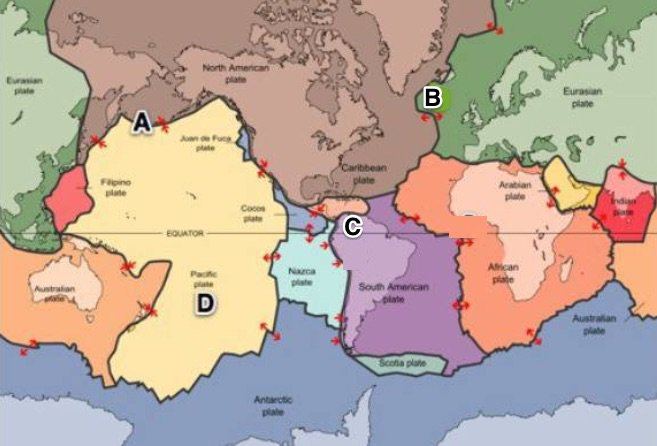
The image shows the Pacific Ring of Fire, a region of high tectonic activity. What evidence supports the theory that the tectonic activity of the region is due to the subduction of tectonic plates?
a)
The region is bound by many oceanic trenches.
b)
North America seems to be colliding with Asia at the north of the ring.
c)
The Asia-Pacific region is dotted by many small and large islands
d)
The landmasses look like they would fit together like the pieces of a jigsaw puzzle.
25.
The Atlantic Ocean gets about 3-5 ______ wider each year.
a)
centimeters
b)
kilometers
c)
miles
d)
meters
26.

Where would sea floor spreading most likely occur?

a)

At convergent boundaries (oceanic vs. oceanic)

b)

At convergent boundaries (oceanic vs. continental)

c)

At divergent plate boundaries (oceanic vs. oceanic)

d)

At transform plate boundaries

27.

Who first proposed the idea of Continental Drift?

a)

Harry Hess

b)

Alfred Wegener

c)

Albert Einstein

d)

Galileo Galilee

28.

What did Wegener name the large supercontinent where all the continents were joined together?

a)

Wegenerland

b)

Gondwanaland

c)

Laurasia

d)

Pangaea

29.

Most geologists rejected Wegener's idea of Continental Drift because _________.

a)

He used too many pieces of evidence to support the idea.

b)

He wanted to know what Earth looked like millions of years ago, which is impossible.

c)

He couldn't identify what would cause continents to move around.

d)

They were afraid of the new idea.

30.

Wegener used the fit of the continents as evidence to support his hypothesis of Continental Drift.

a)

true

b)

false

31.

Wegener used matching mountain ranges across different continents as evidence to support his hypothesis of Continental Drift.

a)

true

b)

false

32.

Wegener used matching matching fossils of the same organisms on different continents as evidence to support his hypothesis of Continental Drift.

a)

true

b)

false

33.

Wegener used evidence of glaciers in places now too warm as evidence to support his hypothesis of Continental Drift.

a)

true

b)

false

34.

Wegener used matching rock types and ages across different continents as evidence to support his hypothesis of Continental Drift.

a)

true

b)

false

35.

Wegener used evidence of convection currents in the mantle as evidence to support his hypothesis of Continental Drift.

a)

true

b)

false

36.

What discovery revived Wegener's idea of Continental Drift and eventually led to the Theory of Plate Tectonics?

a)

discovery of new fossils on Africa and South America

b)

the discovery of mid-ocean ridges and seafloor spreading

c)

the discovery of radioactive isotopes

d)

none of the above

37.

Who first proposed the idea of seafloor spreading?

a)

Alfred Wegener

b)

Harry Hess

c)

James Hutton

d)

Nicolaus Copernicus

38.

Why was the evidence of seafloor spreading so important to the idea of Continental Drift?

a)

it answer the question for HOW continents could be moving

b)

it disproved Alfred Wegener's hypothesis of Continental Drift

c)

It shows how land bridges let prehistoric animals cross the oceans

d)

all of these are true

39.

Which of the following were peices of evidence used by Alfred Wegener to support his hypothesis of Continental Drift? (choose ALL that apply)

a)

fit of the continents

b)

matching rocks and mountains across continents

c)

matching fossils across continents

d)

evidence of glaciers in places now too warm

e)

magnetic striping on the seafloor showing seafloor spreading
40.
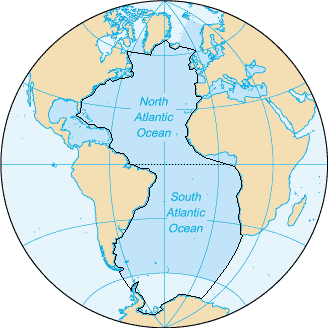
In the Atlantic ocean, where is the youngest seafloor located?
a)
Towards the edges, near the eastern and western continents
b)
Towards the middle of the ocean
c)
Towards the north and south poles
d)
Young seafloor is located randomly throughout the ocean
41.

What two words are BEST used to describe how the seafloor spreads?

a)

Magma and convection

b)

Earthquakes and convection

c)

Mountains and Rift Valleys

d)

Volcanoes and earthquakes

42.
True or False: Our continents will eventually become a supercontinent (like Pangaea) again, far in the future
a)
True
b)
False
43.
The zone where one plate slides under another is called the
a)
Convergent zone
b)
Subduction zone
c)
Transform zone
d)
Mantle zone
44.
The entire cycle of heating occurring in the mantle is called
a)
Convection currents
b)
Compound currents
c)
heat currents
d)
 subcurrents
45.
When looking at mid ocean ridges the oldest rocks are 
a)
In the middle
b)
Found close to the rift zone
c)
Found far from the mid ocean ridges
46.
Undersea mountain range.
a)
Rift
b)
Mid-ocean ridge
c)
seafloor spreading
d)
Continental drift
47.

Process by which new ocean crust forms.

a)

Seafloor spreading

b)

Continental drift

c)

Mid-ocean ridge

d)

Rift

48.
What is label G
a)
Trench
b)
Mid ocean ridge
c)
abyssal plain
d)
sea mount
49.

What is label D

a)

Trench

b)

Mid ocean ridge

c)

abyssal plain

d)

sea mount

50.

what is a Divergent boundary?

a)

One big continent or land mass.

b)

a plate boundary where two plates move toward each other.

c)

A plate boundary where two plates move away from each other.

d)

the point on Earth’s surface directly above an earthquake’s focus.

51.

What is a Convergent boundary?

a)

the theory that pieces of Earth’s lithosphere are in constant motion, driven by convection currents in the mantle.

b)

One big continent or land mass.

c)

the process by which oceanic crust sinks beneath a deep-ocean trench and back into the mantle at a convergent plate boundary.

d)

a plate boundary where two plates move toward each other.

52.

What is a Subduction?

a)

the theory that the Earth's continents have moved over geologic time.

b)

Developed the Continental Drift Theory.

c)

One big continent or land mass.

d)

the process by which oceanic crust sinks beneath a deep-ocean trench and back into the mantle at a convergent plate boundary