wayground logo

Free Printable Worksheets

Font size

S
M
L
XL
Worksheets

Mixtures/Solutions

Total questions: 83

Worksheet time: 1hrs 24mins

Name
Class
Date
1.

Mixtures are created when two or more ______ are mixed together.

a)

liquids

b)

substances

c)

changes

d)

rocks

2.
_____ means to spread out evenly in a liquid. 
a)
melt
b)
mix
c)
dissolve
3.
______ means to combine together. 
a)
stir
b)
mix
c)
distribute
d)
solute
4.

Mixture or Solution?

a)

Solution

b)

Mixture

5.

Mixture or Solution?

a)

Solution

b)

Mixture

6.

Mixture or Solution?

a)

Solution

b)

Mixture

7.

Mixture or Solution?

a)

Mixture

b)

Solution

8.

This is a type of mixture where one substance dissolves into another

a)

Solution

b)

Miscibility

c)

Compound

d)

Solubility

9.

The substance that does the dissolving

a)

Solute

b)

Solvent

c)

Solution

d)

Miscibility

10.

The substance getting dissolved

a)

Solvent

b)

Solute

c)

Solution

d)

Mixture

11.

Sugar dissolved in water is an example of a

a)

Solution

b)

Mixture

12.
To break down into tiny pieces to small to be seen.
a)
solute
b)
solvent
c)
dissolve
d)
solution
13.
process where a liquid becomes a gas
a)
condensation
b)
evaporation
c)
physical property
d)
dissolve
14.
To separate a mixture of salt and water what separation tool/method is used?
a)
Filter
b)
Screen
c)
Magnet
d)
Evaporation
15.
If you spilled nails in a sandbox, what separation tool/method could you use to clean out the sandbox so it would be safe for children to play in?
a)
Filter
b)
Screen
c)
Magnet
d)
Evaporation
16.
Solutions are a type of mixture.  What makes solutions different from other mixtures is....
a)
The elements in a solution react to compounds
b)
One substance dissolves in the other
c)
Two or more substances are combined
d)
There is a chemical change when combined
17.
A combination of two or more substances that can be easily separated.
a)
dissolve
b)
mixture
c)
solution
d)
physical property
18.
One or more substances dissolve in another and cannot be easily separated.
a)
mixture
b)
solution
c)
dissolve
d)
solute
19.
The Law of Conservation of matter states that the total amount of matter ______________ after it undergoes change.
a)
disappears
b)
stays the same
c)
weighs less
d)
explodes
20.
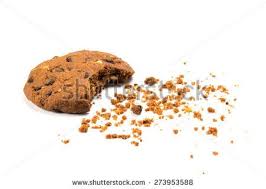
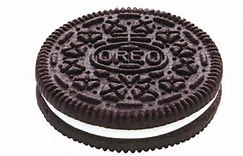
An oreo cookie weighs 20 grams.  It gets crushed into crumbs for a recipe.  How much do its crumbs weigh?
a)
15 grams
b)
25 grams
c)
20 grams
21.
What is a substance that is dissolved in another substance? 
a)
solution
b)
solute
c)
solvent
d)
compound
22.
What is a solvent?
a)
The substance that does the dissolving in a solution.
b)
The substance that is being dissolved in a solution.
c)
The mixing of different substances.
d)
The process in which neutral molecules lose or gain electrons
23.
In the above picture, a powder is about to be poured into the liquid. Which of the following should be done to make this powder dissolve faster?

a)
stir the powder in the liquid
b)
freeze the mixture
c)
add more powder to the liquid
d)
store the mixture in a dark place
24.
Kool-Aid - Powder, sugar, and water
Identify the solvent 
a)
water
b)
powder
c)
sugar
d)
powder and sugar
25.
The concentration of a mixture can be increased in which of the following ways?
a)
Heating the mixture
b)
Adding more water “solvent”
c)
Adding more powder “solute”
d)
Stirring the mixture
26.

The mixture shown here -

a)

Maintains its physical properties when combined

b)

Dissolves after being stirred together

c)

Will evaporate after a certain period of time

d)

Cannot be separated into ingredients

27.

Which of the following is NOT happening in the photo

a)

The temperature is rising

b)

Heat is being added

c)

Thermal energy is taken away

d)

A solid is turning into a liquid

28.

The bobber is able to float in the water because -

a)

It has a greater density than the water

b)

It is too heavy to sink to the bottom

c)

It mass will not allow it to sink

d)

Its density is less than water

29.

The oven mitt shown here is being used because

a)

The mitts conduct thermal energy

b)

The pan conducts heat energy

c)

The pan is an insulator

d)

The mitts make the cook look cool

30.

Why do shadows made by the Sun move throughout the day?

a)

Because the weather changes

b)

Because someone moves the objects

c)

Because the sun appears to move across the sky

d)

Because it's magic!

31.

When the sun gets higher in the sky, shadows get ______.

a)

longer

b)

gone

c)

shorter

d)

darker

32.

What do shadows on Earth help show?

a)

Earth's rotation

b)

Earth's revolution

c)

Earth's equator

d)

Earth's axis

33.

The sun APPEARS to move across the sky, during the day. Which of the following causes shadows to change length throughout the day?

a)

earth's rotation

b)

earth's revolution

c)

sun's revolution

d)

earth's orbit

34.

Which of the following would be the best example to explain Earth's rotation?

a)

funnel

b)

merry-go round

c)

doorknob

d)

swing

35.

Many cultures have different methods to determine the time of day. Which of the following is an ancient tool invented to determine the time of day?

a)

watch

b)

clock

c)

sundial

d)

compass

36.

What direction does the sun appear to move across the sky?

a)

west to east

b)

north to south

c)

east to west

d)

south to north

37.

Earth rotates on its axis once approximately every-

a)

month

b)

24 hours

c)

year

d)

12 hours

38.

A student looks outside and observes the sun in the western sky. Which of the following times could it be?

a)

sunrise

b)

sunset

c)

noon

d)

midnight

39.
Measure of the amount of matter 
a)
mass
b)
volume
c)
weight
d)
density
40.
An oreo cookie weighs 20 grams.  It gets crushed into crumbs for a recipe.  How much do its crumbs weigh?
a)
15 grams
b)
25 grams
c)
20 grams
41.
How much does a 5 gram Hershey's kiss weigh after it is melted in the microwave?
a)
5 grams
b)
3 grams
c)
7 grams
42.
If reaction starts with 20g of reactants it should produce... 
a)
a total of 40g of product
b)
a total of 10g of product
c)
a total of 80 g of product
d)
a total of 20g of product
43.
A student notices that an inflated balloon gets larger when it is warmed by a lamp. Which best describes the mass of the balloon as a result of this change?
a)
The mass of the balloon increases because the size of the balloon has increased.
b)
The mass of the balloon increases because the temperature of the balloon has increased.
c)
The mass of the balloon stays the same because the gas inside the balloon still has the same mass after it warms up.
44.
A 500-gram block of solid cheese is melted in a pot. Which is most likely the mass of the cheese after it is melted?
a)
500 grams, because the cheese does not gain or lose mass just because it was melted
b)
499 grams, because some of the cheese evaporates as it melts
c)
502 grams, because the cheese absorbs heat as it melts
45.
A 55-gram egg is placed in a pot. After the egg is boiled, which is most likely the mass of the egg?
a)
50 
b)
55 
46.

Which is the largest object in our solar system?

a)

Moon

b)

Mars

c)

Venus

d)

Sun

47.
How many planets orbit the Sun?
a)
1
b)
4
c)
8
d)
10
48.
The sun is a glowing ball of _______.
a)
water
b)
liquid
c)
gases
d)
rocks
49.

If it is summer in the northern hemisphere, what season is it in the southern hemisphere?

a)

spring

b)

winter

c)

fall

d)

summer

50.

Why is it colder in winter than in summer?

a)

The earth is tilted toward the sun.

b)

The earth is farther away from the sun.

c)

The earth is tilted away from the sun.

d)

The earth is closer to the sun.

51.

When does the sun create the longest shadows?

a)

Summer

b)

Winter

c)

Spring

d)

Fall

52.
Which season is taking place in the Northern Hemisphere in Position 3?
a)
Winter
b)
Spring
c)
Summer
d)
Fall
53.
Look at the picture.  Would the sun be low or high in the sky in the afternoon picture?
a)
The sun would be directly above.
b)
You would not be able to see the sun at all.
c)
The sun would be low in the sky.
d)
The sun has nothing to do with shadows.
54.
A student draws his shadow at 9am.  How will his shadow look at noon?
a)
shorter than the morning shadow, or no shadow at all
b)
longer than the morning shadow
c)
the same length as the morning shadow
d)
it is impossible to predict how his shadow will change size
55.
How do we name air masses?
a)
Water and temperature
b)
Air pressure
c)
Humidity and temperature
d)
Cold and warm
56.

Condensation occurs when water vapour....

a)

loses heat

b)

gains heat

57.

Condensation involves a change of state from ___ to ___

a)

Liquid to Solid

b)

Liquid to Gaseous

c)

Solid to Liquid

d)

Gaseous to Liquid

58.

Boiling occurs when water ...

a)

loses heat

b)

gains heat

59.

Boiling involves a change of state from ___ to ___.

a)

Solid to Liquid

b)

Liquid to Gaseous

c)

Gaseous to Liquid

d)

Liquid to Solid

60.

Evaporate involves a change of state from ___ to ___.

a)

Solid to Liquid

b)

Gaseous to Liquid

c)

Liquid to Gaseous

d)

Liquid to Solid

61.

Melting involves a change of state from ___ to ___

a)

Gaseous to Liquid

b)

Solid to Liquid

c)

Liquid to Gaseous

d)

Liquid to Solid

62.

What causes objects to melt?

a)

cold

b)

heat

c)

sound

d)

stirring

63.

Concentration is

a)

the amount of solute in the solvent

b)

the amount of solvent in the solute

c)

density

d)

particle size

64.

Which solution is more concentrated?

Solution 1:

500 mL of water

100 g of salt


Solution 2:

500 mL of water

90 g of salt

a)

Solution 1

b)

Solution 2

c)

They have the same concentration

d)

I have no idea

65.

Which solution is more concentrated?


Solution 1:

20 mL of water

5 g of salt


Solution 2:

20 mL of water

10 g of salt

a)

Not enough information to tell

b)

Solution 1

c)

Solution 2

d)

They are equally concentrated

66.

In order to dilute a solution, you need to

a)

add more of the solid

b)

add more water

c)

find the mass

d)

find the volume

67.

Which solution is more diluted?

Solution 1:

1000 mL of water

60g of salt


Solution 2:

500 mL of water

60 g of salt

a)

Not enough information to tell

b)

Solution 1

c)

Solution 2

d)

They are equally diluted

68.

Both of these solutions have a volume of 30 mL. Which solution is more concentrated?

a)

orange solution

b)

green solution

c)

they are equally concentrated

69.

When an object SINKS in a liquid, it is because the object is ______ than the liquid.

a)

More Dense

b)

Less Dense

70.

The mass of 50 mL of honey is 70 g

The mass of 50 mL of water is 50 g


If you pour both into a graduated cylinder, which one will float to the top?

a)

Honey

b)

Water

71.

The mass of 50 mL of honey is 70 g

The mass of 50 mL of water is 50 g


If you pour both into a graduated cylinder, which one will float to the top?

a)

Honey

b)

Water

72.
The ___ is the thing being dissolved
a)
solute
b)
solvent
73.
The amount of solute actually dissolved in a given amount of solvent.
a)
dilution
b)
concentration
c)
saturated solution
d)
supersaturated mixture
74.
When measuring concentration, you must first find
a)
measuring cups
b)
equal volumes
c)
solvent
d)
solute
75.
When there is a high concentration, there is
a)
low concentration
b)
low density
c)
high density
d)
high solvent
76.
When finding a ratio for the concentration of a solution, you have to decide what your ________ for both solute and solvent will be.
a)
amount
b)
measurement
c)
unit
77.
When a solution is made, the mass of the solute and solvent is 
a)
conserved
b)
lost
c)
transparent
78.
True or false, food coloring changes the density of a solution.
a)
true
b)
false
79.
Are all solutions made with soft-drink powder and water the same?
a)
Yes
b)
Maybe
c)
No
80.
Why do ice cubes float in a  glass of water?
a)
the ice cubes are more dense than the water
b)
the water is more dense than the ice cubes
c)
the water is more dense than the glass
d)
the ice is more dense than the glass
81.
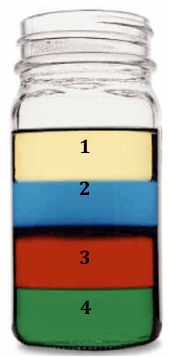
Put the liquids in order from most dense to least dense?
a)
4, 3, 2, 1
b)
1, 2, 3, 4
c)
3, 4, 2, 1, 
d)
4, 3, 1, 2
82.
Put the liquids in order from most dense to least dense?
a)
4, 3, 2, 1
b)
1, 2, 3, 4
c)
3, 4, 2, 1, 
d)
4, 3, 1, 2
83.
Which will float in water (density= 1 g/mL)?
Corn syrup  1.37 g/mL
Vegetable oil  0.91 g/mL
Honey  1.42 g/mL
Lamp oil  0.81 g/mL

a)
Corn syrup and Honey
b)
Vegetable oil and Lamp oil
c)
Corn syrup and vegetable oil
d)
Honey and Lamp oil