
 Worksheets
Earth Science Pre Test
Total questions: 34
Worksheet time: 52mins
What is a negative impact of mining?
Material left after ore is extracted can release toxic chemicals into the groundwater
Mining can improve the air quality where miners work
Quarries attract new species to the area
Mining can decrease soil erosion
What is a negative impact of agriculture?
Fertilizer runoff polluting rivers
More land for animals to graze
Less food available
Increases atmospheric oxygen
Crop rotation is used in order to
Provide alternative crops to the public
Maintain the nutrient health of the soil
Encourage pest diversity and growth
Assure development of new pesticides
What is the underlying force that drives plate tectonics?
Ocean tides
Volcanic eruptions
The rock cycle
Convection currents
Which of the following plate interactions is most likely to form a mountain range?
A transform boundary between ocean plates
A transform boundary between continental plates
A convergent boundary between continental plates
A subduction zone between a continental plate and an ocean plate
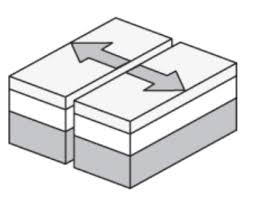

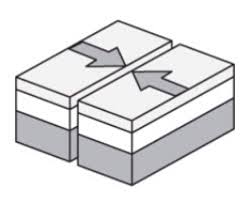
At which plate boundary will you NOT find volcanoes?
Convergent continental-oceanic
Divergent ocean-ocean
Convergent continental-continental
Convergent oceanic-oceanic
Which layer of the atmosphere do we live in?
exosphere
thermosphere
mesosphere
troposphere
The ozone layer is found in the
troposphere
stratosphere
mesosphere
thermosphere
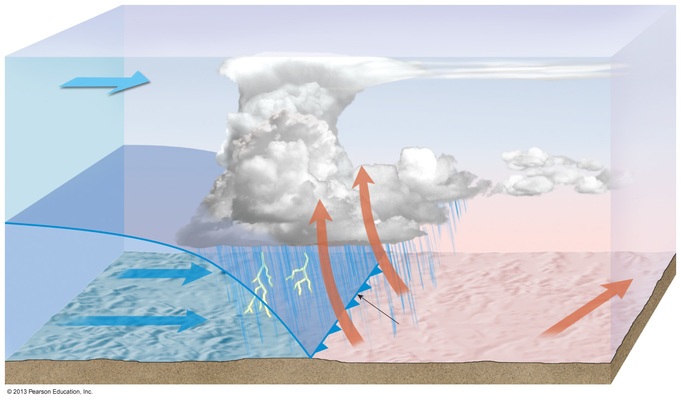
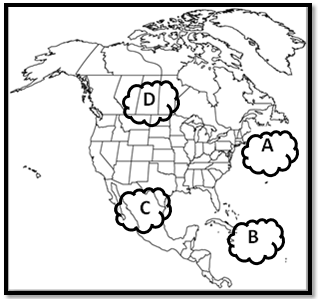
How does the ocean effect (provide the energy for) the formation of hurricanes?
Ocean water is warm and heats the air above it
Ocean water is cool and cools the air above it
Ocean water contains salt that reacts with air, changing air pressure
Ocean water contains algae that make oxygen, changing the air's composition
The atmosphere is divided vertically into layers based on what?
Temperature
Color
Thickness
Chemical compostion

Why do we experience the changing of the season on the earth?
distance from the sun
rotation of the earth
change in solar output
tilt of the earth's axis

Which of the following statements are true? (Choose all that apply)
The planets orbit in a perfect circle
The plants move faster when they are closer to the sun and slower when they are further from the sun
The farther a planet is from the sun the faster the orbit
(P2 = a3)
The center of mass between two objects. This is what the planets truly orbit.
barycenter
precession
nutation
ellipse
Earth's wobble cause by the gravitational pull from the Moon only. This changes the degree of the Earth's tilt and will cause seasonal changes.
barycenter
precession
nutation
ellipse
All the land drained by a river, stream or lake.
Meander
Watershed
Wetland
Estuary
What is one way an aquifer can replenish itself?
Precipitation
Digging wells
Watering crops
Evaporation
What are some ways wetlands benefit the environment?
They absorb & remove pollutants from water
They reduce the speed of flooding by trapping water
They provide a unique habitat for many species
All can be benefits of wetlands
None of these are ways wetlands benefit the environment
Which statement BEST describes the climate of an area?
At 3:00 a.m. a winter storm warning was issued for Lake Tahoe.
At 4:00 p.m. the relative humidity in southern Nevada was 10%.
The average yearly rainfall in Nevada is approximately 23 cm.
The lowest temperature last week in Carson City was 9°C.
Some scientists have predicted that buildup of greenhouse gases will contribute to the occurrence of more hurricanes. Which is the MOST likely assumption used in making this prediction?
Acid rainfall will cause a decrease in oceanic surface temperatures.
Increased atmospheric carbon dioxide will cause increased ocean surface temperatures.
Any measurable increase in ocean surface temperatures must be caused by human activities.
Saturation of nitrogen in the atmosphere will cause a wide range of ocean surface temperatures.
What is sustainable development?
Continuing to use current methods of energy, like coal, until they are all used up
economic development that focuses on using up Earth’s resources
Developing new alternative energy sources that do not deplete natural recources
Using land to build houses and farms
What type of energy is produced/radiated by the sun?
electromagnetic waves
cosmic energy
heat waves
solar wind energy
is the part of Earth where life exists
Biosphere
Biota
Geosphere
Hydrosphere
______ causes deep ocean currents
The Coriolis Effect
gravity
wind
density differences

