wayground logo

Free Printable Worksheets

Font size

S
M
L
XL
Worksheets

Plate tectonics

Total questions: 88

Worksheet time: 1hrs 9mins

Name
Class
Date
1.

Early observers thought continents may have been joined based on what observations

a)

rocks and fossils

b)

earthquakes.

c)

magnetism.

d)

coastlines look like puzzles

2.
A German scientist Alfred Wegener was the first to hypothesize that ...........
a)
Continents were once joined
b)
The sea floor is spreading
c)
Continents are moving
d)
The Earth's magnetic pole flips
3.
Pangaea was an ancient supercontinent made up of...
a)
America, Greenland, and Europe.
b)
Antarctica, India, and America.
c)
all of Earth’s continents.
d)
South Africa, India, Australia, and South America.
4.
One of the fossils Wegener used to support his hypothesis of continental drift was
a)
Glossopteris
b)
Trilobite
c)
insects in tree amber
d)
ammonite molds
5.
Peer scientists reviewing Wegener’s hypothesis of continental drift rejected his notion because
a)
His evidence was too few to make a valid conclusion 
b)
He did not explain how continents move and what moves them
c)
His evidence was not clear in showing  how continents were joined
d)
He lied by including false evidence
6.
Where are most divergent boundaries located?
a)
Along the middle of most ocean floors
b)
Along the margins of most continents
c)
Across the middle of many continents
d)
All the above options are correct
7.
The Himalayan mountains have some of the highest peaks like Mt. Everest, on which type of convergent boundary are they located?
a)
Oceanic/Continental
b)
Oceanic/Oceanic
c)
Continental/Continental
d)
None of the above
8.
What type of features are associated with a divergent boundary?
a)
Rift valleys
b)
Volcanic mountains
c)
Fold mountains
d)
Fault block mountains
9.
The mechanism that moves continents is based on heat energy moving by
a)
Radiation in the core
b)
Conduction in the lithosphere
c)
Convection in the Asthenosphere
d)
None of these options is true
10.
What type of rock makes most of the oceanic crust
a)
Sedimentary
b)
Basalt
c)
Metamorphic
d)
Limestone
11.
The San Andréa fault in California is one example of a...  
a)
Divergent boundary
b)
Convergent boundary
c)
Transform boundary
d)
All of the above
12.
Los Angeles and San Francisco are cities on opposite sides of the San Andreas transform boundary. Suggest how both cities will be like at some point in future
a)
Furthest north and south apart than now
b)
At the same positions as today
c)
Drift apart away from the fault line
d)
Side by side somewhere between them now
13.

The physical layer of Earth made of solid rock and soil and the very top of the mantle is called the ___________.

a)

mesosphere

b)

lithosphere

c)

asthenosphere

d)

mantle

14.
The type of plate boundary where two plates come together is a .....
a)
Convergent Boundary
b)
Divergent Boundary
c)
Transform Boundary
d)
Plate Boundary
15.
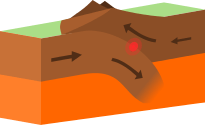
What type of plate boundary is this?
a)
Plate
b)
Divergent
c)
Convergent
d)
Transform
16.
What type of event will occur at this boundary?
a)
Earthquake
b)
Volcano Eruption
c)
Tornado
d)
Mountain Building
17.
A divergent boundary occurs when plates ....
a)
Pull apart
b)
Come together
c)
Slide past each other
d)
subducting
18.
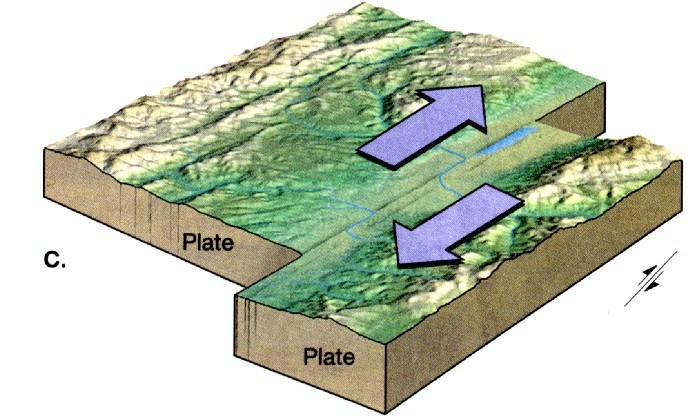
What type of plate boundary is this?
a)
Transform
b)
Convergent
c)
Divergent
d)
Plate
19.

Oceanic Trenches are formed by _______ plate boundaries

a)

Convergent

b)

Transform

c)

Plate

d)

Divergent

20.
A fault is formed by the movement of a __________ plate boundary
a)
Transform
b)
Convergent
c)
Divergent
21.
Islands can from from magma which is pushed up at a __________ plate boundary
a)
Divergent
b)
Convergent
c)
Transform
22.
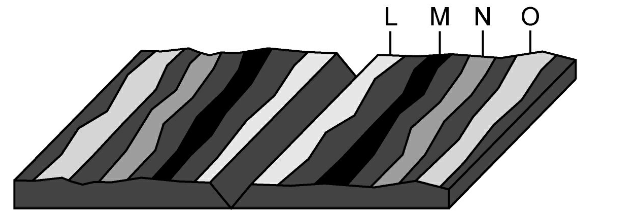
Where would the oldest rock be found?
a)
L
b)
M
c)
N
d)
O
23.
How is it possible for new crust to be formed without increasing the surface area of the Earth?
a)
Crust is destroyed at the same time it is created
b)
New crust is underwater where it sinks
c)
New crust breaks more easily than old crust
24.
Mountains are created when....
a)
Two continental plates collide
b)
Two oceanic plates pull apart
c)
An Oceanic plate subducts under a Continental Plate
d)
Two continental plates pull apart
25.
The Great Rift Valley in Africa and the Mid-Ocean Ridge were all created by this boundary
a)
Divergent
b)
Convergent
c)
Reform
d)
Transform
26.
What are the two types of crust
a)
continental and oceanic
b)
ocean and upper
c)
lower and upper
d)
pizza and subway
27.
When an oceanic plate and a continental plate collide, which one will subduct?
a)
oceanic
b)
continental
c)
neither
28.
The area where two tectonic plates meet.
a)
mantle
b)
focus
c)
plate boundary
d)
convection
29.
This landform can occur at a divergent plate boundary.
a)
ocean trench
b)
mid-ocean ridge
c)
tall mountains
d)
transform fault
30.
A subduction zone is formed...
a)
when one tectonic plate sinks below another
b)
at every type of convergent plate boundary
c)
at every type of divergent plate boundary
d)
at transform boundaries
31.
A subduction zone is formed...
a)
when one tectonic plate sinks below another
b)
at every type of convergent plate boundary
c)
at every type of divergent plate boundary
d)
at transform boundaries
32.
A plate boundary at which two plate move parallel to each other in opposite directions
a)
convergent plate boundary
b)
divergent plate boundary
c)
transform plate boundary
d)
subduction
33.
one tectonic plate moves under another
a)
convergent plate boundary
b)
divergent plate boundary
c)
transform plate boundary
d)
subduction
34.
a boundary at which two plates move away from each other
a)
convergent plate boundary
b)
divergent plate boundary
c)
transform plate boundary
d)
subduction
35.
a boundary at which two plate move toward each other
a)
convergent plate boundary
b)
divergent plate boundary
c)
transform plate boundary
d)
subduction
36.
What feature is formed on the continental crust at an oceanic-continental convergent boundary?
a)
volcanoes
b)
mid-ocean ridge
c)
ocean trench
d)
none of these features are formed at a oceanic-continental convergent boundary
37.
What type of boundary is in this image?
a)
convergent plate boundary
b)
divergent plate boundary
c)
transform plate boundary
d)
subduction
38.
What type of boundary is in this image?
a)
convergent plate boundary
b)
divergent plate boundary
c)
transform plate boundary
d)
subduction
39.
What type of boundary is in this image?
a)
convergent plate boundary
b)
divergent plate boundary
c)
transform plate boundary
d)
subduction
40.
What new feature forms at a convergent plate boundary where two continental plates collide?
a)
mid-ocean ridge
b)
trench
c)
mountain range
d)
none of these features form
41.
Wegener’s proposal of a supercontinent was supported by:
a)
earthquake data
b)
seafloor magnetism
c)
rock, fossil, and climate data.
d)
convection currents in the mantle.
42.

What is the correct order (starting from the surface) of Earth’s layers?

a)

crust, outer core, inner core, mantle

b)

mantle, outer core, inner core, crust

c)

crust, mantle, outer core, inner core

d)

outer core, inner core, crust, mantle

43.

In sea-floor spreading, molten material rises from the mantle and erupts

a)

along the edges of all the continents.

b)

along mid-ocean ridges.

c)

in deep-ocean trenches.

d)

at the north and south poles.

44.

Most geologists think that the movement of Earth’s plates is caused by _______

a)

convection.

b)

continental drift.

c)

subduction.

d)

conduction.

45.

The geological theory of _______ states that pieces of Earth’s lithosphere are in constant, slow motion.

a)

subduction

b)

plate tectonics

c)

deep-ocean trenches

d)

sea-floor spreading

46.

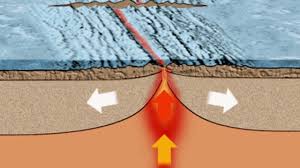
Below is a picture of sea-floor spreading. How are the ocean crusts moving?

a)

Converging

b)

Diverging

c)

Sliding

d)

No movement

47.

The San Andreas Fault in California is known as an active earthquake area. What type of

boundary is it?

a)

Converging

b)

Diverging

c)

Transform

d)

Sea Floor Spreading

48.
This layer of Earth is the thickest part
a)
crust
b)
outer core
c)
mantle
d)
inner core
49.
The Himalayas in Asia are an example of what type of plate boundary?
a)
divergent
b)
continent-to-continent convergent
c)
ocean-to-continent convergent
d)
transform
50.
What is Pangaea?
a)
the name of a German scientist
b)
the name of the super-continent that existed millions of years ago
c)
another name for continental drift
d)
the name of an ancient fossil
51.
Which of the following is NOT evidence to support the theory of plate tectonics?
a)
Fossils
b)
Mountains
c)
Glaciers
d)
Sand Erosion
52.
What geologic feature/event would you most likely to find at a convergent boundary between two pieces of continental crust?
a)
Volcano
b)
Mountain
c)
Rift
d)
Island Arc
53.
The core is mostly made up mostly of which elements?
a)
Oxygen and Silicon
b)
Silicon and Magnesium
c)
Nickel and Iron
d)
Iron and Magnesium
54.
Which piece of evidence did Wegener use to prove continental drift?
a)
The shape of the continents
b)
Similar fossils found on separate continents
c)
Tree fossils found in odd places
d)
All of the above
55.

What is formed when you have a divergent boundary in the middle of a continent, like the Great Rift in Africa?

a)

rift valley

b)

volcanic mountain

c)

volcanic island arc

d)

trenches

e)

mid ocean ridge

56.

slow change, over time, at a constant rate

a)

uniformitarianism

b)

continental drift

c)

Yellowstone eruptions

d)

megaflood

57.

Based on radiometric dating, relative dating, and the slow way in which Earth changes, how old do scientists believe the Earth to be?

a)

3000 years old

b)

300 000 years old

c)

4.6 billion years old

d)

10 000 years old

58.

What was the final piece of evidence that finally allowed scientists to support the theory of plate tectonics?

a)

paleo glacial evidence

b)

Paleo magnetic stripes on the ocean floor

c)

fossil evidence

d)

earthquakes and volcanoes

59.

What feature on Earth allows us to see the direction of movement of the plates?

a)

hotspots

b)

trenches

c)

mountains

d)

midocean ridges

60.

Which feature(s) is formed at a convergent (oceanic/continental) boundary?

a)

mid ocean ridges

b)

rift valley

c)

volcanic mountain

d)

volcanic island arc

e)

trench

61.

Which feature(s) is formed at a convergent (oceanic/continental) boundary?

a)

mid ocean ridges

b)

rift valley

c)

volcanic mountain

d)

volcanic island arc

e)

trench

62.

Which feature(s) is formed at a convergent (continental/continental) boundary?

a)

mid ocean ridges

b)

rift valley

c)

volcanic mountain

d)

mountain

e)

trench

63.

What is located at the star?

a)

Appalachian Mountains

b)

Philippine Islands

c)

Andes Mountains

d)

Alps Mountains

e)

New Zealand

64.

What is located at the Sun?

a)

Appalachian Mountains

b)

Hawaii

c)

Andes Mountains

d)

Alps Mountains

e)

New Zealand

65.

What is located at the blue planet?

a)

Appalachian Mountains

b)

Hawaii

c)

Cascades Mountains

d)

Japan

e)

New Zealand

66.

What is located at the white clouds?

a)

Andes Mountains

b)

Hawaii

c)

Cascades Mountains

d)

Japan

e)

New Zealand

67.

What is located at the rainbow?

a)

Mid- Atlantic Ridge

b)

Hawaii

c)

Cascades Mountains

d)

Marianas Trech

e)

New Zealand

68.

What is located at the lollipop?

a)

Mid- Atlantic Ridge

b)

Hawaii

c)

Iceland

d)

Marianas Trech

e)

New Zealand

69.

What is located at the ninja cat?

a)

Mid- Atlantic Ridge

b)

Alps Mountains

c)

Andes Mountains

d)

Appalachian Mountains

e)

New Zealand

70.

What is located at the eye?

a)

Mid- Atlantic Ridge

b)

Alps Mountains

c)

Andes Mountains

d)

Appalachian Mountains

e)

Himalayas

71.

What is located at the mustache?

a)

Ural Mountains

b)

Alps Mountains

c)

Andes Mountains

d)

Appalachian Mountains

e)

Himalayas

72.

What is located at the sunglasses?

a)

Ural Mountains

b)

Japan

c)

Indonesia

d)

Philipine Islands

e)

Himalayas

73.

What is located at the lips?

a)

Ural Mountains

b)

Japan

c)

Indonesia

d)

Philipine Islands

e)

Himalayas

74.

What is located at the heart?

a)

Ural Mountains

b)

Japan

c)

Indonesia

d)

Philipine Islands

e)

Himalayas

75.

What is located at the black and white target?

a)

Ural Mountains

b)

Japan

c)

Indonesia

d)

Philipine Islands

e)

New Zealand

76.

Which plate is the plate with the star?

a)

N. American

b)

S. American

c)

Eurasian

d)

African

e)

Antarctic

77.

Which plate is the plate with the eye glasses (by the star)?

a)

N. American

b)

S. American

c)

Eurasian

d)

Juan de Fuca

e)

Antarctic

78.

Which plate is the plate with the blue planet?

a)

N. American

b)

S. American

c)

Eurasian

d)

Juan de Fuca

e)

Indo - Austrailian

79.

Which plate is the plate with the lollipop?

a)

N. American

b)

S. American

c)

Nazca

d)

Juan de Fuca

e)

Indo - Austrailian

80.

Which plate is the plate with the rainbow?

a)

Pacific

b)

S. American

c)

Nazca

d)

Juan de Fuca

e)

Indo - Austrailian

81.

Which plate is the plate with the ninja cat?

a)

Pacific

b)

S. American

c)

African

d)

Juan de Fuca

e)

Indo - Austrailian

82.

Which plate is the plate with the heart?

a)

Pacific

b)

S. American

c)

African

d)

Arabian

e)

Indo - Austrailian

83.

Which plate is the plate with the sunglasses?

a)

Pacific

b)

Antarctic

c)

African

d)

Arabian

e)

Indo - Austrailian

84.

Which plate is the plate with the Sun?

a)

Eurasian

b)

Antarctic

c)

African

d)

Arabian

e)

Indo - Austrailian

85.

Which plate is the plate with the cloud?

a)

Eurasian

b)

Antarctic

c)

Indo- Austrailian

d)

Arabian

e)

N. American

86.

Which plate is the plate with the spiral?

a)

Eurasian

b)

Phillipine

c)

Indo- Austrailian

d)

Arabian

e)

Indo - Austrailian

87.

How do plates move?

a)

from trenches to mountains

b)

from mountains to trenches

c)

they don't move

d)

north and then south

88.

Which arrow correctly shows the current motion of the S. American plate?

a)
b)
c)
d)