Wayground logo

Free Printable Worksheets

Font size

S
M
L
XL
Worksheets

Environmental Geology - Natural Disasters

Total questions: 50

Worksheet time: 2hrs 40mins

Name
Class
Date
1.
Which can result from the earthquakes and volcanic eruptions?
a)
glaciation
b)
erosion
c)
precipitation
d)
formation of mountains
2.
An earthquake is usually caused by a _________.
a)
glacier
b)
landslide
c)
very large storm
d)
a movement along a fault
3.
What is a volcano? 
a)
a chemical reaction that produces fire
b)
a valley under the ocean
c)
an atmospheric condition
d)
an opening in Earth’s crust
4.
What measures the waves of earthquakes?
a)
seismic wave
b)
seismograph
c)
seismology
d)
a scientist
5.
How do earthquakes and volcanoes shape land?
a)
weathering and erosion can change the land
b)
build up the land
c)
destroy things, but they can also build up the land
d)
break down the land
6.
What is a huge wave made by an underwater earthquake?
a)
hurricane
b)
tsunami
7.
What is a tropical storm?
a)
a great flow of water over land that is usually dry
b)
rotating storm with low pressure at its center that can turn into a hurricane
8.
What do huricanes often bring?
a)
snow
b)
flooding
c)
an eye
d)
southern moving wind
9.
What ways to volcanoes effect our enviornment?
a)
destroy plants, harm animals, pollute the air, give nutrients to plants
b)
destroy buildings and nature
10.

Which type of earthquake wave comes first?

a)

P-wave

b)

S-wave

c)

T-wave

11.

What type of wave is this?

a)

P-wave

b)

S-wave

c)

T-wave

12.

Caused by sudden movement in the Earth's plates.

a)

Earthquake

b)

Volcano

c)

Landslide

d)

Hurricane

13.

Caused by an underwater earthquake.

a)

Tsunami

b)

Volcano

c)

Landslide

d)

Hurricane

14.

Caused by warm water and a storm

a)

Tsunami

b)

Volcano

c)

Tornado

d)

Hurricane

15.

Caused when a plate subducts into the mantle and melts, causing it to rise back to the surface as lava

a)

Tsunami

b)

Volcano

c)

Tornado

d)

Hurricane

16.

Hurricanes are measured...

a)

category 1-5

b)

category 1-10

c)

richter scale 1-6

d)

richter scale 1-10

17.

Earthquakes are measured...

a)

category 1-5

b)

category 1-10

c)

richter scale 1-6

d)

richter scale 1-10

18.

Seismographs measure...

a)

Landslides

b)

Earthquakes

c)

Tornados

d)

Hurricanes

19.
In which of these ways can volcanoes help build up new land?
a)
by adding heat to Earth's surface
b)
by adding gases to the atmosphere
c)
by adding lava to Earth's surface
d)
by adding water vapor to the atmosphere
20.
Which of the following most likely caused the changes in the location below?
a)
volcano
b)
weathering
c)
earthquakes
d)
thunderstorm
21.
The molten rock BENEATH Earth's surface is called...
a)
volcano
b)
crust
c)
magma
d)
epicenter
22.
A very large ocean wave that is caused by an underwater earthquake is a/an...
a)
flood
b)
tsunami
c)
rockslide
d)
weathering
23.

A/An ________________ is an opening in Earth's crust through which hot ash, gases, and molten rock escape.

a)

volcano

b)

fault

c)

earthquake

24.
A natural disaster hit a town in the foothills of SC.  Freshwater was polluted, hills were greatly eroded, burrowing animals died in their tunnels, and buildings and bridges were destroyed.  Afterwards, everything was covered with mud. What happened?
a)
Earthquake
b)
Volcanic Eruption
c)
A drought
d)
Flood
25.

What do you call the point on the earth's surface directly above where an earthquake starts?

a)

focus

b)

epicenter

c)

plate boundary

d)

fault

26.
Smaller earthquakes that occur in the same area after a larger earthquake has occurred.
a)
aftershock
b)
liquefaction
c)
tsunami
27.
Where is the point at which the first movement occurs during an earthquake?
a)
Epicenter
b)
Focus
c)
Fault
d)
Plate
28.
Which scale measures the intensity of the ground movement?
a)
Mercalli Scale
b)
Richter Scale
c)
Seismogram Scale
d)
Bernoulli Scale
29.
This famous transform fault is located in the western United States creates significant earthquake activity for California
a)
New Madrid
b)
Denali Fault
c)
Ramapo Seismic Zone
d)
San Andreas
30.
One of the results of an earthquake can be...
a)
Landside
b)
Tsunami
c)
Property Damage
d)
All of the above.
31.

Which statement is accurate regarding tsunamis in the open ocean?

a)

The wave is very high, compared to the surrounding water.

b)

The water is lifted, but barely noticeable in deep water.

32.

Tsunami is a ________ word, meaning ____________.

a)

Japanese, harbor wave

b)

Japanese, tidal wave

c)

Chinese, harbor wave

d)

Chinese, egg roll

33.

Tsunamis have occurred in the last 50 years in all of the following areas, except

a)

Indonesia

b)

Japan

c)

New York City

34.
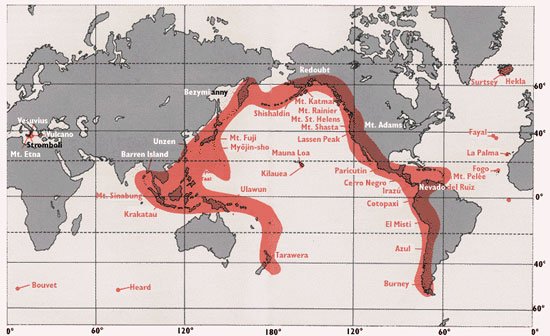
This is the name for the chain of volcanos around the edge of the Pacific Plate.
a)
Circle of Fire
b)
Ring of Lava
c)
Ring of Fire
d)
Circle of Magma
35.
Volcanoes are found...
a)
on land
b)
under water
c)
on islands
d)
all of the above
36.

What type of volcano is Kilauea, which is located in Hawaii? This type is mostly made of fluid lava vents. They are named like this because when viewed from above, you can see just how massive and imposing they are.

a)

Shield Volcano

b)

Cinder Cone

c)

Composite Volcano

37.
Where are most volcanoes found?
a)
Southern Hemisphere
b)
Ring of Fire
c)
Mid-Atlantic Ridge
d)
Hot Spots
38.
What is the definition of dormant?
a)
sleeping
b)
extinct
c)
active
d)
invisible
39.

Where is Mt. St Helens located?

a)

New Jersey

b)

Nebraska

c)

Washington state

40.

A volcano that has steep sides and is formed from lava chunks is called

a)

a shield volcano

b)

a cinder cone volcano

c)

a composite volcano

41.

A volcano that is made from layers of both runny lava and lava chunks is called

a)

a shield volcano

b)

a cinder cone volcano

c)

a composite volcano

42.

What type of volcano is Mt. St. Helens?

a)

shield

b)

composite

c)

cinder cone

43.
Volcanoes that are NOT found at plate boundaries occur in the middle of plates in areas called ___________. 
a)
hot spots
b)
mid-ocean ridges
c)
fissure volcanoes
d)
shield volcanoes
44.
How fast do winds have to be before it is considered a hurricane?
a)
50 mph
b)
75 mph
c)
100 mph
d)
40 mph
45.
Why does cold water or land cause a hurricane to weaken?
a)
because the high pressure of the hurricane can't handle the cold water from a low pressure system
b)
because the land always cools faster than the ocean
c)
because the land breeze shreds the hurricane
d)
because they cut off the energy supply to the hurricane
46.

Where do most hurricanes develop?

a)

temperate zone

b)

tropical zone

c)

Near Canada and Alaska

d)

polar zone

47.
Where does a hurricane get its energy?
a)
Warm ocean waters
b)
High air pressure
c)
Winds along the ocean's surface
d)
Sun 
48.
The area of the hurricane with the calmest winds. 
a)
Upper elevations
b)
Storm surge
c)
Eye Wall
d)
Eye
49.

What is the most devastating part of a hurricane?

a)

winds

b)

storm surge

c)

rain

50.

Hurricanes rotate because of the "Coriolis Effect" which is caused by

a)

Earth's seasons

b)

Earth revolving around the Sun

c)

Earth's tides

d)

Earth's rotation