wayground logo

Free Printable Worksheets

Font size

S
M
L
XL
Worksheets

Rocks and Minerals

Total questions: 63

Worksheet time: 47mins

Name
Class
Date
1.
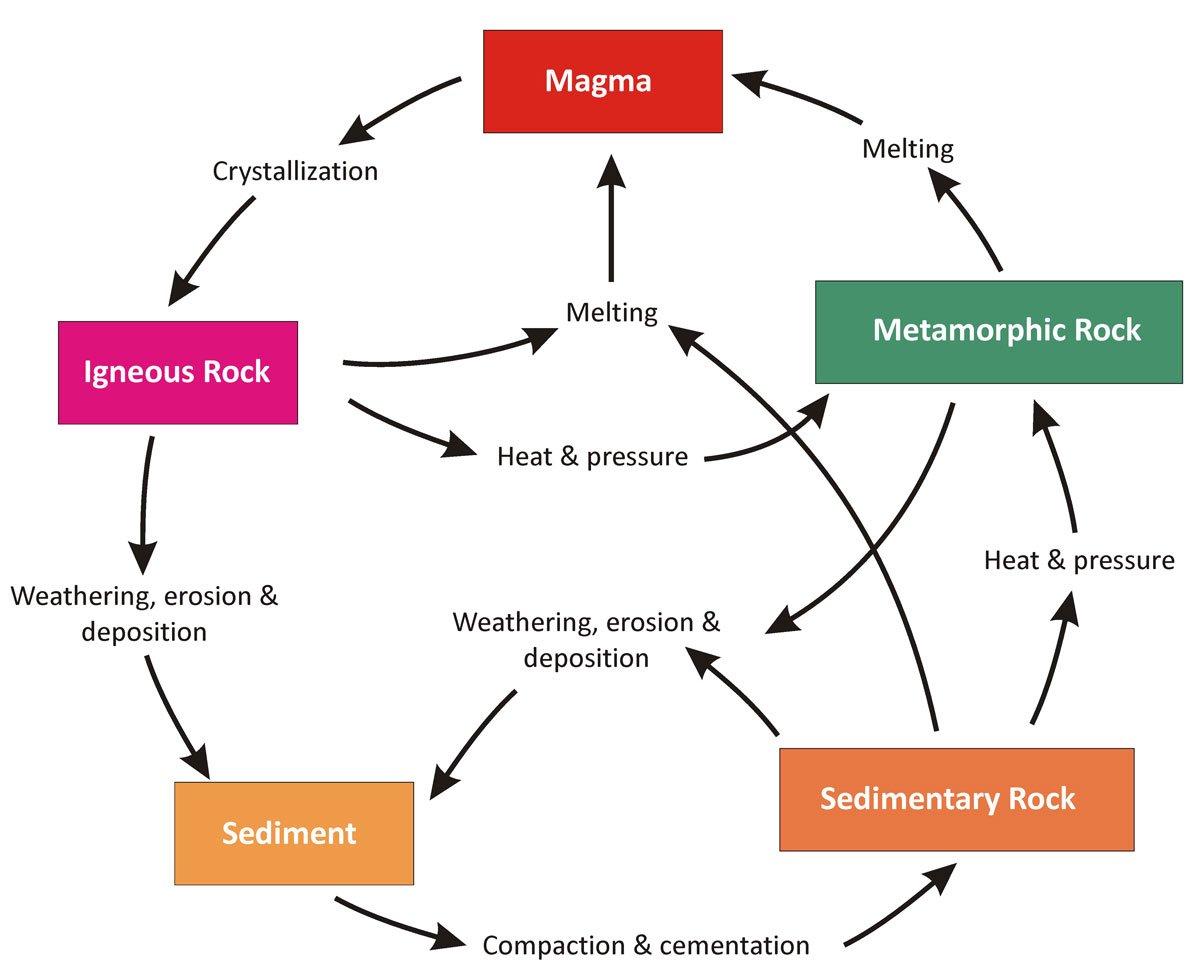
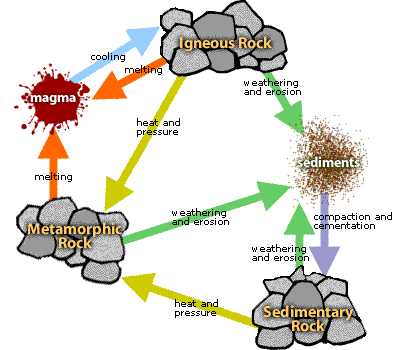
Which BEST describes the rock cycle?
a)
New rocks form from older rocks.
b)
Lunar rocks change into terrestrial rocks.
c)
Rocks in the ocean become rocks on land.
d)
Layers of rock are broken by faults.
2.
The way in which a mineral's surface reflects light.
a)
Cleavage
b)
Fracture
c)
Density
d)
Luster
3.
The tendency of a mineral to break along smooth, flat surfaces.
a)
Cleavage
b)
Fracture
c)
Hardness
d)
Streak
4.
The color of a mineral's powder form.
a)
Streak
b)
Hardness
c)
Magnetism
d)
Luster
5.

A mineral can be scratched by gypsum and quartz.

What is the hardness range?


a)

1-2

b)

2-7

c)

2-10

d)

7-10

6.

Almost all minerals are i__________?

a)

invisible

b)

inorganic

c)

imbeciles

d)

illuminating

7.

All mineral are N____?

a)

Nosy

b)

Nice to look at 

c)

Naturally occurring

d)

Nonsilicates

8.

Minerals can be a pure substance or a mixture.

a)

TRUE

b)

FALSE

9.

Minerals have a definite chemical composition.

a)

TRUE

b)

FALSE

10.
Why is coal not a mineral?
a)
It's not a solid
b)
It is man-made
c)
It is not inorganic
d)
It is made of carbon
11.
By definition, a mineral has which of the following characteristic(s)?
a)
definite chemical composition
b)
crystal structure
c)
naturally occuring
d)
all of the above
12.
What mineral is salt?
a)
quartz
b)
sulfur
c)
halite
d)
calcite
13.
Formed by heat and pressure
a)
Sedimentary
b)
Metamorphic
c)
Extrusive Igneous
d)
Intrusive Igneous
14.
Formed by cooling & solidification of lava
a)
Sedimentary
b)
Metamorphic
c)
Extrusive Igneous
d)
Intrusive Igneous
15.
Formed by cooling & solidification of magma
a)
Sedimentary
b)
Metamorphic
c)
Extrusive Igneous
d)
Intrusive Igneous
16.
Formed by compacting & cementing of sediments
a)
Sedimentary
b)
Metamorphic
c)
Extrusive Igneous
d)
Intrusive Igneous
17.
Formed by weathering & erosion
a)
magma
b)
sediments
c)
sedimentary rock
d)
intrusive igneous
18.
Formed by melting
a)
magma
b)
sediments
c)
sedimentary rock
d)
intrusive igneous
19.
Has large crystals because of slow cooling
a)
sedimentary rock
b)
metamorphic rock
c)
intrusive igneous rock
d)
extrusive igneous rock
20.
Has small or no crystals because of rapid cooling
a)
sedimentary
b)
metamorphic
c)
extrusive igneous
d)
intrusive igneous
21.
Contains fossils. 
a)
sedimentary rocks
b)
metamorphic rocks
c)
extrusive igneous rocks
d)
intrusive igneous rocks
22.
Has wavy bands.
a)
sedimentary rock
b)
metamorphic rock
c)
extrusive igneous rock
d)
intrusive igneous rock
23.

A rock deep within the Earth experiences extreme temperature and pressure. After a long period of time it becomes which rock?

a)

Magma

b)

Igneous

c)

Metamorphic

d)

Sedimentary

24.

In the Starburst Lab, we made models of all types of rocks. Which type of rock is able to turn into a metamorphic rock?

a)

Only sedimentary

b)

Only igneous

c)

Both igneous and sedimentary

d)

Neither igneous or sedimentary

25.
When minerals line up in bands within a metamorphic rock, this rock is...
a)
Nonfoliated
b)
Foliated
c)
Igneous
d)
Sedimentary
26.
The three groups of rocks are classified by
a)
How they form
b)
Color
c)
Grain size
d)
Chemical Composition
27.
When you watch a volcano erupt molten rock, you are seeing _____
a)
Lava
b)
Magma
c)
Mineral Crystals
d)
Igneous Rocks
28.
What are the 3 major types of rocks?
a)
Igneous, Metamorphic, Sedimentary
b)
Metamorphic, Igneous, Cementation
c)
Brown, Red, Gray
d)
Streak, Hardness, Breakage
29.
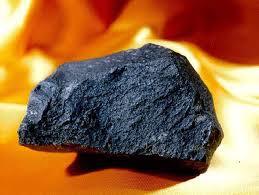
This rock was found near the mouth of a volcano. What type of rock is this?
a)
Sedimentary
b)

Extrusive Igneous

c)
Metamorphic
d)

Intrusive Igneous

30.
The process in which sediment are fused or glued together.
a)
compaction
b)
deposition
c)
organic rock
d)
cementation
31.
What is deposition?
a)
Dropping off sediment
b)
Movement of sediment
c)
Breaking down of sediment 
32.
The process when rocks break into smaller pieces due to exposure to natural elements is called
a)
erosion
b)
weathering
c)
sediments
d)
deposition
33.
 Granite is an igneous rock with large crystals. What does the size of the crystals tell you about granite?
a)
It turned solid immediately.
b)
It turned solid very slowly.
c)
It started out as a sedimentary rock.
d)
It is about to transform into a metamorphic rock
34.
The five characteristics that all minerals share are:
a)
Definite Chemical Composition, Color, Density, Igneous, and Solid
b)
Definite Chemical Composition,  Crystal Structure, Inorganic, Naturally Occurring, and Solid
c)
Cleavage, Faces, Hardness, Metamorphic, and Streak
d)
Cleavage, Crystal Structure, Density, Igneous, and Solid
35.

A student analyzing an unknown rock

that formed on Earth's surface observes

that the rock has no layers, no individual

particles or crystal grains, and is smooth

and glassy. The unknown rock is most

likely classified as

a)

intrusive igneous rock.

b)

extrusive igneous rock.

c)

intrusive metamorphic rock.

d)

extrusive metamorphic rock.

36.

Listed below are six minerals along with their hardness as determined by the Mohs hardness scale:


Alabaster 2.0

Boracite 7.5

Creedite 4.0

Ekanite 5.5

Moissanite 9.3

Spectrolite 6.0


Using the list, which minerals will scratch Ekanite?

a)

Boracite, Spectrolite, and Moissanite

b)

Alabaster and Creedite

c)

Boracite and Moissanite

d)

Alabaster, Moissante, and Creedite

37.

The composition of rock X is:


60% clay

15% gravel

25% sand


Rock X is most likely

a)

organic rock

b)

igneous rock

c)

metamorphic rock

d)

sedimentary rock

38.
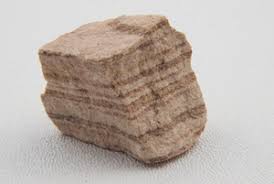
Describe this texture.
a)
Interlocking Crystals
b)
Vesicular
c)
Compacted sediments
d)
Foliation
39.
What is the hardest mineral on the Moh's scale? 
a)
copper
b)
apatite
c)
diamond
d)
talc
40.

When rocks are broken into smaller pieces they are then moved by things such as water or wind. This movement of rock is called...

a)

Weathering

b)
Erosion
c)

Deposition

d)
Compaction
41.
Which mineral property is being shown here?
a)
luster
b)
hardness
c)
cleavage
d)
streak
42.

If a scientist is observing rocks near a volcano, she is most likely observing what kind of rock?

a)

igneous rock

b)

sedimentary rock

c)

sediment

d)

metamorphic rock

43.

The forces that create metamorphic rock are related to which of the following?

a)

The breaking of rock into smaller particles over long periods of time

b)

extreme heat and pressures

c)

The cooling of magma above Earth’s surface after a volcanic eruption

d)

The transportation of Earth materials by moving water

44.

Rock sediments are carried to other places by the wind, running water, and gravity. As these forces lose energy settling takes place. The sediments settle out of the air or water in rock particles graded by size with heavier pieces settling out first. Which term best describes this process of sedimentary rock formation?

a)

weathering

b)

erosion

c)

deposition

d)

melting

45.
Choose the number where the following description best fits:  Great pressure and heat.
a)
1
b)
2
c)
3
d)
4
46.
Choose the number where the following description best fits:  Great heat from the center of the Earth causes melting.
a)
1
b)
3
c)
4
d)
5
47.
Choose the number where the following description best fits:  Hot lava cools.
a)
1
b)
3
c)
4
d)
5
48.
What is small pieces of rock material?
a)
grain
b)
lava 
c)
magma
d)
sediment
49.
Which of the following describes rocks formed by the compaction of living things?
a)
Clastic
b)
Organic
c)
Foliated 
d)
Nonfoliated
50.

Which of the following describes rocks formed when sediments are buried, compacted, and cemented together?

a)

Clastic

b)

Organic

c)

Foliated

d)

Nonfoliated

51.

Which rock can shale transform into by heat and pressure and minerals are arranged in bands/planes?

a)

nonfoliated metamorphic

b)

foliated metamorphic

c)

organic sedimentary

d)

intrusive igneous

52.

Use the chart to answer this question. A student has a mineral that she wants to identify. It is green in color, has a glassy luster, and has a hardness of 5. Based on the information in the table, the mineral the student is testing is most similar to

a)

Calcite

b)

Fluorite

c)

Apatite

d)

Topaz

53.

Use the chart to answer this question. Which mineral contains the greatest variety of elements?

a)

Calcite

b)

Feldspar

c)

Mica

54.

Minerals form naturally from all the following processes EXCEPT:

a)

Precipitation in water solutions

b)

Plant decomposition

c)

Magma cooling

55.

Use the chart to answer this question.

True or False: A piece of glass can be scratched by quartz, but not by calcite

a)

True

b)

False

56.

A mineral is a substance that...

(check ALL that are TRUE)

a)

Is created from rocks

b)

Is formed in nature

c)

Is ONLY formed from ONE element

d)

Has as specific chemical identity

e)

Is a solid

57.

How is it possible to have two DIFFERENT minerals that have the SAME chemical makeup?

a)

Each one has a different crystal structure

b)

One is formed by living things, the other below the ground

c)

One is as solid while the other is a liquid

d)

One was formed in nature and the other in a lab

58.
This rock is made of large bits of gravel cemented together. What type of sedimentary rock is it?
a)
Clastic
b)
Chemical
c)
Organic
59.

How are clastic rocks formed?

a)

minerals dissolve in a solution & then crystallize

b)

rock fragments are squeezed together

c)

remains of plants & animals are deposited in thick layers

60.
This rock is made of the remains of dead sea creatures (which have turned into oil). What type of sedimentary rock is it?
a)
Clastic
b)
Chemical
c)
Organic
61.
Made of the uppermost mantle and crust:
a)
Oceanic Crust
b)
Continental Crust
c)
Lithosphere
d)
Asthenosphere
62.

What are the four layers of the Earth from inside to the outside?

a)

Crust, Outer core, mantle, inner core

b)

Inner core, outer core, mantle, crust

c)

crust, mantle, outer core, inner core

d)

Mantle, outer core, inner core, crust

63.

What materials make up the inner core?

a)

copper and nickle

b)

iron and nickle

c)

metal and copper

d)

water and nickles