
NEW
Font size
 Worksheets
Plate Tectonics Practice
Total questions: 38
Worksheet time: 39mins

The observation that the continents fit together like puzzle pieces, and may once have been connected, led Alfred Wegener to propose a theory called
continental plowing.
continental drift.
wandering continents.
shape matching of continents.
Youngest part of the ocean floor is found near the ____________.
along deep ocean trenches
where ocean sediments are thickest
near ocean ridges
where Earth's magnetic field changes polarity
Which of the following supported Wegener's theory?
Matching fossil plant remains found on two different continents.
Matching reptile remains found on two different continents.
Nearly identical sedimentary rock types of the same age in widely separated locations.
All of the above.

Scientists found that the continents were moving apart from each other due to magma rising out of mid-ocean ridges, and they called this
seafloor spreading.
seafloor rising.
changing seafloor.
underwater volcanoes.
Plate margins are places where a lot of tectonic activity occur. Earthquakes occur, for example, along convergent margins, where plates are
moving apart.
sliding past each other.
colliding.
The boundary at which crust is continually added is a
subduction zone.
transform boundary.
divergent boundary.
convergent boundary.
Subduction is when
earthquakes occur along a transform boundary.
new crust is formed.
one plate slides under another.
new islands are formed.

The mid-ocean ridge occurs along a
convergent boundary where new crust is formed.
transform boundary where crust is subducted.
divergent boundary where seafloor spreading takes place.
divergent boundary where subduction takes place.
When two continental plates pull apart a _________________ forms.
subduction zone
mountain range
earthquake
rift valley
Oceanic crust is _____________ than continental crust.
less dense
more dense
less hot
more hot
Which of the following occurs because of convection currents?
Tectonic plates move.
The mantle increases in size.
Pressure in the crust increases.
Pressure in the crust decreases.
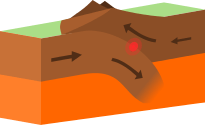
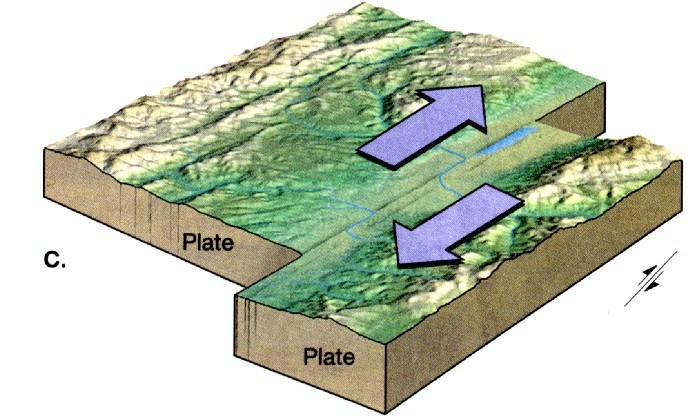

Which of the following shows a convergent boundary?


Which of the following shows a divergent boundary?
Which of the following shows a transform boundary?
The Himalayas are and example of a folded mountain range that formed at a ________________ boundary.
divergent
transform
oceanic-oceanic convergent
oceanic-continental convergent
continental -continental convergent
Continental Drift was not widely accepted when it was first proposed because ____.
Wegener couldn't explain why or how the continents moved
continental landmasses were too big to move slowly over Earth's surface
Magnetic and sonar data proved that Wegener's hypothesis was incorrect
mantle convection currents weren't in motion at the time
Scientists have observed that the continents move apart or come together at the speeds of a few centimeters per ___.
century
decade
day
year
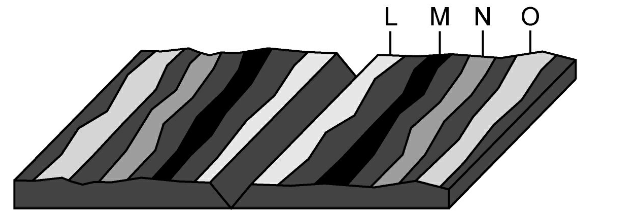
While studying the ocean floor, scientists found ____ bands of magnetism.
plastic
alternating
no
rectangular
The East African Rift is an example of a ___.
mid-ocean ridge
continental rift
convergent boundary
transform boundary
Crust is neither destroyed nor formed along which of the following boundaries?
convergent
transform
divergent
magnetic
Scientists believe that differences in ___ cause hot, plasticlike rock in the asthenosphere to rise toward Earth's surface.
density
magnetism
weight
composition
Plates of the lithosphere float on the
crust
asthenosphere
core
atmosphere
Continental-continental plate collisions produce ____.
island arcs
rift valleys
deep-sea trenches
very tall mountain ranges
A _____ can also form when two oceanic plates collide.
hot spot
line of volcanoes
transform boundaries
rift valley
Active volcanoes are most likely to form at ____.
transform boundaries
divergent boundaries
the center of continents
convergent oceanic - continental boundaries
The downward part of convection current causes a sinking force that ___.
pulls tectonic plates towards one another
moves plates apart from one another
lifts and splits the lithosphere
creates a divergent boundary
What is the theory of plate tectonics?
Earth’s outer layer is made up of large, moving pieces called plates
Cracks in the Earth's crust cause volcanoes
The Earth was created by meteors crashing into each other

