wayground logo

Free Printable Worksheets

NEW

Font size

S
M
L
XL
Worksheets

8th Grade Universe review

Total questions: 43

Worksheet time: 56mins

Name
Class
Date
1.
As a whole, Giants are considered hotter than White Dwarfs.
a)
True
b)
False
2.
In the diagram given, what happens as we move to the left?
a)
Stars Get Larger
b)
Stars get Colder
c)
Stars get hotter
3.
Compared to the rest of the stars, our sun is considered...
a)
Extremely Large and Cold
b)
Small with a medium temperature
c)
Medium size with medium temperature
4.
The category that contains the most stars is...
a)
Main Sequence
b)
Supergiants
c)
Giants
5.
The HR Diagram shows a relationship of a star's surface temperature and its
a)
color
b)
size
c)
apparent magnitude
d)
absolute magnitude
6.
What color are the hottest stars?
a)
red
b)
yellow
c)
orange
d)
blue
7.

Look at the H-R diagram. Which star is

sort of cool, dim (not too much light), and red?

a)

Betelguse

b)

Sirius B

c)

Procyon B

d)

Barnard's star

8.
Which star has the lowest temperature?
a)
A
b)
B
c)
C
d)
D
9.
What determines the color of a star? 
a)
It's size
b)
It's temperature
c)
It's composition
d)
They are all the same color 
10.
What are electromagnetic waves?
a)
sound waves
b)
electric & magnetic fields that travel through space very quickly
c)
ocean waves
d)
things like longitudinal waves
11.
A wave with a large wavelength will have a ______ frequency and _____ energy
a)
high, low
b)
high, high
c)
low, high
d)
low, low
12.
Which has the LONGEST wavelength and, therefore, the lowest frequency/energy
a)
Gamma Rays
b)
Radio Waves
c)
Visible Light
d)
Infrared rays
13.
Which has the SHORTEST wavelength and, therefore, the highest frequency/most energy
a)
Radio waves
b)
Ultraviolet Rays
c)
Gamma Rays
d)
X-rays
14.
Which section of the spectrum is the ONLY one we can see?
a)
X-rays
b)
Visible Light
c)
Gamma Rays
d)
Ultraviolet Rays
15.
Which part of the electromagnetic spectrum has high enough energy to cause damage to eyes and skin, and sometimes even cancer?
a)
Infrared Rays
b)
Radio Waves
c)
Microwaves
d)
Ultraviolet Rays
16.
The blue section of the wave is measuring _________________.
a)
wavelength
b)
crest
c)
trough
d)
amplitude 
17.
The orange line is measuring the _________________________.
a)
wavelength
b)
amplitude
c)
crest
d)
trough
18.
The higher the frequency the ______ the energy. 
a)
higher
b)
lower
c)
neither, stays the same
19.
True or false: The electromagnetic spectrum is the complete range of electromagnetic waves placed in order of increasing frequency
a)
True
b)
False
20.

absolute magnitude

a)

the magitude a star would have if veiwed from a certain distans

b)

the path a body follows

c)

the force that keeps us on the ground

d)

a german scientist who figures out the law of relitivety

21.

milky way

a)

the property of a body that causes it to have weight

b)

an independent agency of the United States government responsible for aviation and spaceflight

c)

the galaxy containing the solar system

d)

one of the twelve divisions of the calendar year

22.
What type of galaxy is this?
a)
Spiral
b)
Elliptical
c)
Irregular 
d)
Irrational
23.
What type of galaxy has no defined pattern or shape?
a)
Spiral 
b)
Elliptical
c)
Irregular
d)
Constellation
24.
The type of galaxy that is composed of the older stars and low-mass stars.
a)
Spiral
b)
Elliptical
c)
Irregular
d)
Constellation
25.
Distance measurement used by astronomers for distant objects.
a)
Kilometers
b)
Light Years
c)
Miles
d)
Light Seconds
26.
How many stars are in a galaxy.
a)
millions or billions
b)
thousands
c)
hundreds
d)
Ten
27.
What are in galaxies?
a)
ice and rock
b)
dust, gas, and stars
c)
stars and ice
d)
water and dust
28.
A galaxy is a large collection of stars, gas and dust. What is responsible for holding the stars, gas, and dust together in a galaxy?
a)
heat
b)
light
c)
gravity
d)
friction
29.
At which stage does a star swell up many times larger than its normal size?
a)
Protostar
b)
Nebula
c)
Main Sequence
d)
Red Giant
30.
Less massive stars turn into ___ when they die
a)
White Dwarfs
b)
Black Hole
c)
Neutron Star
d)
Either a black hole or a neutron star
31.
More massive stars turn into ___ when they die
a)
White Dwarf
b)
Black Hole
c)
Neutron Star
d)
Either a black hole or a neutron star
32.
Which stage in a stars life is similar to "old age" in humans
a)
Nebula
b)
Main Sequence
c)
Red Giant
d)
White Dwarf
33.
Which star below would most likely supernova into a black hole
a)
Star like our sun
b)
Star 5 times more massive than our sun
c)
Star 5 times less massive than our sun
d)
Star 2 time more massive than our sun
34.
At 10,000 degrees Celsius, hydrogen begins to change into helium and energy is released in a process called
a)
supernova
b)
pulsar
c)
nuclear fusion
d)
nuclear fission
35.
All stars begin their life in a
a)
Main Sequence
b)
Nebula
c)
Protostar
d)
Black Dwarf
36.
Our sun is currently in what star stage?
a)
Protostar
b)
Nebula
c)
Main Sequence
d)
Red Giant
37.
Most stars are made of which elements?
a)
Hydrogen only
b)
Hydrogen and Lithium
c)
Hydrogen and Sodium
d)
Hydrogen and Helium
38.
A ________ is an object so dense with so much gravity that even light cannot escape.
a)
neutron star
b)
white dwarf
c)
blackhole
d)
black dwarf
39.

This is an image of the first stage in the formation of a star, also known as a ....

a)

Main Sequence

b)

Planetary Nebula

c)

Supernova

d)

Nebula

40.

Which element is NOT present in the composition of the star?

a)

Calcium

b)

Sodium

c)

Helium

d)

Hydrogen

41.

Which elements make-up the mixture of gases found in the star?

a)

lithium and cadmium

b)

strontium and lithium

c)

strontium and cadmium

d)

all three

42.
What gases are in the unknown mixture?
a)
Gas B & Gas D
b)
Gas C & Gas B
c)
Gas A & Gas D
d)
Gas D & Gas C
43.
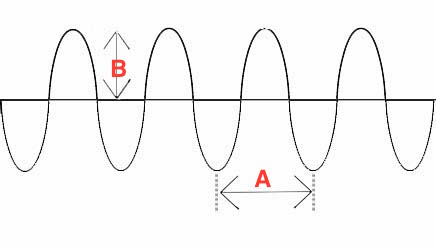
What property of the wave is represented by the letter "B"?
a)
amplitude
b)
crest
c)
trough
d)
wavelength