
 Worksheets
Sound Unit Test Review
Total questions: 49
Worksheet time: 59mins
Late one night your brother's loud music wakes you up. What property of sound is this an example of?
Pitch
Force
Tension
Loudness
You notice that when you sing "Twinkle Twinkle Little Star" your voice changes and gets higher during some parts of the song. What property of sound is this an example of?
Pitch
Force
Tension
Loudness
Which of the following about sound is TRUE?
Sound travels in vibrations
Sound can only travel through air
Sound cannot be blocked
Sound is a form of light energy
Daniel plays the guitar in music class. What should she do to change the pitch of the guitar.
Pluck all the strings very forcefully
Strum all the strings together
Adjust the length of the strings
Put holes in the guitar
Hudson plucks two strings of a violin. The first string makes a low pitch, but the second makes a high pitch. What does this tell you?
The first string is producing faster vibrations
The second string is producing faster vibrations
The two strings are vibrating at the same speed
Someone with a deep voice produces...
A high pitch
A low pitch
A small tuning fork produces
A high pitch
A low pitch
A large tuning fork produces
A high pitch
A low pitch
Your teacher has a LOUD voice. This means their voice
Produces larger vibrations
Produces smaller vibrations
Produces the same amount of vibrations as a person with a soft voice.
Produces no vibrations

What does this table tell us about how sound travels
Sound travels at the same speed
Sound travels fastest through solids
Sound travels fastest through liquids
Sound travels fastest through gasses
Michael Taps a small tuning fork on her desk, and then she strikes the same tuning fork on her desk. Which will produce more vibrations
Tapping
Striking

What is the BEST conclusion Angelina could make from her experiments with violin strings?
The thinner the string the higher the pitch
The thicker the string the higher the pitch
The 5cm string make the lowest sound.
The thickness of a string does not affect the pitch.

Mary wants to figure out how to make the loudest sound at a basketball game. She experiments to see how force affects how loud her sound is. She measure the volume of the sound using decibels. Based on the chart, predict how loud kicking the seat will be in decibels.
5 decibels
15 decibels
45 decibels
100 decibels

Anthony's class has a short tuning fork, a medium tuning fork, and a long tuning fork. Their teacher tells them to strike the tuning fork and place the fork in a bowl of water. They oversee the pitch created and measure the vibrations of the tuning fork in Hertz.
What conclusion can Anthony's class make about how vibrations affect sound?
The size of the tuning fork affects the volume of a sound.
Higher pitches produce more vibrations
Lower pitches produce more vibrations
Larger objects produce more vibrations
Which answers are an example of sound producing vibrations?
Hitting the tuning fork
Plucking a rubber band
Ruler being held off of the desk and being hit
Tuning fork put in water after being hit
Bunched up particles in a vibration
rarefaction/expanded
Hertz
compression
Noise
Spread out particles in a vibration
rarefaction/expanded
frequency
vibrations
sound quality
Number of vibrations per second
rarefaction
compression
frequency
noise

The tuning fork on the right would produce a _____frequency
high frequency
Low frequency
The strong, rich effect of a sound when it is reflected or causes another object to vibrate.
resonance
sound quality
frequency
pitch
What is the highest point of a wave?
Trough/valley
Wavelength
Amplitude
Crest/peak
A __ wave moves the particles perpendicular to the motion of the wave.
Surface
Compression/Longitudinal
Transverse
Slinky
Sound travels in which type of wave?
Transverse
Surface
Compression/Longitudinal
Waves are created when a sound source causes a __.
medium to vibrate
body of water to move
medium to fall
body of water to turn
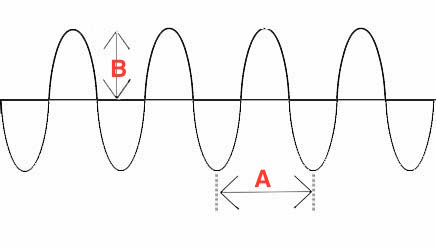
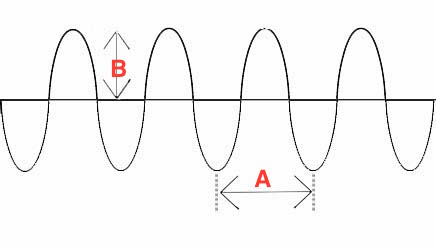

what type of wave is pictured
transverse
Compression/longitudinal
slinky
The motion of matter in a compression/longitudinal wave is...
perpendicular to the energy direction
same direction as the energy direction
the motion of matter in a transverse wave is...
perpendicular to the energy direction
same direction as the energy direction
Frequency is?
The height of the wave
The length of the wave
The number of waves that pass in a second
The time it takes for one wave to pass

What type of wave are these?
Transverse
Surface
Combination
Compression/Longitudinal
How high or low a sound is
frequency
volume
vibration
pitch
Sound is a form of?
energy
pitch
volume
______________ sounds have a larger amplitude
quiet
loud
Pitch describes human perception of which property?
resonance
frequency
amplitude
overtones
Which property of a sound wave determines how close together the particles are in the compression region?
amplitude
frequency
wavelength
wave speed
Which type of wave carries more energy, a wave with a high amplitude or a wave with a high frequency?
a wave with a high amplitude
a wave with a high frequency
When you double the frequency of a wave, what will happen to the energy?
It will increase exponentially (quadruple)
it will decrease exponentially
it will double
it will decrease by half
When you double the amplitude of a wave, what will happen to the energy?
It will increase exponentially (quadruple)
it will decrease exponentially
it will double
it will decrease by half

