wayground logo

Free Printable Worksheets

NEW

Font size

S
M
L
XL
Worksheets

Physical Science Review 1

Total questions: 62

Worksheet time: 1hrs 17mins

Name
Class
Date
1.
Anything that takes up space and has mass is...
a)
Matter
b)
Work
c)
Power
d)
Newton's 1st Law
2.
The classification of matter as a solid, liquid, or a gas.
a)
Matter
b)
Mass
c)
Physical State
d)
Thermal Energy
3.
The amount of stuff in something, measured in kg
a)
Matter
b)
Mass
c)
Solubility
d)
Conductor
4.
Students place ice cubes outside on the ground, on a hot summer day. Which best describes how the ice cubes change over time?
a)
Gas to solid to liquid
b)
Liquid to gas to solid
c)
Solid to liquid to gas
d)
Solid to gas to liquid
5.
What is happening at the boiling point?
a)
liquid to gas
b)
gas to liquid
c)
solid to liquid
d)
liquid to solid
6.
What is happening at freezing point?
a)
gas to liquid
b)
solid to liquid
c)
liquid to solid
d)
liquid to gas
7.

Gases

a)

don’t have a definite shape and don’t have a definite volume

b)

don’t have a definite volume and have a definite shape

8.

Solids

a)

have a definitive shape and have a definitive volume

b)

have a definitive shape and don't have a definitive volume

9.

The Sun produces ______ and ______ energy

a)

thermal, light

b)

chemical, sound

c)

kinetic, light

10.
The ability to move, work or cause a change in matter is...
a)
mass
b)
volume
c)
energy
d)
density
11.
How many states of matter are there?
a)
4
b)
3.1415926535897932384626433832795028841971693993751058209749445923078164062862089986280348253421170679821480865132823066470938446095505822317253594081284811174502841027019385211055596446229489549303819644288109756659334461284756482337867831652712019091456485669234603486104543266482133936072602491412737245870066063155881748815209209628292540917153643678925903600113305305488204665213841469519415116094330572703657595919530921861173819326117931051185480744623799627495673518857527248
c)
3
d)
SPIDER-CAM
12.
How many states does a solid go through before it is a plasma?
a)
3: Liquid, Gas, Plasma
b)
2: Plasma, Gas
c)
4: Solid, Gas, Liquid, Plasma
d)
600: Spider-Cam, Thor, Hulk, etc.
13.
When you stretch a rubber band, you are storing __________ energy. 
a)
kinetic 
b)
potential
c)
none of the above
d)
all of the above 
14.
Can energy be destroyed
a)
no
b)
yes
15.
Energy due to motion is ____________ energy. 
a)
Potential 
b)
Energy
c)
Kinetic
d)
Friction
16.
__________ is stored energy. 
a)
Potential
b)
Kinetic
c)
None of the above 
d)
All of the above 
17.
What kind of energy is in a stretched rubber band?
a)
Potential
b)
Kinetic
18.
What kind of energy is in a waving hand?
a)
Potential
b)
Kinetic
19.
Food has _________ energy. 
a)
Potential 
b)
Kinetic 
c)
None of the above 
d)
All of the above 
20.

The change that is tested in an experiment.

a)

hypothesis

b)

data

c)

variable

d)

observation

21.

Uses your senses to gather information.

a)

observation

b)

variable

c)

hypothesis

d)

data

22.

The general steps used when conducting an experiment.

a)

observation

b)

variable

c)

hypothesis

d)

scientific method

23.

A written explanation of what you think will happen, an idea that is tested in an experiment, and may be proven to be true.

a)

observation

b)

variable

c)

hypothesis

d)

data

24.

Study of the natural world through observation and investigation.

a)

Science

b)

Hypothesis

c)

Experiment

d)

Flying monkeys

25.

Is something that is kept the same, remaining unchanged in an experiment.

a)

Control

b)

Variable

c)

Data

d)

P, B, & J

26.

Is a procedure carried out under controlled conditions to test a hypothesis.

a)

Science

b)

Watching YouTube

c)

Experiment

d)

Hypothesis

27.
It is a measure of how close measurements come to each other when they are made in the same way
a)
Accuracy
b)
Precision
c)
Error
d)
Extrapolation
28.

How close a measurement is to the accepted value is called..

a)

Accuracy

b)

Precision

c)

Significant

d)

Estimate

29.
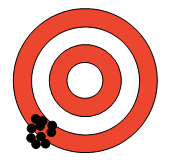
This bullseye demonstrates...
a)
High Accuracy & High Precision
b)
High Accuracy & Low Precision
c)
Low Accuracy & High Precision
d)
Low Accuracy & Low Precision
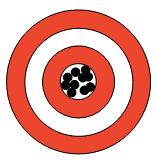
30.
?
a)
High Accuracy & High Precision
b)
High Accuracy & Low Precision
c)
Low Accuracy & High Precision
d)
Low Accuracy & Low Precision
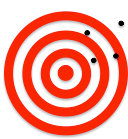
31.
Describe the accuracy and precision of the image
a)
Accurate and Precise
b)
Accurate and not precise
c)
Not Accurate and Precise
d)
not accurate and not precise
32.

How close a measurement is to the true value is called..

a)

Accuracy

b)

Precision

c)

Significant

d)

Estimate

33.
This image is an example of...
a)
precision ONLY
b)
accuracy ONLY
c)
BOTH precision and accuracy
d)
NEITHER precision and accuracy 
34.

Which Student is the most Precise?

a)

Alex

b)

Shandra

c)

Luis

35.

Write 7.113 x 10⁷ in standard form.

a)

71,130,000

b)

7,113,000

c)

0.0000007113

d)

7,113

36.
Write 7.8 x 10⁻³  in standard form.
a)
0.0078
b)
7,800
c)
78
d)
0.078
37.
Write 2.08 x 10²  in standard form.
a)
208
b)
0.0208
c)
20,800
d)
0.208
38.
UNDERSTANDING
If the exponent is a negative number...
a)
you will get a large number
b)
you will get a small number
39.
Which of the following is correct scientific notation?
a)
20.35 x 10⁴
b)
.2035 x 104
c)
2035 4
d)
2.035 x10⁴
40.
Write in scientific notation:
4060
a)
4.06 x 10⁻³
b)
4.06 x 10²
c)
4.06 x 10³
d)
4.06 x 10⁻²
41.
Light travels at a rate of 186,000 miles per second.  Write this number in scientific notation.
a)
1.86 x 10⁵
b)
1.86 x 10⁴
c)
18.6 x 10⁴
d)
186 x 103
42.
What does 8-2 equal?
a)
1/16
b)
1/64
c)
-16
d)
-64
43.
Which of these is NOT a basic piece of an atom?
a)
proton
b)
neutron
c)
electron
d)
quantron
44.
Which atomic particle has a negative charge?
a)
proton
b)
neutron
c)
electron
d)
all of the above
45.
Which of these phrases best describes an atom?
a)
a positive nucleus surrounded by a hard negative shell
b)
a positive nucleus surrounded by a cloud of negative charges
c)
a hard sphere with postive and negative charges on the outside
d)
a negative nucleus surrounded by protons and neutrons
46.
Which of the following particles has the smallest mass?
a)
neutron
b)
proton
c)
nucleus
d)
electron
47.
What is true about an atom?
a)
Most of the space in an atom is taken up by the nucleus
b)
Atoms are mostly empty space
c)
Atoms have no mass
d)
Electrons have much more mass that protons or neutrons.
48.
The positively charged parts of an atom are the
a)
protons
b)
electron clouds
c)
neutrons
d)
electrons
49.

What part of the atom is indicated by the red sphere?

a)

nucleus

b)

electron cloud

c)

electrons

d)

neutrons

50.
Matter that is made up on only one type of atom is called
a)
a compound
b)
a subatomic particle
c)
an element
d)
water
51.
The term "neutral" means
a)
having only a little bit of charge
b)
having a positive charge
c)
having a negative charge
d)
having no charge at all
52.
Atoms are neutral because they have the same number of
a)
protons and neutrons
b)
protons and electrons
c)
electrons and neutrons
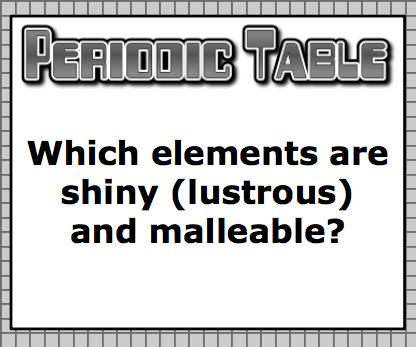
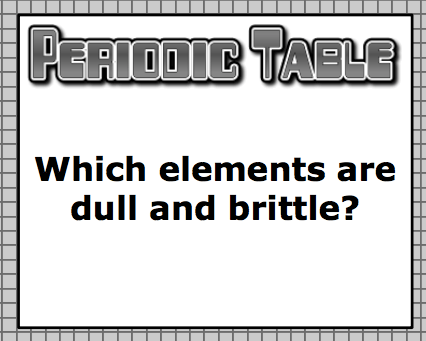
53.
a)
Metals
b)
Nonmetals
c)
Metalloids
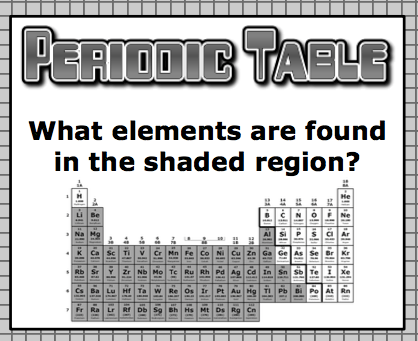
54.
a)
Metals
b)
Nonmetals
c)
Metalloids
55.
a)
Metals
b)
Nonmetals
c)
Metalloids
56.
What is the atomic number?
a)
the number of protons
b)
the number of protons and neutrons
c)
the number of neutrons
d)
the number of protons and electrons
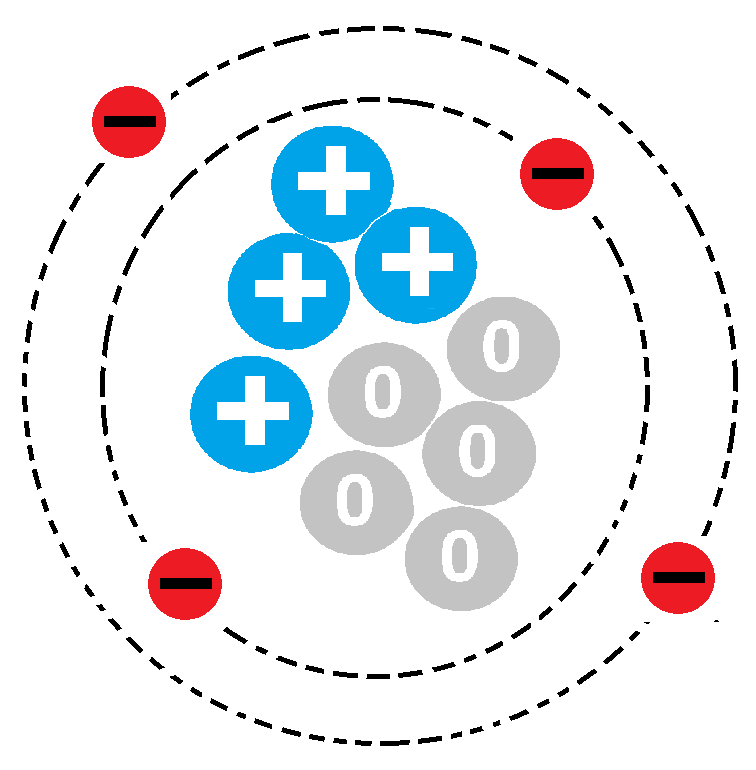
57.
What is the atomic number of this nucleus?
a)
1
b)
3
c)
4
d)
7
58.
What is the atomic number of this atom?
a)
4
b)
5
c)
9
d)
none of the above
59.
What is the atomic number of this atom?
a)
9
b)
10
c)
19
d)
27
60.
Which particle has a positive charge?
a)
electron
b)
orbital
c)
proton
d)
neutron
61.
This particle determines what element you have - the elements identity.
a)
electron
b)
proton
c)
neutron
d)
valence shell
62.
The atomic number of Hydrogen is
a)
1
b)
2
c)
3
d)
4