

Wayground logo

Free Printable Worksheets

Font size

S
M
L
XL
Worksheets

Evolution

Total questions: 35

Worksheet time: 50mins

Name
Class
Date
1.

An antibiotic which was effective 20 years ago against a specific type of bacterial infection no longer works against the same kind of infection today. Which best explains why the antibiotic is no longer as effective as it was 20 years ago?

a)

bacteria resistant to the antibiotic have killed off nonresistant bacteria

b)

viruses have changed the structure of the bacteria that causes the infection

c)

resistant bacteria have survived and reproduced at a greater rate than nonresistant bacteria

d)

the human body has developed an immunity to the antibiotics

2.

An insecticide kills most of the ants on a plant. Over time, it is determined that the insecticide is not as effective for killing ants. Which statement best explains this observation?

a)

the ants killed initially by the insecticide were genetically the same as the surviving ants

b)

the ants killed initially by the insecticide had thinner cell membranes than the surviving ants

c)

the ants that survived were younger than those that died as a result of the insecticide

d)

the ants killed by the insecticide and the surviving ants were genetically different

3.

Some marine worms and mollusks go through similar larval stages during development. Which can be inferred about their relationship?

a)

they share a common ancestor

b)

they mate with each other

c)

they compete for a habitat

d)

they share the same food source

4.

Which statement best describes natural selection?

a)

as the weather changes, organisms that are able to find shelter need less energy to live

b)

organisms that eat only plants need less food than organisms that eat animals

c)

organisms better adapted to their environment are more likely to reproduce and pass on their traits to their offspring

d)

small organisms are more likely to survive than larger organisms

5.

Some scientists claim recent evidence suggests birds should be reclassified to share more taxonomic groups with dinosaurs. What type of evidence would provide the best support for this claim?

a)

evidence showing birds shared similar habitats with dinosaurs

b)

evidence showing birds shared similar nutritional requirements as dinosaurs

c)

evidence showing birds shared similar behaviors with dinosaurs

d)

evidence showing birds shared a common genetic history with dinosaurs

6.
Two different populations of birds live in the same area and eat the same types of food. Which most likely describes the relationship between these two populations of birds? 
a)
competition
b)
mutualism
c)
parasitism
d)
predator-prey
7.
What will most likely happen if the human population continues to grow at current rates?
a)
There will be fewer natural resources available for future generations.
b)
There will be an increase in nitrogen levels in the atmosphere. 
c)
There will be a decrease in water pollution. 
d)
There will be an increase in the number of strong hurricanes. 
8.
A sea turtle has washed up on a remote section of a beach. This is known as a “stranding.” Stranding occurs when a dead, sick or injured sea turtle washes up on the shoreline. Which statement best explains why “stranding” should be reported immediately to local authorities? 
a)
The information can be very useful to biologists and managers who are trying to protect the species.
b)
The information can be very useful to protect sea turtles from predators. 
c)
The information can be very useful to local fishermen who try to catch fish that sea turtles eat. 
d)
The information can be very useful to tourists who may want to keep sea turtles as pets.
9.
Matthew has discovered a new species of fish. During the summer months, the male fish separate themselves from the female fish and swim to cooler waters. During one summer, a volcano erupts and the molten rock forms a barrier preventing the male and female fish from reuniting. Matthew has discovered a new species of fish. During the summer months, the male fish separate themselves from the female fish and swim to cooler waters. During one summer, a volcano erupts and the molten rock forms a barrier preventing the male and female fish from reuniting.
a)
The fish would become extinct as they would not be able to reproduce.
b)
The species would not be affected by the barrier.
c)
The male fish would begin to produce eggs and sperm.
d)
The fish would develop legs and walk across the barrier.
10.
A mountain seperates a population of mice into two distinct eastern and western populations. The eastern area is inhabited by owls, which hunt at night. No owls live in the western area. Over time, the eastern population of mice will MOST LIKELY
a)
change over time and become less active at night
b)
become more active at night
c)
remain identical with the western population
d)
grow stronger claws and teeth to better fight the owls
11.

Examine the diagrams. Columns I and II contain rock layers A, B, C, D, E and F. Both columns were taken from the same dig site at different locations. Which two layers are of approximately the same age?

a)

C & D

b)

A & D

c)

B & E

d)

B & F

12.
All of the scenarios are examples of evolution, with the EXCEPTION of the
a)
change of a caterpillar into an adult butterfly
b)
loss of hind limbs by whales
c)
gradual loss of toes on the feet of horses
d)
change of bones in ostriches, from hollow to solid
13.
The genetic information in human and chimpanzee DNA shows a high degree of similarity, as humans share about 96-99% of their DNA code with chimpanzees. What is an explanation for this similarity?
a)
They evolved from a common ancestor.
b)
They evolved from each other.
c)
They evolved at the same time.
d)
Their evolution is nearly complete.
14.
The bone structure of the baleen whale and the hummingbird pictured above suggests that they share
a)
a common ancestor
b)
the same diet
c)
a similar environment
d)
similar mating rituals
15.
One of the major elements of natural selection is that all species have genetic
a)
variation
b)
digression
c)
melanism
d)
stability
16.
Some mutations always occur from generation to generation. But most mutations do not persist over time in the gene pool. Which mutation is MOST likely to become established and persist in a species?
a)
a mutation that helps a rabbit conceal itself from predators
b)
a mutation that changes the color of a fruit fly’s eyes
c)
a mutation that makes it harder for a frog to catch food
d)
a mutation that causes a leopard attack humans more frequently
17.
The dots represent a bacterial infection. Sal was very sick with this bacterial infection. The infection was treated with antibiotics. Sal seemed to get well, but in a few weeks, she was sick again. How can this be explained using natural selection?
a)
The stronger, more resistant bacteria survived the antibiotics and reproduced.
b)
The antibiotics were ineffective to this strain of bacteria.
c)
The antibiotics did not kill the bacteria; it only forced them to be dormant.
d)
Antibiotics will only kill a portion of the bacteria, no matter how much medicine Sal takes.
18.
When all of the organisms of a species have died it is called,
a)
Extinction
b)
Evolution
c)
Adaptation
d)
Natural Selection
19.
What is the study of organisms at the early stages of development?
a)
Embryology
b)
Fossil record
c)
Molecular Genetics
d)
Extinction
20.
What is this an example of?
a)
Variation
b)
Diversity of species
c)
Vestigial structure
d)
Molecular Genetics
21.
What is this an example of?
a)
Homologous Structures
b)
Embryology
c)
Fossil record
d)
Vestigial structures
22.

Predict which moth would increase in population

a)

Dark

b)

Light

23.
The males of a bird species do a “dance” and “sing a song” each spring. What is the main purpose of these behaviors? 
a)
to scare off young birds
b)
to imprint young birds
c)
to clean their feathers
d)
to attract female birds
24.
The following diagram shows a mutation that occurs in the hemoglobin gene to produce a recessive genetic disorder called sickle cell anemia.
Which of the following statements best describes why the change in only one DNA base of the hemoglobin gene results in a different protein product of the gene?
a)
the change prevents mRNA from being made
b)
the change alters the amino acid sequence of the protein
c)
the change causes the blood cells to divide in an uncontrolled way
d)
the change creates a second strand of mRNA for each RNA molecule
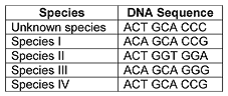
25.
According to this data, the unknown bacterial species is most closely related to: 
a)
Species I
b)
Species II
c)
Species III
d)
Species IV
26.

Which statement best describes this outcome?

a)

Finches that are best suited to survive and reproduce (points 1 and 3) are more likely to pass on beneficial traits to their offspring; those less suited (point 2) fail to pass on their traits to their offspring.

b)

Finches that are least suited to survive and reproduce (points 1 and 3) are more likely to pass on beneficial traits to their offspring; those more suited (point 2) fail to pass on their traits to their offspring.

c)

Finches that are best suited to survive and reproduce (point 2) are more likely to pass on beneficial traits to their offspring; those less suited (points 1 and 3) fail to pass on their traits to their offspring.

d)

Finches that are least suited to survive and reproduce (point 2) are more likely to pass on beneficial traits to their offspring; those more suited (points 1 and 3) fail to pass on their traits to their offspring.

27.
Which two orgainsms have hair? 
a)
Sharks & Ray Finned Fish
b)
Primates & Rodents
c)
Birds & Crocodiles
d)
Rabbits & Birds
28.

According to this cladogram, primates are MOST closely related to which organism?

a)

Amphibians

b)

Ray finned fish

c)

Crocodiles

d)

Rodents and rabbits

29.
The diagram illustrates an embryonic stage of two organisms. Which of the following can be determined by observing the embryos shown in the diagram?
a)
 The organisms share a common ancestry.
b)
 The organisms belong to the same genus.
c)
 The organisms are native to the same geographic areas.
d)
 The organisms will grow into anatomically similar adults.
30.
Scientists are studying the evolutionary history of a group of plants in the United States, and they developed an evolutionary tree, as shown. Which statement can be inferred from the evolutionary tree?
a)
Species 1 is most closely related to Species 8.
b)
 Species 2 is most closely related to Species 3.
c)
Species 3 is most closely related to Species 7.
d)
 Species 5 is most closely related to Species 6.
31.
The diagram below shows a proposed theory of the origin of eukaryotic cells, called endosymbiosis. Which of the following explains why cells that contained mitochondria-like organelles had an evolutionary advantage?
a)
They were able to photosynthesize
b)
 They had more DNA
c)
They were able to make more use of available energy
d)
 They were immune to bacterial invasion.
32.
Over time, the climate of an island became drier, which resulted in changes to the populations of various island finch species. Finch populations with a certain beak shape thrived, while those not having that beak shape decreased. Which of the following describes a necessary condition for these changes in the finch populations to occur?
a)
 fewer mutations
b)
 limited food resources 
c)
 limited beak variations
d)
overproduction of offspring
33.
A small population of chimpanzees lives in a habitat that undergoes no changes for a long period. How will genetic drift probably affect this population?
a)
 It will accelerate the appearance of new traits.
b)
 It will promote the survival of chimpanzees with beneficial traits.
c)
 It will increase the number of alleles for specific traits.
d)
 It will reduce genetic diversity.
34.
A small portion of the population that is geographically isolated from the rest of the population runs the risk of decreased.
a)
genetic drift
b)
mutation rate
c)
natural selection
d)
genetic variation
35.
Theodosius Dobzhansky discovered that successful species tend to have a wide variety of genes that do not appear to be useful to the species in its present environment. What did this discovery help explain about genetics and the changes that occur in a species over time?
a)
Environments with more organisms tend to have more successful species.
b)
Species with greater genetic diversity adapt more easily to changing environments.
c)
 Changing environments prevent species from adapting and surviving.
d)
 Species in a stable environment are more resistant to a changing environment.
