
NEW
Font size
S
M
L
XL
 Worksheets
atom
Total questions: 40
Worksheet time: 37mins
Name
Class
Date
1.

What is the atomic mass of "F"
a)
9
b)
18
c)
17
d)
19
2.
all matter is made of what
a)
energy
b)
atoms
c)
electrons
d)
compounds
3.
The positive particles of an atom are
a)
electrons
b)
positrons
c)
neutrons
d)
protons
4.
the central region of an atom where its neutrons and protons are is its
a)
nucleus
b)
electron cloud
c)
core
d)
center
5.
All matter is made of what?
a)
energy
b)
atoms
c)
electrons
d)
compounds
6.
electrons have this type of charge?
a)
negative
b)
positive
c)
neutral
7.
What is the mass of an atom if it has 11 protons, 12 neutrons, and 11 electrons?
a)
22
b)
11
c)
34
d)
23
8.
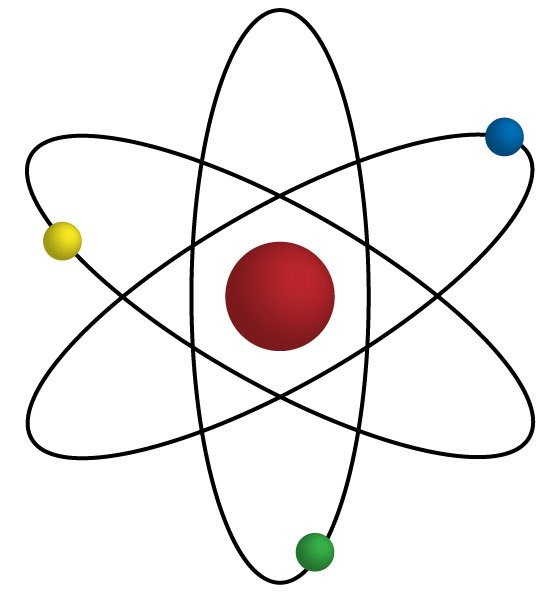
What are the 3 particles that make-up the atom?
a)
protons, neutrons, and isotopes
b)
neutrons, isotopes, and electrons
c)
positives, negatives, and electrons
d)
protons, neutrons, and electrons
9.

From the diagram, which particles are indicated with the arrow?
a)
electrons and protons
b)
protons and neutrons
c)
electrons and neutrons
d)
photons and nucleons
10.

These particles orbit around the nucleus of an atom. What are they called?
a)
electrons
b)
protons
c)
neutrons
d)
photons
11.

Near the outside of an atom, you'd find _____
a)
electrons
b)
protons
c)
neutrons
d)
photons
12.

Old pictures of the atom from science textbooks are wrong because _____
a)
they show the nucleus at the center
b)
they're not drawn to scale
c)
the nucleus is drawn too small
d)
the electrons are on the outside
13.
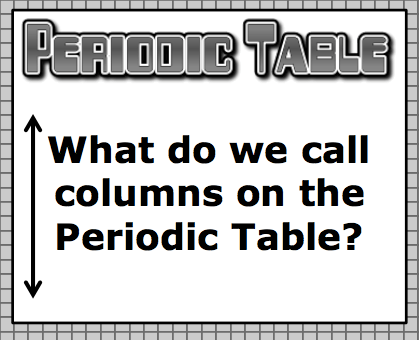
a)
Periods
b)
Groups
14.
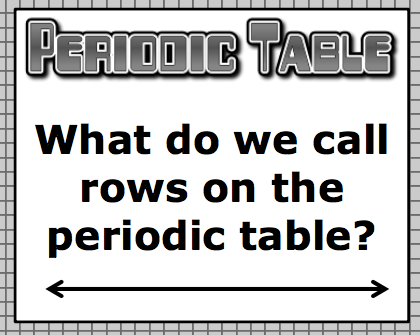
a)
Periods
b)
Groups
15.

a)
energy levels
b)
valence electrons
c)
protons
d)
neutrons
16.
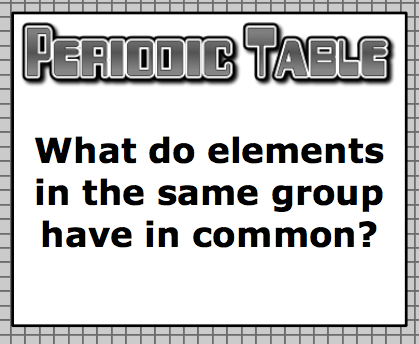
a)
energy levels
b)
valence electrons
c)
protons
d)
neutrons
17.
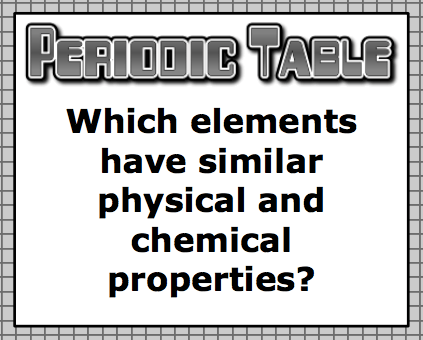
a)
Same group
b)
Same period
18.
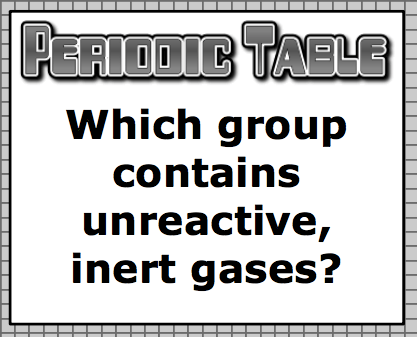
a)
Group 1
b)
Group 17
c)
Group 2
d)
Group 18
19.
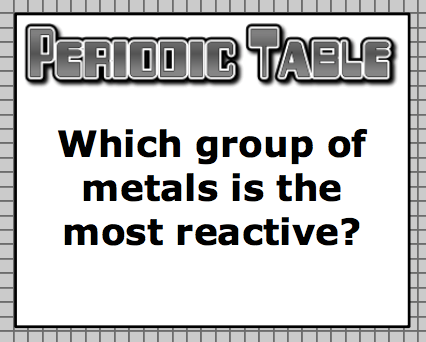
a)
Group 1
b)
Group 17
c)
Group 18
d)
Group 2
20.
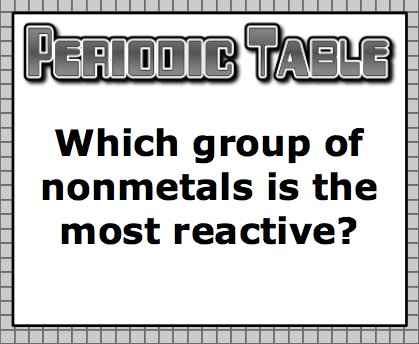
a)
Group 1
b)
Group 17
c)
Group 18
d)
Group 2
21.
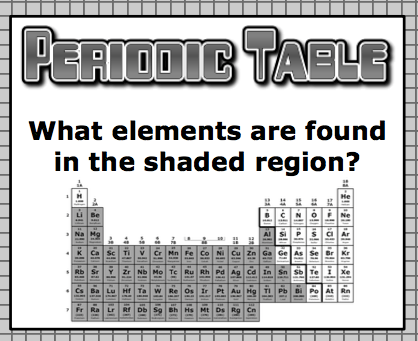
a)
Metals
b)
Nonmetals
c)
Metalloids
22.
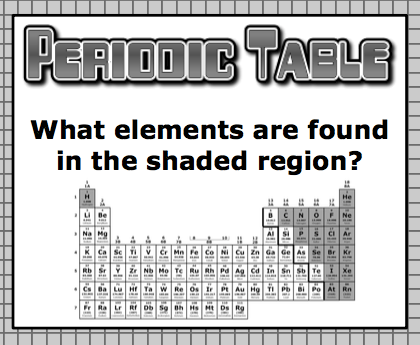
a)
Metals
b)
Nonmetals
c)
Metalloids
23.
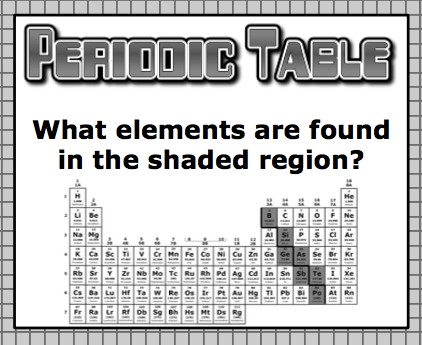
a)
Metals
b)
Nonmetals
c)
Metalloids
24.
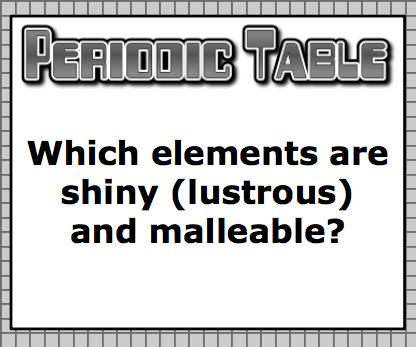
a)
Metals
b)
Nonmetals
c)
Metalloids
25.
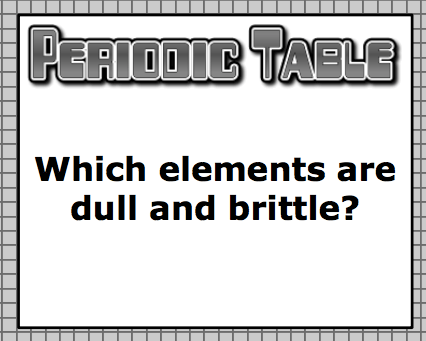
a)
Metals
b)
Nonmetals
c)
Metalloids
26.
Each column in the periodic table is called a
a)
period
b)
group
c)
cluster
d)
unit
27.
The atomic number tells you what?
a)
number of electrons
b)
number of protons
c)
number of neutrons
d)
both electrons and protons in an atom.
28.
Which group of the periodic table is composed of inert (not reactive) gases?
a)
alkali metals
b)
alkaline earth metals
c)
halogens
d)
noble gases
29.
Elements which are shiny, conduct electricity and heat are called
a)
metal
b)
nonmetal
c)
metalloid
d)
nonexistent
30.

The atoms along the staircase are called
a)
metals
b)
nonmetals
c)
metalloids
d)
noble gases
31.

How many neutrons are in a Gold atom?
a)
79
b)
196
c)
118
d)
275
32.

How many electrons does a Copper atom have?
a)
63
b)
29
c)
92
d)
34
33.

What's a valence electron?
a)
electrons in the second energy level
b)
electrons in the outermost energy level
c)
the atomic number
d)
electrons in the first level
34.

What does the 1.00794 stand for?
a)
Hydrogen
b)
atomic number
c)
atomic mass
d)
atomic explosion
35.
The electrons of an atom are found...
a)
in the outer "cloud" surrounding the atom.
b)
in the nucleus of the atom.
c)
in the cloud and in the nucleus.
36.
A ___________ is an arrangement of elements in columns
a)
columns
b)
rows
c)
periodic table
d)
electron shell
37.
The atomic number tells you what?
a)
number of electrons
b)
number of protons
c)
number of neutrons
d)
both electrons and protons in an atom.
38.
Which group of the periodic table is composed of inert (not reactive) gases?
a)
alkali metals
b)
alkaline earth metals
c)
halogens
d)
noble gases
39.
Which element is not a metalloid?
a)
H
b)
Re
c)
Al
d)
B
40.
True or False? Neutrons have a negative charge
a)
True
b)
False
Reset

