

wayground logo

Free Printable Worksheets

Font size

S
M
L
XL
Worksheets

Blood and Blood Spatter Review

Total questions: 54

Worksheet time: 3hrs 39mins
Name
Class
Date
1.
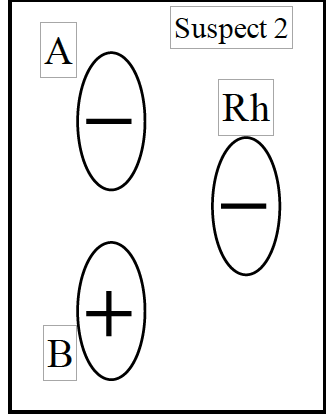
What is suspect 2's Blood Type?
a)
A-
b)
B-
c)
A+
d)
B+
2.
What blood type has anti-A antibodies?
a)
Type A
b)
Type B
c)
Type AB
d)
Type O
3.
What blood type has anti-B antibodies?
a)
Type A
b)
Type B
c)
Type AB
d)
Type O
4.

Who discovered the ABO blood groups ad RH factor?

a)

Oliver

b)

Decastello

c)

Landsteiner

d)

Balthazard

5.
Blood Typing is considered what type of evidence?
a)
Indiviual
b)
Class
c)
Trace
d)
Physical
6.
Small secondary droplets around the main blood spatter drop are called:
a)
Spikes
b)
Splats
c)
Satellites
d)
Gushes
7.
What blood stain pattern is created or formed by the force of gravity acting alone?
a)
Passive Drop
b)
Low Velocity Impact Spatter
c)
Flow Pattern
d)
Drip Pattern
8.
What determines blood type?
a)
Proteins on red blood cells
b)
Proteins on white blood cells
c)
Proteins in the plasma
d)
Proteins on platelets
9.
Blood is made up of __ % blood cells. 
a)
45
b)
55
10.
Plasma makes up about __ % of blood. 
a)
45
b)
55
11.
What does blood transport?
a)
Nutrients
b)
Oxygen 
c)
Carbon Dioxide
d)
All of the above
12.

Mackenzie has blood type B+, she can receive blood from which blood donors?

a)

B+, B-, O+, O-

b)

B+, A-, O+, O-

c)

B+

d)

O-

13.
At what angle does a "tail" start to form on a blood stain?
a)
75 degrees
b)
30 degrees
c)
60 degrees
d)
90 degrees
14.
What type of spatter creates the largest blood droplets?
a)
Low velocity impact
b)
Medium velocity impact
c)
High velocity impact
15.
Which test uses antibodies that react to human blood to tell if mammal blood is from a human?
a)
Kastle-Meyer 
b)
Luminol
c)
ELISA
d)
Fluorescein
16.
Mike has type O blood. Mike can receive blood from someone who has Type A or Type B.
a)
True
b)
False
17.
What is the study of bodily fluids called?
a)
toxicology
b)
serology
c)
physiology
d)
histology
18.

What protein is found in red blood cells that binds to and transports oxygen?

a)

peptidoglycan

b)

iron

c)

hemoglobin

d)

plasma

19.

These are found in blood and help fight infections...

a)

white blood cells

b)

platelets

c)

plasma

d)

red blood cells

20.

These are found in blood and help the blood to clot correctly.

a)

white blood cells

b)

platelets

c)

plasma

d)

red blood cells

21.

This is the colorless liquid in which the components of blood are suspended...

a)

red blood cells

b)

platelets

c)

plasma

d)

white blood cells

22.

Which is the rarest blood type?

a)

O+

b)

O-

c)

B+

d)

AB-

23.

Red blood cells will do this if they encounter the wrong antibodies...

a)

swell

b)

agglutinate

c)

dehydrate

d)

no reaction will occur

24.

Someone with both Type A & B antibodies is which blood type?

a)

A

b)

B

c)

AB

d)

O

25.

Someone with Type A blood has...

a)

A antigens

b)

A antibodies

c)

B antigens

d)

A & B antigens

26.

This determines whether a person's blood type is positive or negative...

a)

Rh factor

b)

platelets

c)

D antibodies

d)

plasma

27.

Another term for the Rh factor...

a)

Rhesus factor

b)

red blood cell

c)

D antibody

d)

D antigen

28.

Which blood type is known as the universal donor? (can be used by all)

a)

AB +

b)

AB -

c)

O+

d)

O-

29.

This test shows results for which blood type?

a)

B+

b)

B-

c)

A+

d)

A-

30.
Proteins on the surface of the red blood cells that account for blood type
a)
antibodies
b)
antigens
c)
agglutination
d)
anti browns offense
31.

Using the diagram to determine the blood type

a)

Type A

b)

Type B

c)

Type AB

d)

Type Z - for Zebra this blood is from a zoo

32.

Is the blood type shown in the image is RH ______

a)

Positive

b)

Negative

c)

Neon

d)

magenta - its a pretty pink color

33.

The process between a blood sample and the antiserum that causes the blood to clumping is called

a)

non-gluten

b)

gluten free

c)

agglutination

d)

antibodies

34.

The blood type shown in the image is ..

a)

type Z % for zebra

b)

type A+

c)

type AB-

d)

type B+

35.

Type O - is known as the universal donor, because it can be given to anyone. This is possible because it has....

a)

only type O surface proteins

b)

no surface proteins at all

c)

type A and type B proteins

d)

not type Z proteins remember that was for Zebra's

36.

Which blood type is the least common?

a)

type A

b)

type B

c)

type AB

d)

type O

37.
Based upon this picture, what test was done to determine whether or not a stain was blood (the picture shows a positive and negative test). 
a)
Kastle-Meyer presumptive blood test
b)
Leukomalachite green presumptive blood test
c)
Luminol presumptive blood test
38.
What blood spatter pattern is seen in the photo?
a)
Wipe
b)
Swipe
c)
Walking Drip
d)
Flow
39.

What happens during an antigen-antibody response?

a)

The patient has a seizure.

b)

Agglutination & possibly death.

c)

Severe blood clotting.

d)

The patient can get a fever, but return to normal within a few hours.

40.

What does an elongated blood drop indicate? (Choose all that apply.)

a)

Movement

b)

Direction

c)

Weapon

d)

Angle

41.

The movement and the number of swings can often be documented by examining what type of blood spatter pattern?

a)

Arterial Sputter

b)

Cast Off pattern

c)

impact spatter

d)

low velocity pattern

42.

At what angle do you think this blood droplet was dropped at?

a)

800

b)

300

c)

600

d)

100

43.

At what angle do you think this blood droplet was dropped at?

a)

800

b)

600

c)

400

d)

300

44.

DNA profiling from blood is considered what type of evidence?

a)

Class

b)

Individual

c)

Suspect

d)

Testimonial

45.

Small secondary droplets around the main drop that are due to blood falling from a height or at a high velocity are called what?

a)

Cast-Off spatter

b)

Wipe patterns

c)

Satellite spatter

d)

Parent drops

46.

What happens to the shape of a blood droplet as the angle of release changes from a 90-degree drop toward a 10-degree drop?

a)

It becomes more wider than long

b)

It becomes more circular

c)

It has more spines

d)

It becomes more longer than wide

47.
How does the velocity of impact change the blood stain pattern?
a)
Higher velocity, larger diameter
b)
higher velocity, smaller diameter
c)
lower velocity, smaller diameter
d)
Medium velocity, small diameter
48.
What blood spatter pattern is seen in the picture?
a)
Transfer/Contact
b)
Swipe
c)
Wipe
d)
Saturation
49.

The drop shown above would have more than likely been dropped from an angle of ________________________degrees.

a)

90

b)

50

c)

30

d)

10

50.
The protrusions around and connected to the drops are called
a)
radial lines
b)
spines or spikes
c)
blood edges
d)
satellite spatters
51.
Which one of these was dropped from the biggest angle?
a)
1 (top left)
b)
4 (top right)
c)
7 (bottom left)
d)
9 (bottom right)
52.
What bloodstain pattern is created when an object moves through an existing stain, removing or altering its appearance?
a)
Swipe
b)
Walking Drip
c)
Wipe
d)
Contact
53.

Bloody clothes should be allowed to dry in paper bags during the collection process

a)

True

b)

False

54.
Which of the following CANNOT be determined from blood spatter?
a)
Exact Weapon Used
b)
Manner of Death
c)
Velocity
d)
Area of Origin
