wayground logo

Free Printable Worksheets

Font size

S
M
L
XL
Worksheets

Nervous System Test Review

Total questions: 58

Worksheet time: 1hrs 12mins

Name
Class
Date
1.
Dendrites receive the impulse and conduct them to the_____.
a)
Cell body
b)
Cerebellum
c)
Cerebrum
d)
Spinal cord
2.
Which letter on the illustration represents the frontal lobe
a)
A
b)
B
c)
C
d)
D
3.
Which letter on the illustration represents the temporal lobe
a)
A
b)
B
c)
C
d)
D
4.

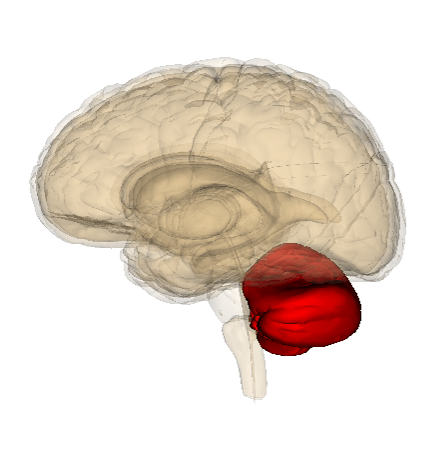
The dark red shaded portion is the ________

a)

Cerebrum

b)

Cerebellum

c)

Brain Stem

d)

Diencephalon

5.
Where is the Central Nervous System? (CNS)
a)
Organs & Limbs
b)
Brain & Spinal Cord
c)
Cerebellum
d)
Sensory Neurons
6.
Which is the correct sequence in the transmission of a neural impulse?
a)
axon, dendrite, cell body, synapse
b)
dendrite, axon, cell body, synapse
c)
synapse, axon, dendrite, cell body
d)
dendrite, cell body, axon, synapse
7.
Which of the following is NOT a part of the brainstem?
a)
Cerebellum
b)
Medulla oblongata
c)
Midbrain
d)
Pons
8.

Glial cell that defends neurons

a)

ependymal

b)

microglial

c)

schwann

d)

oligodendrocyte

9.

Two glial cells that insulate neurons by producing myelin

a)

Schwann cells

b)

Satellite

c)

Oligodendrocyte

d)

Ependymal cell

10.

The junction between the axon tip of the sending neuron and the dendrite or cell body of the receiving neuron.

a)

axon

b)

synapse

c)

dendrite

d)

vesicle

11.
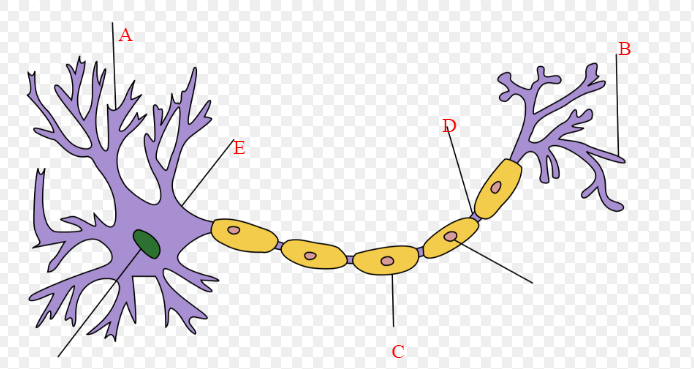
A
a)
Dendrite
b)
Axon
c)
Axon Terminal
d)
Cell Body
12.
B
a)
Dendrite
b)
Axon
c)
Axon Terminal
d)
Cell Body
13.
C
a)
Synapse
b)
Soma
c)
Axon Terminal
d)
Myelin Sheath
14.
D
a)
Synapse
b)
Axon
c)
Axon Terminal
d)
Dendrite
15.
E
a)
Synapse
b)
Cell Body
c)
Axon 
d)
Dendrite
16.

Choose the glial cells that are in the CNS

a)

Schwann cells

b)

astrocytes

c)

ependymal cells

d)

satellite

17.
The brain's supporting cells are called: 
a)
glial cells
b)
mitochondria
c)
neurons
d)
nuclei
18.
Neurons that travel toward the central nervous system are called
a)
afferent neurons
b)
efferent neurons
c)
exit neurons
d)
CNS neurons
19.
An unmyelinated axon, dendrite, and cell body are also known as
a)
white matter
b)
grey matter
c)
glia
d)
astrocytes
20.

Which of the following divisions of the nervous system controls voluntary behaviors?

a)

Sympathetic

b)

Parasympathetic

c)

Autonomic

d)

Somatic

e)

Afferent

21.

The sympathetic and parasympathetic nervous systems together make up which division of the nervous system?

a)

Central

b)

Autonomic

c)

Somatic

d)

Peripheral

e)

Regional

22.

Another name for motor neurons is

a)

efferent neurons.

b)

afferent neurons.

c)

somatic neurons.

d)

sympathetic neurons.

e)

parasympathetic neurons .

23.

What type of neuroglial cell participates in the production and circulation of cerebrospinal fluid?

a)

oligodendrocytes

b)

microglia

c)

ependymal cells

d)

astrocytes

24.

An electrical impulse within a single neuron is called a

a)

synapse

b)

membrane potential

c)

action potential

d)

cell body

25.

This neurotransmitter is linked to feelings of pleasure, euphoria, and reward.

a)

dopamine

b)

serotonin

c)

substance p

d)

glutamate

e)

endorphins

26.
What is a neurotransmitter?
a)
fatty covering of the axon
b)
nerve cell
c)
chemical messenger
d)
gap between neurons
27.

Which of the following symptoms would lead to a diagnosis of Parkinson disease?

a)

Tremor

b)

Rigidity

c)

Postural instability

d)

All of the above

28.

Cranial nerve II is _____.

a)

trochlear

b)

vagus

c)

facial

d)

optic

29.

Cranial nerve IV is _____.

a)

trochlear

b)

accessory

c)

vagus

d)

trigeminal

30.

Cranial nerve V is _____.

a)

facial

b)

vagus

c)

accessory

d)

trigeminal

31.

Cranial nerve X is _____.

a)

facial

b)

vagus

c)

accessory

d)

optic

32.

Cranial nerve VIII is _____.

a)

vestibulocochlear

b)

glossopharyngeal

c)

vagus

d)

facial

33.

Cranial nerve I is ______.

a)

abducens

b)

oculomotor

c)

olfactory

d)

facial

34.

Cranial nerve III is ______.

a)

optic

b)

vestibulocochlear

c)

oculomotor

d)

trigeminal

35.

Cranial nerve XII is _______.

a)

hypoglossal

b)

glossopharyngeal

c)

trigeminal

d)

accessory

36.

Cranial nerve XI is _____.

a)

hypoglossal

b)

facial

c)

accessory

d)

olfactory

37.

Cranial nerve VII is ______.

a)

abducens

b)

optic

c)

hypoglossal

d)

facial

38.

Cranial nerve IX is _____.

a)

olfactory

b)

vestibulocochlear

c)

vagus

d)

glossopharyngeal

39.

Cranial nerve VI is _____.

a)

vagus

b)

abducens

c)

optic

d)

trochlear

40.

Which part of the brain controls your blood pressure and heart rate?

a)

brain stem

b)

occipital lobe

c)

cerebellum

d)

frontal lobe

41.

Which part of the brain controls your balance and coordination?

a)

brain stem

b)

occipital lobe

c)

cerebellum

d)

frontal lobe

42.
A person has a stroke on her occipital lobe.  What might happen to her?
a)
reduced planning abilities
b)
deafness
c)
coma
d)
blindness
43.
Possesses the Motor Cortex
a)
Temporal Lobe
b)
Parietal Lobe
c)
Occipital Lobe
d)
Frontal Lobe
44.
Makes decisions, plans, reasons, and carries out behaviors
a)
Frontal Lobe
b)
Parietal Lobe
c)
Occipital Lobe
d)
Temporal Lobe
45.
Which has to do with speech, taste,  and thought?
a)
frontal lobe
b)
occipital lobe
c)
parietal lobe
d)
temporal lobe
46.
Area of the frontal lobe that is responsible for speech production.
a)
Broca's Area
b)
Wernicke's Area
c)
Amygdala 
d)
Central Gyrus
47.
Area of the temporal lobe involved in language comprehension.
a)
Broca's Area
b)
Wernicke's Area
c)
Central Sulcus
d)
Somatosensory Cortex
48.
Speech that is jumbled and not understandable is a sign of:
a)
Wernicke's Aphasia
b)
a split brain operation
c)
Broca's aphasia
d)
sensory aphasia
49.

This part contributes to controlling your emotions (associated with the limbic system) and has important autonomic functions including; cardiovascular, temperature, appetite and gastrointestinal control.

a)

thalamus

b)

hemisphere

c)

hypothalamus

d)

cerebrum

50.

Involved in emotions such as anxiety and fear.

a)

amygdala

b)

basal ganglia

c)

brainstem

d)

medulla oblongata

51.

Both Parkinson's Disease and Schizophrenia are associated with dysregulation of...

a)

GABA

b)

Dopamine

c)

Serotonin

d)

Endorphins

52.

_______ plays a key role in Reward Pathways and is implicated in addictive disorders

a)

Acetylcholine

b)

Serotonin

c)

Dopamine

d)

GABA

53.
Serotonin is a neurotransmitter that helps regulate:
a)
learning and memory
b)
pain and pleasure
c)
muscle movements
d)
sleep, moods/emotions
54.
What is a neurotransmitter?
a)
fatty covering of the axon
b)
nerve cell
c)
chemical messenger
d)
gap between neurons
55.
Which neurotransmitter is involved in muscle movements?
a)
Acetylcholine
b)
Endorphins
c)
Serotonin
d)
GABA
56.
Which neurotransmitter inhibits brain activity?
a)
Acetylcholine
b)
GABA
c)
Endorphins
d)
Dopamine
57.
Which neurotransmitter is released in response to stress and trauma?
a)
Acetylcholine
b)
Endorphins
c)
Serotonin
d)
GABA
58.

When not enough dopamine is produced in the brain a resulting condition is called

a)

Alzheimer' disease

b)

Parkinson's disease

c)

Stroke

d)

Multiple sclerosis