Wayground logo

Free Printable Worksheets

Font size

S
M
L
XL
Worksheets

Test Review - Comprehensive

Total questions: 105

Worksheet time: 2hrs 38mins

Name
Class
Date
1.

Which of the following elements is most likely to have similar properties to those of sodium (Na)?

a)

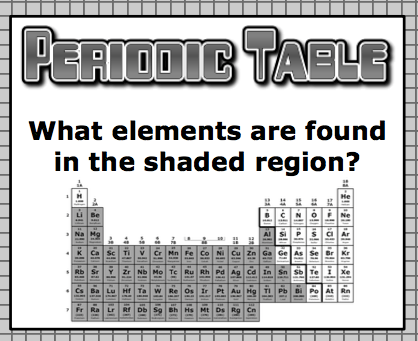
Magnesium (Mg)

b)

Sulfur (S)

c)

Francium (Fr)

d)

Titanium (Ti)

2.

Which element is located in group 3?

a)

Yttrium (Y)

b)

Carbon (C)

c)

Sodium (Na)

d)

Lithium (Li)

3.

Which element is located in period 4?

a)

Zirconium (Zr)

b)

Silicon (Si)

c)

Beryllium (Be)

d)

Iron (Fe)

4.

Which element is located in period 4?

a)

Zirconium (Zr)

b)

Silicon (Si)

c)

Beryllium (Be)

d)

Iron (Fe)

5.

Which element is located in period 4?

a)

Zirconium (Zr)

b)

Silicon (Si)

c)

Beryllium (Be)

d)

Iron (Fe)

6.

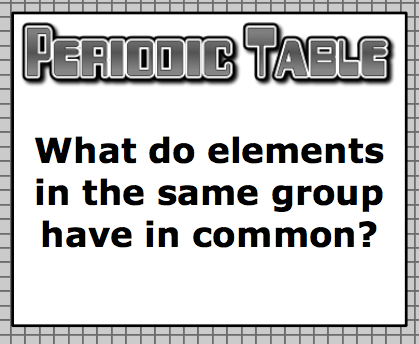
Two elements that have similar physical and chemical properties are most likely in the same...

a)

period

b)

row

c)

group

7.

Which element is most likely to have six valence electrons?

a)

Barium (Ba)

b)

Carbon (C)

c)

Oxygen (O)

d)

Americium (Am)

8.

Which element is located in period 4 and group 5?

a)

Vanadium (V)

b)

Zirconium (Zr)

c)

Niobium (Nb)

d)

Titanium (Ti)

9.

In which group would an element that is very reactive most likely be located?

a)

1

b)

5

c)

15

d)

18

10.

What is the atomic mass of an element with 16 protons, 13 neutrons, and 16 electrons?

a)

13 amu

b)

16 amu

c)

29 amu

d)

45 amu

11.

How many neutrons are located in the nucleus of an atom that has 12 protons, 12 electrons, and an atomic mass of 28 amu?

a)

12

b)

16

c)

28

d)

40

12.
The majority of elements on the periodic table are
a)
man made.
b)
nonmetals.
c)
metals.
d)
gases.
13.
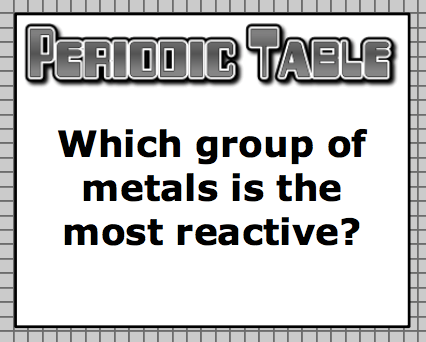
Name group 1A on the periodic table.
a)
alkali metals
b)
alkaline earth metals
c)
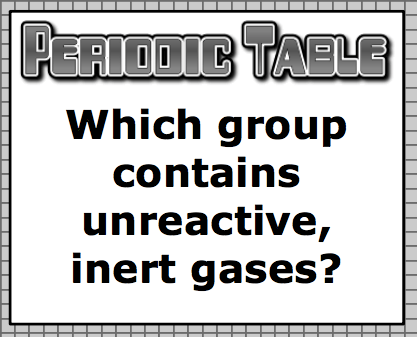
noble gases
noble gases
d)
halogens
14.
Name group 2A on the periodic table.
a)
alkali metals
b)
alkaline earth metals
c)
noble gases
d)
transition metals
15.
Name groups 3B - 12B on the periodic table.
a)
noble gases
b)
halogens
c)
metalloids
d)
transition metals
16.
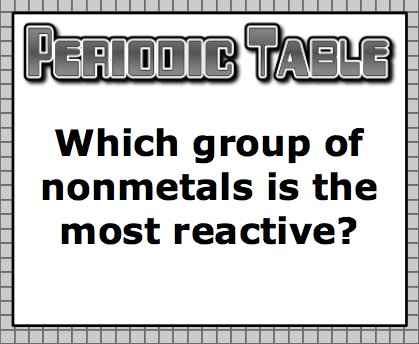
Which group has the most reactive nonmetals?
a)
alkali metals
b)
noble gases
c)
metalloids
d)
halogens
17.
The atoms along the staircase are called 
a)
metals
b)
nonmetals
c)
metalloids
d)
noble gases
18.
Where are the nonmetals located on the periodic table?
a)
top left corner
b)
bottom left corner
c)
top right corner
d)
bottom left corner
19.
a)
energy levels
b)
valence electrons
c)
protons
d)
neutrons
20.
a)
energy levels
b)
valence electrons
c)
protons
d)
neutrons
21.
a)
Group 1
b)
Group 17
c)
Group 2
d)
Group 18
22.
a)
Group 1
b)
Group 17
c)
Group 18
d)
Group 2
23.
a)
Group 1
b)
Group 17
c)
Group 18
d)
Group 2
24.
a)
Metals
b)
Nonmetals
c)
Metalloids
25.
The molar mass of an element is equal to its...
a)
Atomic mass
b)
Atomic number
c)
Oxidation number
d)
Valence electrons
26.
What is the molar mass of sodium?
a)
11
b)
23
c)
45.98
d)
3
27.
What is the molar mass of table salt (NaCl)?
a)
116.886 g/mol
b)
35.453 g/mol
c)
22.990 g/mol
d)
58.443 g/mol
28.
What is the mass of one mole of aluminum chloride (remember to determine the correct formula first)?
a)
62.435g
b)
116.399g
c)
133.341g
d)
97.888g
29.
What is the molar mass of CO2?
a)
12
b)
16
c)
32
d)
44
30.

What is the molar mass of Cl2?

a)

17 g/mol

b)

35.5 g/mo;

c)

71.0 g/mol

d)

89 g/mol

31.

Calculate the molar mass of Ba(C2H3O2)2

a)

255.3 g/mol

b)

237.3 g/mol

c)

228.3 g/mol

d)

196.3 g/mol

32.

Calculate the molar mass of Cu2O.

a)

37 g/mol

b)

45 g/mol

c)

79.5 g/mol

d)

143 g/mol

33.

What is the percent by mass of oxygen in MgO? Hint: The attached image is an example of a worked problem other than this one.

a)

20%

b)

40%

c)

50%

d)

60%

34.
What is the percent composition by mass of sulfur in the compound MgSO4 (gram formula mass = 120 g/mol)?
a)
20%
b)
27%
c)
46%
d)
53%
35.
What is the percent composition by mass of oxygen in the compound MgSO4 (gram formula mass = 120 g/mol)?
a)
20%
b)
27%
c)
46%
d)
53%
36.
Find the percent composition of Cu2S?
a)
%Cu= 67.987 %S= 32.013
b)
%Cu= 79.854   %S= 20.145
c)
%Cu= 35.946   %S= 64.054
37.

Which element has an abundance of 39.03% in the compound sodium phosphate, Na3PO4

a)

Na

b)

P

c)

O

d)

None of the above

38.
What is the percent composition of Benzene, C6H6?
a)
C = 50%
H = 50%
b)
C = 85.7 %
H = 14.3%
c)
C = 92.2%
H = 7.8%
d)
C = 71.9%
H = 28.1%
39.
What is Avogadro's Number? 
a)
6.02 x 10²³
b)
- 6.02 1023
c)
6.02 x 10²²
d)
6,020,000,000,000
40.
How many atoms are in 1 mole of NaCl? 
a)
6.02 x 10²³
b)
58 
c)
11
d)
17
41.
How many atoms of iodine are in a mole of iodine?
a)
53
b)
63.55g
c)
126.9
d)
6.02 x 10²³
42.
We use the periodic table to calculate...
a)
mass
b)
molar mass
c)
moles
43.

Find the mass of 11.37 mol of BaO. Round to the nearest whole number.

a)

1,354 g

b)

1,740 g

c)

17.40 g

d)

1,684 g

44.

Determine the number of moles of AlNO3 that are in 264 g of the compound.

a)

2.97 mol

b)

3.45 mol

c)

2.73 mol

d)

1.86 mol

45.

Find the mass of 3.45 mol of NaBr. Round to the nearest whole number.

a)

35.5 g

b)

465 g

c)

355 g

d)

345 g

46.

Determine the amount of moles in CuBr that are in 276.9 g of the compound.

a)

3.2 mol

b)

1.7 mol

c)

2.1 mol

d)

1.9 mol

47.

Find the mass of 5.82 mol of MgCl2. Round to the nearest tenth.

a)

552.9 g

b)

436.8 g

c)

55.2 g

d)

555.9 g

48.

Find the mass of 3.8 mol of H2O. Round to the nearest tenth.

a)

57.9 g

b)

54.8 g

c)

68.4 g

d)

62.3 g

49.

Determine the number of moles of Mg3P2 that are in 583 g of the compound.

a)

2.9 mol

b)

6.1 mol

c)

4.3 mol

d)

1.7 mol

50.

Find the mass of 3.6 mol of Au.

a)

843.6 g

b)

709.2 g

c)

435.9 g

d)

196.9 g

51.

Determine the number of moles of KNO3 that are in 784 g of the compound.

a)

7.7 mol

b)

6.9 mol

c)

10.6 mol

d)

7.8 mol

52.
What is the mass in grams of 5.90 mol C8H18?
a)
.0512 g
b)
19.4 g
c)
673 g
d)
389 g
53.
How many moles are in 19.82 g Mg? 
a)
1.226mol Mg
b)
481.7mol Mg
c)
1.000mol Mg
d)
 0.8156 mol Mg
54.

How many grams are in 0.523 mol of AlPO4?

a)

63.78 g

b)

38.68 g

c)

47.23 g

d)

55.43 g

55.

How many moles are in 100 g of carbon dioxide, CO2?

a)

2.27 mol

b)

2.36 mol

c)

3.51 mol

d)

1.49 mol

56.
What is an ion?
a)
A Charged Atom
b)
A Large Atom
c)
A Small Atom
d)
A Cute Atom
57.
Barium atoms want to form...
a)
an anion
b)
a cation
c)
an onion
d)
a cuddly kitten friend
58.
Why are ions formed?
a)
To make our lives difficult
b)
Because atoms want 8 valence electrons
c)
Because atoms have the same number of protons and electrons
d)
Because atoms gained neutrons
59.
Cations are...
a)
Positive
b)
Negative
c)
Neutral
d)
Purring
60.
Anions are...
a)
Positive
b)
Negative
c)
Neutral
d)
Crying
61.
An atom becomes _________ when it gains electrons.
a)
Positive
b)
Negative
c)
Neutral
d)
Invinsible
62.
An atom becomes _______ when it loses electrons.
a)
Positive
b)
Negative
c)
Neutral
d)
Invinsible
63.
Which particles change the charge in atoms when ions are formed?
a)
Protons
b)
Electrons
c)
Neutrons
d)
Kittens
64.
Valence electrons are: 
a)
Electrons farthest away from the nucleus
b)
Electrons closest to the nucleus
c)
Electrons that just come and go - they don't stay with the atom
65.
Ions are: 
a)
atoms with a positive or negative charge
b)
atoms with no charge
c)
atoms with ONLY a positive charge
d)
atoms with ONLY a negative charge
66.
Negative ions form when atoms _________ valence electrons.
a)
lose
b)
gain
c)
share
67.
The positive particles of an atom are 
a)
electrons 
b)
positrons 
c)
neutrons 
d)
protons 
68.
the central region of an atom where its neutrons and protons are is its 
a)
nucleus 
b)
electron cloud
c)
core 
d)
center 
69.
an atom with atomic number 6 would have how many protons 
a)
6
b)
12
c)
3
d)
cannot be determined 
70.
Particles in an atom that are neutral and have no charge are 
a)
negatrons 
b)
electrons 
c)
neutrons 
d)
protons 
71.
An atoms overall charge is 
a)
positive 
b)
depends on its mood 
c)
neutral 
d)
negative 
72.
Which statement best describes an electron?
a)
Smaller mass than a proton and a negative charge
b)
Smaller mass than a proton and a positive charge
c)
Greater mass than a proton and a negative charge
d)
Greater mass than a proton and a positive charge
73.
Atoms have no electric charge because they...
a)
have an equal number of charged and non charged particles
b)
have neutrons in their nuclei
c)
have an equal number of electrons and protons
d)
have an equal number of neutrons and protons
74.
Most of the mass in an atom is concentrated in the...
a)
electrons
b)
nucleus
c)
protons
d)
empty space
75.
What does the nucleus consist of?
a)
Protons + Electrons
b)
Neutrons + Electrons
c)
Atoms
d)
Protons + Neutrons
76.
What charge does an Electron have?
a)
Negative
b)
Positive
c)
Neutral
d)
Complicated
77.
Which property of matter is determined by dividing its mass by its volume?
a)
elasticity
b)
buoyancy
c)
density
d)
viscosity
78.
Which property of matter is determined by dividing its mass by its volume?
a)
elasticity
b)
buoyancy
c)
density
d)
viscosity
79.
A piece of copper has a mass of 89g and a volume of 10 cm3.  What would be the density of the copper?
a)
0.89 g/cm3
b)
89 g/cm3
c)
8.9 g/cm3
d)
890 g/cm3
80.
What is the measuring unit for mass?
a)
centimeter 
b)
millimeter 
c)
grams 
d)
pounds
81.
Which units of measurement are used for volume?
a)
grams
b)
centimeters
c)
grams/milliliter
d)
milliliter
82.
A student has a rectangular block. It is 2.13 cm wide, 3.05 cm tall, and 25.00 cm long. It has a mass of 600.95 g. What is the volume of the block?
a)
30.18 cm3
b)
162 cm3
c)
0.27 cm3
d)
3.7 cm3
83.
A mechanical pencil has the density of 3.000 g/cm3.  The volume of the pencil is 15.8 cubic centimeters.  What is the mass of the pencil?
a)
47.4 g
b)
50 g
c)
0.190  g
d)
5.27 g
84.
A screwdriver has the density of 5.5 grams per cubic centimeter.  It also has the mass of 2.3 grams.  What is the screwdriver’s volume?
a)
2.4 mL
b)
0.42 mL
85.
What is the mass of a 350 cm3 sample of pure silicon with a density of 2.336 g/cm3?
a)
820 g
b)
0.0067 g
c)
150 g
86.

___________________ discovered the proton.

a)

Chadwick

b)

Dalton

c)

Rutherford

87.

_________________ discovered the electron.

a)

Thompson

b)

Dalton

c)

Walter White

88.

________________ discovered the neutron.

a)

Walter White

b)

John Smith

c)

Chadwick.

89.

This subatomic particle identifies the element.

a)

Proton

b)

Neutron

c)

Megatron

90.

The gold foil experiment determined that___________

a)

the nucleus is large

b)

that electrons are negative

c)

the nucleus is small, dense, and positively charged.

91.

A cathode ray tube was used to discover this subatomic particle.

a)

Proton

b)

Mega

c)

Electron

92.

In a stable element the number of _____________ equals the number of ______________.

a)

protons, electrons

b)

neutrons, electrons

c)

protons, neutrons

93.

The mass number is the number of ___________ plus ___________.

a)

protons, neutrons

b)

protons, protons

c)

electrons, protons

94.

An isotope has different number of__________________.

a)

neutrons

b)

protons

c)

electrons

95.

_________________ invented the periodic table.

a)

Bohr

b)

Dalton

c)

White

d)

Mendelev

96.

The modern periodic table is arranged by this subatomic particle.

a)

proton

b)

neutron

c)

electron

97.

Another name for a group is a ________________.

a)

Period

b)

Quantum

c)

Family

98.
Electronegativity is...
a)
how good an atom is at attracting electrons
b)
the ability of an atom to lose electrons
c)
the energy required to remove an electron from a specific atom
d)
how easy it is to make friends. 
99.
A covalent bond is a bond between a _____ and a ______
a)
metal, nonmetal
b)
metal, metal
c)
nonmetal, nonmetal
100.
When metals bond with non-metals they form what type of bonds
a)
covalent
b)
ionic
c)
cooperative
d)
lewis
101.
How are covalent bonds formed?
a)
Sharing of electrons
b)
Transfer of electrons
102.
How are ionic bonds formed?
a)
Transfer of electrons
b)
Sharing of electrons
103.
This is a picture of a
a)
Flask
b)
Triple Beam Balance
c)
Beaker
d)
Meter Stick
104.
This is a picture of a
a)
Beaker
b)
Graduated Cylinder
c)
Test tube
d)
Flask
105.

This is a picture of a

a)

Beaker

b)

Graduated Cylinder

c)

Test tube

d)

Flask