
 Worksheets
Chemistry Unit 6 Review Game
Total questions: 37
Worksheet time: 44mins
Choose all of the physical reactions.
2 H2(g) + O2(g) → 2 H2O(l)
H2O(s) → H2O(l)
I2(s) → I2(g)
KNO3(s) → KNO3(aq)
C6H12O6(s) → C6H12O6(aq)
Choose all of the chemical reactions.
2 H2(g) + O2(g) → 2 H2O(l)
H2O(s) → H2O(l)
I2(s) → I2(g)
KNO3(s) → KNO3(aq)
C6H12O6(s) → C6H12O6(aq)
Example: H2
In a reaction A + B ----> C, reactant A has 5g and product C has 9g. How many grams does reactant B have?
4g
5g
9g
14g
PCl5 + ___ H2O → ___ HCl + H3PO4
4, 5
1, 6
3, 8
2,2

Which equation is balanced?
PbO2 + 2H2
SO2 + H20 --> H2SO4
2Na + 2H2O --> 2NaOH + H2
Synthesis (Combination)
Decomposition
Single diplacement
Double displacement
What reaction has the following general formula: CxHy + O2 −>CO2 + H2O
Combination
Decomposition
Single Exchange
Double Exchange
Combustion
Combination
Combustion
Single Exchange
Double Exchange
What is the molar mass of sodium? (round to 0.1s)
23.0
12.0 g/mol
16.0 g/mol
32.0 g/mol
44.0 g/mol
What is the molar mass of B2(CO3)3? Round to 0.1s
81.6 g/mol
94.8 g/mol
38.8 g/mol
201.6 g/mol
6.023 x 10²²
6022 million
6022 moles
6.022 x 10²³
0.0512 g
What is the mass of 5.0x10²² molecules of CH3OH?
0.08 mol
32.0 g/mol
2.6 g
12.3 g
What is the Molar Mass of K2S? (round to 0.1s place)
110.3 g/mol
110 g/mol
110.0 g/mol
111.0 g/mol
N2 + 3H2 → 2NH3
What is the mole ratio between Nitrogen and Ammonia in the above reaction?
1 mol NH3 / 2 mol N2
2 mol NH3 / 1 mol N2
2 mol N2 / 3 mol NH3
1 mol N2 / 3 mol NH3
Balance this equation.
_SnO2 +_H2-->_Sn +_H2O
2 C2H6 + 7 O2 → 4 CO2 + 6 H2O
Ethane (C2H6) combusts in the above reaction. What is the mole ratio of ethane to oxygen gas?


N2 + 3H2 --> 2NH3
How many moles of NH3 is produced from 6 moles of N2?
12 moles
3 moles
2 moles
1.5 moles
What is the total number of moles of HCl produced when 3 moles of H2 is completely consumed?
12.00 moles of NaClO3 will produce how many grams of O2?
What mass of O2 will be needed to burn 36.1 g of B2H6?
(Honors) When 12 moles of O2 reacts with 1.1 mole of C10H8 what is the limiting reactant? C10H8 + 12 O2 --> 10 CO2 + 4 H2O
Oxygen
C10H8
Water
Carbon Dioxide
(Honors) 200g of P2O5 reacts with 40.0 g of H2O.
What is the limiting reactant and how many grams of H3PO4 is theoretically collected?
3H2O + P2O5 -> 2H3PO4
P2O5, 240 g
H2O, 40 g
H2O, 120 g
H2O, 145 g
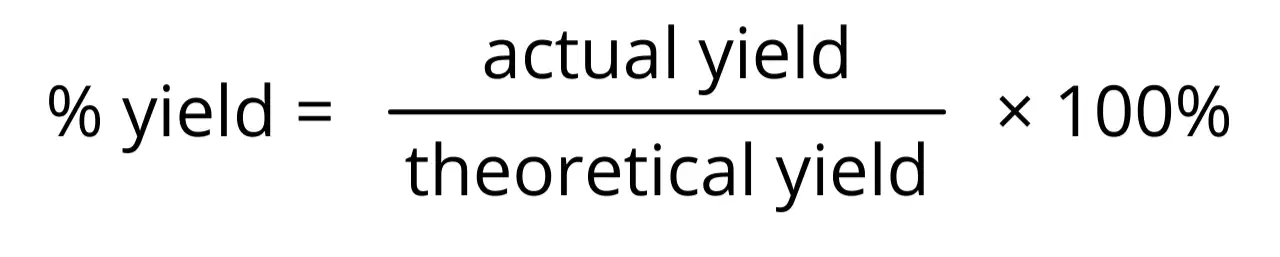
If stoichiometry calculation says that 11.2 grams of product should be collected, but a laboratory experiment produces on 8.5 g of product
%y = 76%
%y = 60%
%y = 132%
%y = 57%

This calculation...
Converts moles of sodium hydroxide to grams of calcium hydroxide
Converts grams of sodium hydroxide to moles of calcium hydroxide
Converts moles of sodium hydroxide to moles of calcium hydroxide
Converts grams of calcium hydroxide to grams of sodium hydroxdie
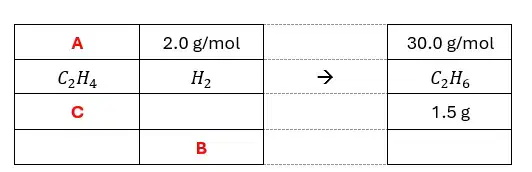
When this table is filled out, the following choices are INCORRECT. Select all that apply.
A = 28
B = 0.10
A = 30
C = 1.4
C = 1.5

