
 Worksheets
Covalent Bonding Test Review
Total questions: 108
Worksheet time: 2hrs 43mins
How are atoms held together in covalent bonds?
By gaining and losing electrons
By sharing electrons
Which of the following has the highest melting point?
O2
F2
Na2O
CCl4
In forming covalent bonds, why do atoms share electrons?
To achieve noble-gas notation
To become charged
To form ions
If the bond between two atoms has the electronegativity difference of 0.4, what type of bond do the atoms have?
Ionic
Polar Covalent
Non-polar covalent
What types of elements combine to form ionic bonds?
Metals and metalloids
Metals and non metals
Non metals only
Metalloids only
Metals only
When diatomic fluorine creates a molecule, what type of bond is used? (Hint, you may have to draw the Lewis structure)
Single bond
Double bond
Triple bond
What are atoms used to complete an octet but not used in bonding called?
Shared pair
Lone pair
Bonded pair
unshared pair
Which of the following is NOT one of the seven diatomic molecules?
Hydrogen
Carbon
Bromine
Iodine
Oxygen
A compound has a boiling point of 8915°C , dissolves in water, and makes an electrolyte. Which of the following compounds is most likely being described?
Ionic Compound
nonpolar covalent Compound
polar covalend compound
What type of bond will N - H form?
Polar Covalent
Non-polar Covalent
Ionic
If the bond between two atoms has an electronegativity difference of 0.6, what type of bond do the atoms have?
Ionic
Polar Covalent
Non-polar Covalent
Which group has no electronegativity value?
Halogen
Transition Metals
Noble Gases
Alkaline Earth Metals
In a polar covalent bond, electrons are shared ____________ between two atoms.
equally
unequally
Which of the following has the greatest electronegativity?
O
S
Br
Si
How many electrons are shared between two atoms in a double covalent bond?
1
2
4
6

The compound CBr4 has a tetrahedral shape, what is the molecular polarity?
Polar
Nonpolar
If a bond between two atoms has an electronegativity difference of 1.9, we can assume that bond is ________________
Ionic
Polar Covalent
Non Polar Covalent

What is the molecular geometry (shape) of NH3?
Bent
Trigonal Planar
Trigonal Pyramidal
Tetrahedral
Linear

What is the correct molecular geometry AND molecular polarity of HCN?
Tetrahedral, nonpolar
Tetrahedral, polar
Bent, polar
Linear, polar
Linear, nonpolar
Which of the following bonds is the most polar?
O-F
N-F
H-F
S-F
When drawing the structure of diatomic oxygen (O2), what type of bond is used?
single
double
triple
quadruple


Which of the following elements will NOT be surrounded by an octet of electrons in a correctly drawn Lewis structure?
carbon
oxygen
chlorine
hydrogen
Which of the following has an ionic bond?
H3N
CaCl2
NO2
SCl

Pictures correspond with a-d.
Choose the structure that forms a double bond (draw the Lewis structure).
Carbon monoxide (CO)
Carbon dioxide (CO2)
Water (H2O)
Cyanic Acid (HCN)
Choose the structure that forms a triple bond (remember these exist in diatomic form in nature). (draw the Lewis structures)
Hydrogen
Fluorine
Oxygen
Nitrogen

When drawing a Lewis structure, after drawing in your bonds and lone pairs, what do you do if you don't have enough electrons to get each atom to its octet? (this is for the counting method I showed later)
Place dots until everything has eight
Place dots only around the terminal atoms
Add a multiple bond
Have eight only around the central atom
How many covalent bonds does carbon need to form in order to have a full octet?
2
3
4
5

Is this molecule polar or non-polar?
Polar
Non-polar

Is this molecule polar or non-polar?
Polar
Non-polar

Is this molecule polar or non-polar?
Non-polar
Polar


Will this molecule be polar or nonpolar? H2S
polar
nonpolar

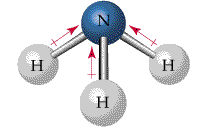
What is the molecular geometry for this molecule?
Bent
Trigonal pyramidal
Trigonal planar
Linear

The electrons in a polar covalent molecule are shared...
Evenly
Unevenly
Electrons are not shared
None of the Above
The electrons in a nonpolar covalent molecule are shared...
Evenly
Unevenly
Electrons are not shared
None of the Above
The electrons in an ionic molecule are shared...
Evenly
Unevenly
Electrons are not shared
None of the Above
In a nonpolar covalent bond, the electrons spread around...
The atom with the Greatest Electronegativity
The atom with the Lowest Electronegativity
Each atom Equally
None of the Above
The polarity of a bond is determined by...
The sum of the electronegativities of the two atoms
The difference in the electronegativities of the two atoms
The charges of the atoms
None of the Above
Molecules that contain whole number charges on atoms (+1,-3, etc.) must be...
Polar Covalent
Nonpolar Covalent
Ionic
Polar Covalent or Ionic
In a polar covalent bond, which atom will have a partial positive charge? (choose 2 correct answers)
The atom that attracts electrons less
The atom with the greater electronegitivity
The atom that attracts more electrons
The atom with the lower electronegativity
What must be the approximate difference in electronegativity between two atoms be in order for the bond between them to be polar covalent?
less or equal to 0.4
greater than 1.8
greater than 0.4 and less than 2.0
exactly 0
Order the types of bonds based on the charge of their molecules. (lowest amount of charge to greatest)
Polar Covalent --> Ionic --> Nonpolar Covalent
Ionic --> Nonpolar Covalent --> Polar Covalent
Ionic --> Polar Covalent --> Nonpolar Covalent
Nonpolar Covalent --> Polar Covalent --> Ionic
A bond with a partially negative end and a partially positive end is:
ionic
polar
non-polar
called a dipole
A diatomic molecule like O2 is always_______ because electrons are shared ________.
nonpolar; equally
polar; equally
nonpolar; unequally
nonpolar; unequally
The electronegativity difference in the bonds of CH4 (methane) is:
0.4
5.9
-0.4
1.7
The electronegativity difference in the bonds of CCl4 (carbon tetrachloride) is:
0.4
0.5
9.5
5.5
According to VSEPR, molecules adjust their shapes to keep which of the following as far away as possible?
groups of valence electrons
Inner shell electrons
Mobile Electrons
Electrons closest to the nucleus

Use your knowledge and electronegativity sheet to predict what the following compound is classified as.
nonpolar covalent
polar covalent
ionic
metallic
Use your knowledge and electronegativity sheet to predict what the following compound is classified as.
polar covalent
nonpolar covalent
ionic
metallic
Use your knowledge and electronegativity sheet to predict what type of bond would form between calcium and bromine.
non-polar covalent
polar covalent
ionic
metallic
Use your knowledge and electronegativity sheet to predict what type of bond would form between phosphorus and fluorine.
non-polar covalent
polar covalent
ionic
metallic
What causes a partial charge on a molecule?
unequal sharing of electrons
an electronegativity difference between 0.4 and 1.8.
the shape of the molecule
all of the above
Which of the following types of compounds will likely dissolve in water, since it is polar?
ionic compounds
polar molecules
nonpolar molecules
metallic compounds


The following are requirement for hydrogen bonding EXCEPT
H atom bonded to electronegative N, O and F
Electronegative element like N, O and F must be present
H atom bonded with lone pair electrons from any Gp 7 element
Attraction between H atom with lone pair electron from N,O,F

Arrange the boiling point of molecules from lowest to highest.
lowest H2 - N2 - H2O - CI2 highest
lowest H2 - H2O - N2 - CI2 highest
lowest H2 - N2 - CI2 - H2O highest
lowest H2O - N2 - H2 - CI2 highest

Arrange the boiling point for molecules (RMM given) from lowest to highest.
lowest A - B - C- D highest
lowest A - C - B - D highest
lowest D - A - B - C highest
lowest D - A - C - B highest

Which substance would have the weakest intermolecular forces of attraction?
CH4
NaCl
H2O
MgF2
________________________ have the strongest intermolecular forces of attraction.
Dipole- Dipole
LDF
Hydrogen Bonds

Intermolecular forces for: CO2
LDF
Dipole dipole
Hydrogen bonding
Which of the following molecules would have the lowest boiling point?
CH4
C2H6
C3H8
C4H10
HCl and F2 both have a molecular mass of approximately 36 g/mol. Based on IMF, which will have a lower boiling point?
HCl
F2
Which of these has the strongest London forces?
F2
Br2
Cl2
I2

Polar covalent bond
Nonpolar covalent bond
Hydrogen bond
London dispersion forces

C4H10, because it has more H atoms, resulting in more H-bonding
C4H10, because it has more electrons, resulting in greater polarizability and stronger LDFs
C2H6, because its molecules are smaller and they can get closer to each other, resulting in stronger LDFs
C2H6, because its molecules are more polar, resulting in stronger dipole-dipole attractions
Which of the following will take the longest to evaporate?
CH3CH2OH
CH3OH
CH3CH3
Which molecule will exhibit resonance?
SO2
CO2
NH3
CCl4
When both shared electrons originate from only one atom, it is called a/an
ionic bond
London covalent bond
coordinate covalent bond
resonance bond
A polar covalent bond is an example of an ____________ force while a hydrogen bond is an example of ________________ force.
intermolecular/intramolecular
intermolecular/intermolecular
intramolecular/ionic
intramolecular/intermolecular
The intermolecular force that holds DNA strands together and helps determine the folded structure of proteins is
dipole-dipole forces
London dispersion forces
H-bonds
ionic forces
We tend to draw the extreme resonance solutions for Lewis structures but in reality a _______________________ exists in which the double bond electrons are delocalized over the entire molecule.
resonance isomer
resonance hybrid
ionic hybrid
dipole isomer
All molecules and atoms will have London Forces occur between them.
True
False
Molecules have to have permanent polarity in order to experience dipole-dipole forces between them.
True
False
When you boil a molecular substance, you are interrupting
only intramolecular forces
only intermolecular forces
both intermolecular and intramolecular forces
neither intermolecular nor intramolecular forces

