
 Worksheets
WWI Study Guide
Total questions: 78
Worksheet time: 56mins
Which of the following means military draft?
conscription
complex
mobilization
unrestricted
One legacy of World War I was the
breakup of the Ottoman Empire.
rejection of strong central governments.
expansion of the Austro-Hungarian Empire.
elimination of ethnic minorities in eastern Europe.
Germany was especially opposed to Article 231 of the Treaty of Versailles because it
forced Germany to reduce the size of its army and navy.
returned the territories of Alsace and Lorraine to France.
awarded sections of eastern Germany to the new Polish state.
held Germany (and Austria) responsible for the war and required reparations.
Negotiations at the Paris Peace Conference were complicated by
Russia's refusal to attend the talks.
territorial disputes among the Big Three.
Woodrow Wilson's Fourteen Points.
Germany's refusal to pay for the war.
Initially, the war effort on the Western Front was characterized by
slow but steady advancement of the German army on the ground.
trench warfare that kept both sides in the same positions for four years.
decisive victories by the French army and swift retreat of German forces.
innovative strategies that used new technologies available to both armies.
As the war progressed, both the Allied Powers and the Central Powers sought new allies in order to
get more money and supplies.
expand their colonial empires.
open new avenues for commerce.
pave the way for peace negotiations.
Which nations were the first to get involved in the initial conflict between Serbia and Austria-Hungary?
Germany and Russia
France and Belgium
United States and Britain
Italy and Bulgaria
Serbia angered Austria-Hungary when it
developed imperialist ambitions.
tried to form an independent state.
mobilized troops along Austria's border.
promised to support Germany's interests.
Why were tensions heightened among countries in Europe after 1900?
Socialists had seized power.
Some nations refused to trade with each other.
Nations began mobilizing for war.
People were joining the Black Hand.
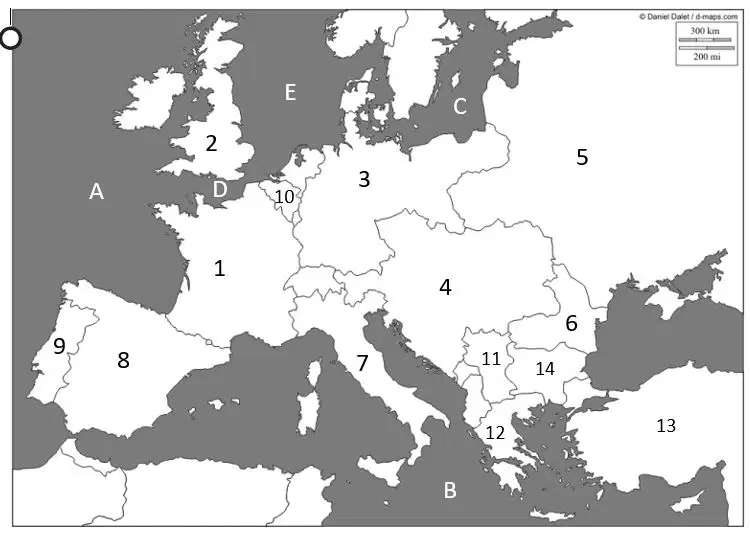
Using the map, Italy is indicated by which number?
9
7
6
8
4
Who systematically murdered the Armenians during WWI?
Ottoman Empire
German Empire
French Empire
Austro-Hungarian Empire
British Empire
Who were systematically murdered by the Ottoman Empire during WWI?
Armenian
Jews
Serbians
Turks
Slavic
Which country was not a part of the "Big Three"?
Italy
France
Britain
US
Who of the following was not considered one of the "Big Three"?
Alfred Von Schlieffen
David Lloyd George
Georges Clemenceau
Woodrow Wilson
What is the correct sequence for WWI?
Assassination
War
Armistice
Conference
Treaty
Treaty
War
Conference
Armistice
Assassination
Assassination Conference
War
Armistice
Treaty
War
Assassination
Conference
Armistice
Treaty
Which country spent the most money on WWI?
Germany
France
United States
Russia
British Empire
The sinking of ____ was a catalyst that brought the US into WWI.
the Lusitania
the Emden
the British Fleet
the Dreadnought
WWI is characterized by trenches. What were the areas between enemy trenches called?
Trench zone
Allied Occupation Zone
Land of No Soul
No Man's Land
No Zone of Soul of Man

One of the worst things about fighting in the trenches were the rats, the boredom, and ___ from standing in water.
trenchfoot
altitude sickness
propaganda
food
Which of the following means relating to the armed forces or to soldiers, arms, or war?
military
complex
mobilization
unrestricted
What is the acronym to remember the causes of WWI?
MAIN
BRAT
GARGLE
AIMS
Which of the following means having many intricate parts
military
complex
mobilization
unrestricted
Which of the following means the process of assembling troops and supplies and making them ready for war?
military
complex
mobilization
unrestricted
Which of the following means ideas spread to influence public opinion for or against a cause?
propaganda
trench warfare
war of attrition
planned economies
What was the name of the terrorist organization in Serbia?
Serbian Mafia
Black Hand
Schlieffen Players
Nazi Party
Severed Principles
Which of the following means fighting from ditches protected by barbed wire, as in WWI
propaganda
trench warfare
war of attrition
planned economies
Which of the following means a war based on wearing down the other side with constant attacks and heavy losses, such as WWI
propaganda
trench warfare
war of attrition
planned economies
Which of the following means a war that involved the complete mobilization of resources and people, affecting the lives of all citizens in the warring countries, even those remote from the battle field?
propaganda
trench warfare
total war
planned economies
Which of the following means an economic system directed by government agencies?
propaganda
trench warfare
total war
planned economies
Which of the following means a overthrow of government?
soviets
revolution
abdicate
war communism
Which of the following means to formally give up control of a country or state?
soviets
aid
abdicate
war communism
Which of the following means in WWI Russia, government control of banks and most industries, the seizing of grain from peasants, and centralization of state administration under Communist control?
soviets
aid
abdicate
war communism
Which of the following means mental; directed toward the will or mind?
psychological
cooperation
armistice
mandate
Which of the following means a truce or an end to fighting?
psychological
cooperation
armistice
mandate
Which of the following means a payment made to the victor by the vanquished to cover the costs of war?
psychological
reparation
armistice
mandate
Which of the following means a territory temporarily governed by another country on behalf of the League of Nations?
psychological
reparation
armistice
mandate
A nationalist group from which country killed Archduke Franz Ferdinand?
Serbia
Austria-Hungary
Germany
France
Which one of the following was one the four MAIN reasons for WW1?
Amplification
Alliances
Assimilation
Acculturation
What countries were not part of the Triple Entente?
UK
Russia
France
Germany
Whose death sparked World War I?
Kaiser Wilhelm
Archbishop Ussher
Archduke Franz Ferdinand
Gavrilo Princip
Armenian Muslims
In What years did WW1 occur?
1914 - 1918
1815 - 1818
1913- 1917
1941-1945
How would imperialism become a cause of World War One?
The pride for one's nation lead towards countries competing with one another to prove they are superior.
The development of ever growing militaries.
Raising awareness through imagery served as a primary cause of the war.
The quest for colonies sometimes pushed European nations to the brink of wars.
Which of the following empires-nations were not involved with the Balkans?
United States of America
Russia
Austria-Hungary
Ottoman Empire
Serbia
The three key motivations for European explorers were God, gold, and ______.
Grace
Glory
Greed
Glaciers
A period within a war where neither side gains any advantage is referred to as
trench warfare
total war
stalemate
standstill

Which of the following means the making amends for a wrong one has done, by paying money to or otherwise helping those who have been wronged?
Armistice
Alliance
Reparations
Propaganda

Which of the following is a policy of extending a country's power and influence through diplomacy or military force?
Nationalism
Imperialism
Militarism
Socialism

What did the Germans called their submarines?
U-Boats
Convoy System
Red Scare
Reparations

This forced Germany to accept full blame for WWI.
Fourteen Points
Treaty of Versailles
Armistice
Red Scare
Trench Warfare update
Lusitania Note
Zimmerman's Telegram
Berchtold Ultimatum
Pick the vocabulary word: A yellow gas that would burn your insides until you die.
Trenches
Mustard Gas
No Man's Land
Lusitania
Trigger
Gavrilo Princip
Vladimir Lenin
Woodrow Wilson
Ja Morant
Alfred von Schlieffen
What was one effect of the sinking of the Lusitania?
The American public started to support attacking Spain.
The American public started to support fighting Great Britain.
The American public started to support entering World War I.
The American public wanted to be even more neutral in World War I.
What effect did the sinking of the Lusitania have on World War I?
England surrendered to the Axis Powers.
America decided to support Germany.
World War I began in Europe.
The United States joined the war.
Who was the president of the United States that led the nation to join World War I?
Theodore Roosevelt
Woodrow Wilson
Abraham Lincoln
William McKinley
Which of the following was an international conflict that primarily involved European nations until the US entered the war in 1917?
World War I
World War II
Spanish-American War
World War III
Which lands would Mexico gain back if Germany won the war? (a)
The Zimmermann Note was intended to be sent to what nation?
(a)
Who convinced the Arabs to revolt against the Ottoman Empire in return for lands?
John J. Pershing
Ataturk
Baron Manfred Von Richthofen
TE Lawrence
Which of the following battles occurred on August 26- 30, 1914 and was Germany’s biggest win against Russia along Eastern Front?
Germans intercept radio messages, allowing them to cause 30,000 casualties and take 90,000 prisoners.
Tannenberg
First Battle of the Marne
Gallipoli
Verdun
Which of the following battles occurred on September 6-12, 1914 , where the French and British forces stop German advance into France
and Germans forced to retreat to Lower Aisne River
Allied victory?
Tannenberg
First Battle of the Marne
Gallipoli
Verdun
Which of the following battles occurred February 19, 1915 to January 9, 1916 , where Allies attempted to seize Constantinople and control the Suez Canal? Also brought in New Zealand and Australia.
Intended to be a swift victory, resulted in Allied forces withdrawing and 180,000+ casualties
Tannenberg
First Battle of the Marne
Gallipoli
Verdun
Which of the following battles occurred February 21 to December 18, 1916, and was WWI’s longest single battle?
Germans attempt to go on the offensive and advance into France, but end up retreating and caused
600,000 casualties.
Tannenberg
First Battle of the Marne
Gallipoli
Verdun
Which of the following was the biggest naval fight of WWI?
Somme
North Mine Sea Barrage
Jutland
Indian Ocean
How did the Industrial Revolution change warfare in WWI?
Created the ability to mass produce weapons
Allowed for increased communication with telegraph and telephones
Increased agricultural output
led to the development of rapid fire guns, tanks, battleships, and airplanes
All of these are correct.
Which country had the greatest number of casualities?
Russia
Germany
France
Austria-Hungary
Great Britain
Which country proposed a "League of Nations"?
Italy
France
Britain
US
Who of the following created the 14 points?
Alfred Von Schlieffen
David Lloyd George
Georges Clemenceau
Woodrow Wilson
What was the purpose of the League of Nations?
A group of countries with the goal of settling disputes through negotiation, rather than war.
Cutting off supplies to Europe for food, oil, metal, and other imports.
A new weapon designed to kill or harm all nations fighting in WWI.
A group of elite fighting soldiers created by the Allies for special assignments.
Using the map, Great Britain is indicated by which number?
1
2
3
8
4
Using the map, Germany is indicated by which number?
1
2
3
8
4
Using the map, Austro-Hungarian Empire is indicated by which number?
1
2
3
8
4
Using the map, Serbia is indicated by which number?
11
12
13
8
6
Using the map, the Ottoman Empire is indicated by which number?
11
12
13
8
6
Using the map, Russia is indicated by which number?
5
2
3
8
4
What is the acronym to remember the 6 parts of The Treaty of Versailles?
MAIN
BRAT
GARGLE
AIMS
Which article of the Treaty of Versailles was referred to as the War Guilt Clause?
Article 231
Article 22
Article 87
Article 178
How many countries were in attendance for the Treaty of Versailles?
32
41
231
6

