Wayground logo

Free Printable Worksheets

Font size

S
M
L
XL
Worksheets

Plate Tectonics

Total questions: 45

Worksheet time: 35mins

Name
Class
Date
1.
What are the puzzle pieces of the Earth's surface called?
a)
Tectonic plates
b)
Puzzles
c)
Earthquakes
2.
What is the outermost layer of the Earth called?
a)
Core
b)
Mantle
c)
Crust
3.
Lava that is still deep inside the earth is called ____________________________.
a)
lava
b)
magma
c)
volcano
d)
earthquake
4.

This famous fault in California has a lot of earthquakes!

a)

New Madrid

b)

Denali Fault

c)

Ramapo Seismic Zone

d)

San Andreas Fault

5.

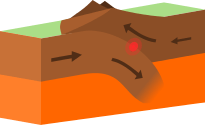
What type of boundary is shown in the diagram?

a)

Divergent

b)

Convergent

c)

Transform

6.

What type of boundary is shown in the diagram?

a)

Divergent

b)

Convergent

c)

Slide/Transform

7.

What type of boundary is shown in the diagram?

a)

Divergent

b)

Convergent

c)

Slide/Transform

8.
What is a divergent boundary? 
a)
two plates moving towards each other
b)
two plates grinding/sliding past each other.
c)
two plates moving away from each other
d)
plates that don't move at all
9.
What kind of plate boundary is shown here?
a)
divergent
b)
convergent
c)
transform
d)
strike slip
10.
Plates slide grind/slide  past one another at ____________ boundaries.
a)
divergent
b)
convergent
c)
transform
d)
submerged
11.
What is the term for the process by which a heavier, denser plate slides under a less dense plate?
a)
plate boundary
b)
submersion
c)
accretion
d)
subduction
12.

At which plate boundary is crust neither created nor destroyed?

a)

divergent

b)

convergent

c)

transform

d)

submerged

13.
Some volcanoes are formed without being near plate boundaries.  These are known as
a)
deep ocean trenches
b)
subduction zones
c)
faults
d)
hot spots
14.
Which of the following causes Earth's tectonic plates to move?
a)
Energy from the Sun
b)
Magnetic Pole Reversal
c)
Convection currents in the mantle
d)
Faults in Mountain Ranges
15.
What type of plate boundary is this?
a)
Plate
b)
Divergent
c)
Convergent
d)
Transform
16.
What type of event will occur at this boundary?
a)
Earthquake
b)
Volcano Eruption
c)
Tornado
d)
Mountain Building
17.
Which of the following is the name of the ancient supercontinent formed 28 Million Years ago.
a)
Pangea
b)
Gondwanda
c)
Laurasia
d)
Neverland
18.

Which of the following is NOT evidence to support the theory of continental drift?

a)

Fossils

b)

Mountains

c)

Glaciers

d)

Sand Erosion

19.

The theory that says Earth's continents once made up an ancient supercontinent, and have been drifting apart ever since, is called the theory of...

a)

Pangea

b)

Continental Drift

c)

Natural Selection

d)

Gravity

20.
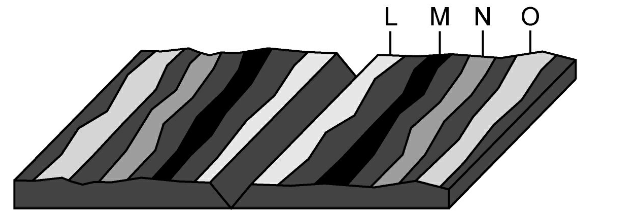
Where would the oldest rock be found?
a)
L
b)
M
c)
N
d)
O
21.
What type of boundary is shown at A?
a)
transform
b)
convergent
c)
divergent
d)
subduction
22.
What is happening at point B?
a)
subduction
b)
a divergent boundary
c)
convection
d)
an earthquake
23.
The physical layer of Earth made of solid rock and soil is called the ___________. 
a)
mesosphere
b)
lithosphere
c)
asthenosphere
d)
mantle
24.
What are the two types of crust
a)
continental and oceanic
b)
ocean and upper
c)
lower and upper
d)
pizza and subway
25.
Pangaea was an ancient supercontinent made up of...
a)
America, Greenland, and Europe.
b)
Antarctica, India, and America.
c)
all of Earth’s continents.
d)
South Africa, India, Australia, and South America.
26.
Evidence used by Wegener to supported his idea of continental drift included
a)
Ocean rocks and sediments
b)
Ocean floor topography
c)
Magnetic isochron patterns
d)
Climatic data
27.
Peer scientists reviewing Wegener’s hypothesis of continental drift rejected his notion because
a)
His evidence was too few to make a valid conclusion 
b)
He did not explain how continents move and what moves them
c)
His evidence was not clear in showing  how continents were joined
d)
He lied by including false evidence
28.
The mechanism that moves continents is based on heat energy moving by
a)
Radiation in the core
b)
Conduction in the lithosphere
c)
Convection in the Asthenosphere
d)
None of these options is true
29.
What two mechanisms do scientists think help convection currents in mantel move plates?
a)
Ridge push and Slab pull
b)
Normal and Reversed magnetism
c)
Action and Reaction tectonic forces 
d)
Gravitational and Rotational pull
30.
Why is the Inner Core solid?
a)
Extreme Heat
b)
High Pressure
c)
All the layers are solid
d)
It's made of rock
31.

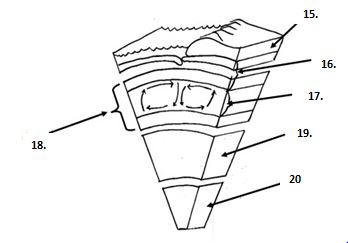
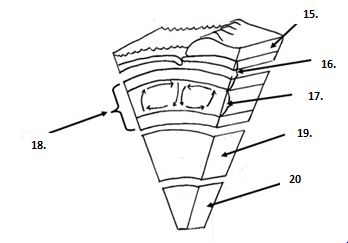
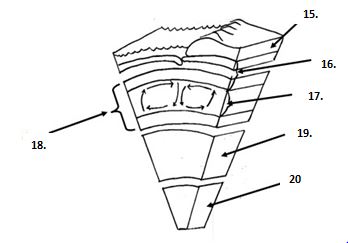
Identify each layer - #20.

a)

mantle

b)

asthenosphere

c)

inner core

d)

outer core

32.

Identify each layer - #15.

a)

Lithosphere

b)

Mantle

c)

Crust

d)

Asthenosphere

33.

Identify each layer - #19.

a)

mantle

b)

lithosphere

c)

inner core

d)

outer core

34.
The soft layer of the mantle on which the tectonic plates move
a)
Asthenosphere
b)
Outer Core
c)
Mantle
d)
Mesosphere
35.
The core is made-up of what two elements?
a)
iron and nickel
b)
iron and oxygen
c)
nickel and silicon
d)
oxygen and silicon
36.
What is the thinnest layer of the earth’s composition?
a)
mantle
b)
inner core
c)
crust
d)
outer core
37.
The thickest layer of the earth is the 
a)
crust
b)
mantle
c)
inner core
d)
outer core
38.
The solid, outer layer of the Earth that consists of the crust and the rigid upper part of the mantle
a)
Lithosphere
b)
Mesosphere
c)
Mantle
d)
Crust
39.
Temperature _____________________ as you go deeper into the earth.
a)
increases
b)
decreases
c)
goes up and down depending on the layer
d)
stays the same
40.
Pressure ______________________ as you go deeper into the Earth
a)
increases
b)
decreases 
c)
goes up or down depending on the layer
d)
stays the same
41.
Is the outer core a liquid or solid?
a)
liquid
b)
solid
42.

Oceanic crust is more dense than continental crust?

a)

true

b)

false

43.

Scientists know about the Earth Layers due to _________.

a)

volcanic activity

b)

seismic waves

c)

magnetic properties

44.
The lithosphere combines what two layers?
a)
Athenosphere & Crust
b)
Crust & Upper Mantel
c)
Mantel & Athenosphere
45.

There are 5 of these layers. They are classified based on the properties the layers possess for example density, state of matter (liquid, solid)

a)

chemical layers

b)

compositional layers

c)

physical layers