wayground logo

Free Printable Worksheets

NEW

Font size

S
M
L
XL
Worksheets

Adv. Chem: States of Matter Pretest

Total questions: 32

Worksheet time: 32mins

Name
Class
Date
1.

According to the KMT, particles of matter _____.

a)

are in constant motion

b)

have different shapes

c)

have different colors

d)

are always fluid

2.

Particles of a solid are not moving.

a)

True

b)

False

3.

A real gas _____.

a)

follows all the assumptions of the KMT

b)

does not follow all the assumptions of the KMT

4.

The biggest difference between a gas and a liquid is _____.

a)

The shape of the particles

b)

The mass of each particle

c)

The distance between particles

5.

Diffusion is ______.

a)

Gas particles colliding

b)

Gas particles spreading out to take the shape of their container

c)

Gas particles attracting each other

6.

Which of the following is NOT an intermolecular force

a)

London Dispersion

b)

Hydrogen Bonding

c)

Dipole-Dipole

d)

Gravitational Force

7.

Which of the following has the states of matter in order from strongest to weakest intermolecular forces?

a)

Gas, Liquid, Solid

b)

Solid, Gas Liquid

c)

Solid, Liquid Gas

d)

Gas, Solid, Liquid

8.

Which state of matter has the highest kinetic energy?

a)

Solid

b)

Liquid

c)

Gas

9.

A substance can exist as all 3 states of matter at once ______.

a)

Never

b)

at the equivalence point

c)

at the triple point

d)

at the critical point

10.

A substance's gas and liquid states are indistinguishable ______.

a)

Never

b)

at the equivalence point

c)

at the triple point

d)

at the critical point

11.

A solid to a liquid

a)

Freezing

b)

Melting

c)

Vaporization

d)

Condensation

12.

Solid to a gas

a)

Sublimation

b)

Deposition

13.

The higher the boiling point, the weaker the intermolecular forces.

a)

True

b)

False

14.

During a phase change, the temperature of the substance doesn't change.

a)

True

b)

False

15.
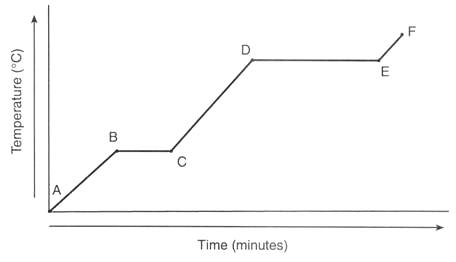
What line segment represents only the solid state?
a)
A-B
b)
B-C
c)
C-D
d)
D-E
16.
In which segment is the kinetic energy remaining constant?
a)
A-B
b)
B-C
c)
C-D
d)
E-F
17.
Which process takes the longest to occur?
a)
melting
b)
boiling
c)
freezing
d)
heating the solid
18.
What state(s) of matter are present at D-E?
a)
Solid-liquid
b)
Liquid
c)
Liquid-gas
d)
Gas-Solid
19.
Between which points is the temperature of the substance increasing?
a)
A-B only. 
b)
A-B, C-D, E-F
c)
B-C only. 
d)
B-C, D-E
20.
Between which points is the substance changing state?
a)
A-B only. 
b)
A-B, C-D, E-F
c)
B-C only. 
d)
B-C, D-E
21.
This type of graph is called a:
a)
Phase diagram
b)
Heating curve
c)
State of matter
d)
Temperature chart
22.
What state of matter is X?
a)
solid 
b)
liquid
c)
gas
d)
supercritical fluid
23.
What state of matter is Y?
a)
solid 
b)
liquid
c)
gas
d)
supercritical fluid
24.
What state of matter is Z?
a)
solid 
b)
liquid
c)
gas
d)
supercritical fluid
25.
What is point A?
a)
triple point
b)
critical point
c)
equilibrium point
d)
normal melting point
26.
What is point B?
a)
triple point
b)
critical point
c)
equilibrium point
d)
normal melting point
27.
What change occurs from F to E?
a)
sublimation
b)
deposition
c)
melting
d)
condensation
28.
What change occurs from E to C?
a)
sublimation
b)
freezing
c)
melting
d)
boiling
29.
What change occurs from C to D?
a)
condensation
b)
vaporization
c)
melting
d)
sublimation
30.
The pressure is increased on a sample of water at 0 °C from 0 mmHg to 800 mmHg.  In order, what changes occur?
a)
deposition, melting
b)
sublimation, melting
c)
condensation, freezing
d)
deposition, freezing
31.
What is the normal boiling point of this substance?
a)
150 °C
b)
100 °C
c)
-50 °C
d)
0 °C
32.
What is the normal melting point of this substance?
a)
150 °C
b)
100 °C
c)
-50 °C
d)
0 °C