wayground logo

Free Printable Worksheets

NEW

Font size

S
M
L
XL
Worksheets

Cold War

Total questions: 65

Worksheet time: 1hrs 7mins

Name
Class
Date
1.
During what event did U.S. airplanes drop food and supplies to the people in West Berlin?
a)
Berlin Airlift
b)
World War II
c)
British Air Raid
d)
Soviet Food Drive
2.
I was a senator in the 1950s.
I wanted to find Communists in the US.
My work was part of the Red Scare.
My ideas became unpopular.
Who am I?
a)
Henry Ford
b)
Charles Lindbergh
c)
Joseph McCarthy
d)
General Eisenhower
3.
In 1950, Korea fought a civil war over the spread of communism.  Communists from the north tried to take over the south.  What role did he US play in this war?
a)
The US and its allies went to Vietnam to fight Korean Communists.
b)
The US and its allies did not join the Korean War.
c)
The US and its allies join the fight to keep communism from spreading.
d)
The US and its allies fought to defend the North.
4.
In the 1950s, the United States became involved in the Vietnam War. Why did the United States become involved in this war?
a)
to prevent the collapse of the government of North Vietnam
b)
to stop the spread of communism to South Vietnam
c)
to stop Vietnam from taking over Hong Kong
d)
to prevent attacks against United States shipping
5.
I was born in 1894.
I was the leader of the USSR.
I wanted to put nuclear missiles on Cuba. I served as leader until 1964.
Who am I?
a)
Adolf Hitler
b)
Joseph McCarthy
c)
Benito Mussolini
d)
Nikita Khrushchev
6.
How did the US respond to finding out that the Soviets had missiles in Cuba?
a)
They sent the Air Force to bomb Cuba.
b)
They placed a naval blockade around Cuba.
c)
They began placing missiles in the Soviet Union.
d)
They invaded Cuba and the Soviet Union.
7.
Why was the Cuban Missile Crisis one of the MOST important events of John Kennedy’s presidency?
a)
The US almost started a war with Cuba.
b)
The US and the USSR almost started a nuclear war.
c)
The US landed a person on the moon.
d)
The USSR broke apart into nation-states.
8.
Who built the Berlin Wall?
a)
Soviet Union
b)
NATO
c)
The UN
d)
China
9.
What does NATO stand for? 
a)
North Atlantic Treaty Organization
b)
North American Treaty Organization
c)
North American Truce Organization
d)
North Asian Trust Order
10.
What does the ‘Iron Curtain’ symbolize? 
a)
The division between East Germany and West Germany
b)
The division between East Berlin and West Berlin
c)
The division between communist Europe and noncommunist Europe 
d)
The division between North Korea and South Korea
11.
Who were the two participants in the Space Race?
a)
The US and Cuba
b)
The USSR and US
c)
China and US
d)
US and North Vietnam
12.
What was the name of the first satellite in space launched by the Soviet Union?
a)
Gagarin
b)
Sputnik
c)
Apollo 11
d)
Apollo 13
13.
What was the spaceflight in July of 1969 conducted by America that landed Americans on the moon?
a)
Vostok 1
b)
Sputnik
c)
Apollo 13
d)
Apollo 11
14.
In what country is the city of Berlin located?
a)
France
b)
Germany
c)
England
d)
Soviet Union
15.
Which country was the aggressor that started the Korean War?
a)
North Korea
b)
South Korea
c)
Neither - they were forced into war by Germany
d)
Japan
16.
Which country did the U.S. send military aid to during the Korean War?
a)
North Korea
b)
South Korea
c)
Germany
d)
Japan
17.
What type of race was the U.S. involved in with Russia in the 1950's?
a)
Naval
b)
Arms
c)
Foreign Aid
d)
Land expansion
18.
What best describes the Soviet satellite Sputnik?
a)
The first satellite launched into space
b)
The first satellite to reach the moon
c)
The first satellite to carry a person into space
d)
The first satellite to carry a laboratory rat into space
19.
Who was the first man to set foot on the moon?
a)
Louis Armstrong
b)
Neil Armstrong
c)
Yuri Gagarin
d)
Charles Lindbergh
20.
Which U.S. President challenged America to be the first to put a man on the moon?
a)
Franklin D. Roosevelt
b)
Joseph Stalin
c)
John F. Kennedy
d)
Harry S. Truman
21.
Why is the Cold War called a "cold" war?
a)
The areas affected were in the polar regions of the world
b)
The war was fought during winter months only
c)
Leaders of the superpowers were sick with coughs and fevers
d)
There was never direct fighting between the two superpowers
22.
During the Cold War, who was the United States' biggest adversary?
a)
Germany
b)
North Korea
c)
England
d)
Soviet Union
23.

How much money did the u.s. donate to Europe?

a)

1billion

b)

50billion

c)

13billion

d)

15billion

24.

What guaranteed citizens of the United States, 18 years or older, the right to vote?

a)

NATO

b)

26th Amendment

c)

Berlin Airlift

d)

19th Amendment

25.

Which is a military operation led by the United States after World War II? The residents of West Berlin,Germany, were blockaded by the Soviet Union. Led by the United States, Western nations delivered food and supplies to them by airplane.

a)

Iron Curtain

b)

Communism

c)

Joseph McCarthy

d)

Berlin Airlift

26.

Which is the political idea that all property should be publicly owned and managed by a central government?

a)

Iron Curtain

b)

NATO

c)

Nuclear War

d)

Communism

27.

A dispute during the Cold War between the United States and the Soviet Union. The Soviet Union had built missile sites in Cuba. President John F. Kennedy set up a naval blockade of the island until Soviet leader Nikita Khrushchev ordered the missiles removed.

a)

26th Amendment

b)

Vietnam War

c)

Cuban missile crisis

d)

Korean War

28.

An imaginary line in Europe separating nations of the West, such as the United States and European countries, and the Soviet Union and its allies.

a)

proxy war

b)

Tet Offensive

c)

propaganda

d)

Iron Curtain

29.

A fighter who, as part of a small group, does not fight directly, but makes surprise raids or quick attacks from under cover.

a)

embargo

b)

refugee

c)

diplomacy

d)

guerrilla

30.

A conflict from 1964 to 1975, between the Communist North Vietnamese and the U.S.-supported South Vietnamese.

a)

Vietnam War

b)

Korean War

c)

proxy war

d)

Cold War

31.

What did Americans fear after the end of WWII?

a)

The spread of democracy

b)

The spread of NATO

c)

The spread of communism

d)

The spread of capitalism

32.

Which of the following is a way in which democracy is different than communism?

a)

Communism allows the government to run the country and democracies allow the military to run the country.

b)

Democracies give the citizens the power to make choices and communism gives the power to the government.

c)

Communism allows the citizens to decide how the government is run and democracies are run by the military.

d)

Democracy believes all property should be shared and communism does not.

33.

Why did the Soviets begin constructing nuclear missile sites in Cuba?

a)

It was in response to President Eisenhower working to end the Korean War.

b)

It was in response to President Kennedy sending Cuban exiles to invade Cuba.

c)

It was in response to President Truman joining NATO.

d)

It was in response to President Kennedy sending ships to form a blockade.

34.

Why did the United States get involved in the Korean War?

a)

to get a close relationship with China

b)

to help the Soviet Union win the war

c)

to take over acres of land in North Korea

d)

to prevent the spread of communism

35.

Why was the Cuban Missile Crisis so significant in the Cold War?

a)

It was the first conflict between the U.S. and the U.S.S.R.

b)

It was the closest the world had ever come to a nuclear war.

c)

It led to the assassination of President John F. Kennedy.

d)

It was the end of the conflict between the U.S.S.R. and the U.S.

36.

How did the U.S. respond to finding out that the Soviets had missiles in Cuba?

a)

They began placing missiles in the Soviet Union.

b)

They placed a naval blockade around Cuba.

c)

They invaded Cuba and the Soviet Union.

d)

They sent the Air Force to bomb Cuba.

37.

• president of the United States from 1961 until 1963

• agreed to increase the number of U.S. military forces in Vietnam in 1961

• was assassinated in Dallas, Texas, in 1963


Which U.S. president is being described here?

a)

Richard Nixon

b)

Lyndon B. Johnson

c)

Dwight D. Eisenhower

d)

John F. Kennedy

38.

television coverage showed Americans what was happening in the war

• the U.S. drafted young men in order to get more soldiers to fight

• troops from North Vietnam proved hard to beat and showed they would not give up


How did the issues listed above impact the U.S. in the Vietnam War?

a)

The U.S. government started giving more war powers to the president.

b)

Reporting the news became more important as an industry than it had been before.

c)

People started to fear that communism would spread to the United States.

d)

Many Americans started to think the U.S. should not be involved in the war.

39.

Why did the United States enter into the Korean and Vietnam wars?

a)

to decrease the threat to democracy in Japan

b)

to promote trade in Asian countries

c)

to stop the spread of communism

d)

to protect important historical sites

40.
Why was the United States involved in the Berlin Airlift?
a)
to airlift food to the people of West Berlin
b)
to bomb East Berlin
c)
to demolish the Berlin Wall
d)
to transport people out of East Berlin
41.
Why did the United States become involved in the Korean War?
a)
to contain communism
b)
to colonize Korea
c)
to spread communism
d)
to Christianize Koreans
42.
Where was Korea divided?
a)
18 parallel
b)
34 parallel
c)
38 parallel
d)
15 parallel
43.
In 1950, Korea fought a civil war over the spread of communism.  Communists from the north tried to take over the south.  What role did he US play in this war?
a)
The US and its allies went to Vietnam to fight Korean Communists.
b)
The US and its allies join the fight to keep communism from spreading.
c)
The US and its allies did not join the Korean War.
d)
The US and its allies fought to defend the North.
44.
In the 1950s, the United States became involved in the Vietnam War. Why did the United States become involved in this war?
a)
to prevent the collapse of the government of North Vietnam
b)
to stop Vietnam from taking over Hong Kong
c)
to stop the spread of communism to South Vietnam
d)
to prevent attacks against United States shipping
45.

What did the "Iron Curtain" symbolize?

a)

The best areas for mining iron in Europe

b)

The divide between democracy and communism

c)

The border between North and South Korea

d)

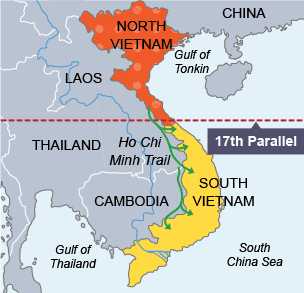
The Ho Chi Minh Trail

46.

The United States and its allies were in favor of this government type:

a)

theocracy

b)

communism

c)

socialist

d)

democratic

47.

Which of the following choices best describes the U.S. foreign policy during the Cold War?

a)

Containment of communism

b)

Whoever smelt it dealt it

c)

The enemy of my enemy is my friend

d)

Whoever supplied it denied it

e)

The War on Terror

48.

What was the name given to the buildup of weapons during the Cold War?

a)

Space Race

b)

Bombageddon

c)

Arms Race

d)

Cuban Missile Crisis

e)

Nuka-palooza

49.

Which event signaled the end of the Cold War?

a)

Cuban Missile Crisis

b)

end of the Vietnam War

c)

collapse of the Soviet Union

d)

fall of the Berlin Wall

50.

What was the purpose of NATO when it was created?

a)

To guard against the Spanish Inquisition

b)

To regulate the price of oil on the world market

c)

To protect its members from the Soviet Union and communism

d)

To remove all trade barriers and increase trade between North American countries

e)

To be the first to put a man on the moon

51.

Type of government where the government owns everything and makes all the decisions.

a)

Constitutional monarchy

b)

Direct democracy

c)

Republic

d)

Communist

52.

Which leader came up with the term "Iron Curtain"?

a)

Mikhail Gorbachev

b)

Harry Truman

c)

John F. Kennedy

d)

Winston Churchill

e)

Nixon Bunch

53.
Which country had the first man in space?
a)
US
b)
USSR
c)
China
d)
Germany
54.
What does NATO stand for?
a)
North Atlantic Treaty Organization
b)
North American Trade Organization
c)
Northern Alliance Trade Origins
d)
Native American Tribal Organization
55.

Who falsely accused people of being communists?

a)

Harry Truman

b)

Joseph McCarthy

c)

Joseph Stalin

56.
How is a Cold War different from a regular war?
a)
It's fought in the winter.
b)
It is a war that divides countries.
c)
It's fought in certain countries.
d)
It is a war of words and ideas instead of bullets and guns.
57.
What was the Iron Curtain?
a)
an imaginary line dividing communist and non-communist countries 
b)
an imaginary line connecting the major cities of Europe
c)
the border between France and Germany
d)
the border between the United States and Europe.
58.

Who was the first man to walk on the moon's surface on July 20, 1969?

a)

John Glenn

b)

Alan Shepard

c)

Neil Armstrong

d)

Yuri Gagarin

59.

On July 16, 1969, three U.S. astronauts set off on the Apollo 11 space mission to attempt the...

a)

first lunar (moon) landing

b)

first orbit of the Earth

c)

first journey into outer space

60.

Which country was the first to send a man into space?

a)

Soviet Union

b)

United States of America

61.
What event during the Cold War does this newspaper headline describe?
a)
Korean War
b)
Building of the Berlin Wall
c)
Cuban Missile Crisis
d)
Space Race
62.
Which country does NASA work for?
a)
Germany
b)
France
c)
Spain
d)
United States
63.
What was the name of the first satellite?
a)
Sputnik
b)
Satellite 1
c)
Orbiter
d)
Silver Ball
64.
Which U.S. President promised to send a man to the moon before 1970?
a)
President Franklin D. Roosevelt
b)
President Abraham Lincoln
c)
President John F. Kennedy
d)
President Harry S. Truman
65.
Who was the first person to set foot on the moon?
a)
Neil Armstrong
b)
Buzz Aldrin
c)
Valentina Tereshkova
d)
Yuri Gagarin