Wayground logo

Free Printable Worksheets

Font size

S
M
L
XL
Worksheets

Economics Vocabulary Chapter 1-5

Total questions: 66

Worksheet time: 51mins

Name
Class
Date
1.

What are the characteristics of a traditional economic system?

a)

Relies on government

b)

Driven by consumers

c)

built upon traditions, customs, and beliefs

2.
Utility is the
a)
benefit or satisfaction that a person gets from the consumption of a good or service
b)
measure of how useful a resource is in the production process
c)
measure of productivity associated with a good or service
d)
economic term for consumption possibilities
3.
The most important measure of economic growth is... 
a)
GNP
b)
GNC
c)
DDP
d)
GDP
4.
Gross Domestic Product (GDP) ONLY refers to the total value of FINAL goods and services produced in a country in one year
a)
True
b)
False
5.

Land includes...

a)

The "gifts of nature" or natural resources not created by human effort.

b)

the tools, equipment, and factories used in production of goods and services

c)

people with all their efforts and abilities

d)

individuals who start a new business or bring a product to market.

6.

Capital refers to...

a)

The "gifts of nature" or natural resources not created by human effort.

b)

people with all their efforts and abilities

c)

the tools, equipment, and factories used in production of goods and services

d)

individuals who start a new business or bring a product to market.

7.

Labor refers to...

a)

people with all their efforts and abilities

b)

individuals who start a new business or bring a product to market.

c)

the tools, equipment, and factories used in production of goods and services.

d)

The "gifts of nature" or natural resources not created by human effort.

8.

Entrepreneurs are...

a)

people with all their efforts and abilities

b)

individuals who start a new business or bring a product to market.

c)

The "gifts of nature" or natural resources not created by human effort.

d)

the tools, equipment, and factories used in production of goods and services

9.
A herd of cattle is an example of ...
a)
Land
b)
Labor
c)
Entrepreneur
d)
Capital
10.
Your Mail lady is an example of...
a)
Land
b)
Labor
c)
Entrepreneurs
d)
Capital
11.
A bulldozer is an example of...
a)
Land
b)
Labor
c)
Entrepreneurs
d)
Capital
12.
Country X can manufacture a particular product better and at a lower cost than country Y can.
What conclusion can be drawn from this situation?
a)
Country X has solved the problem of scarcity.
b)
Country X should discontinue making that product.
c)
Country Y should try to produce the same product. 
d)
Country X should sell that product to Country Y.
13.

To conduct an accurate cost/benefit analysis, don’t forget to include

a)

calculated risk

b)

threats

c)

insurance benefits

d)

opportunity cost

14.
What is a cost?
a)
the item you receive after you pay
b)
giving up one thing for another
c)
the amount of money paid for something
15.
What is a benefit?
a)
the item you receive after you pay for it
b)
giving up one thing for another
c)
the amount of money paid for something
16.
What is an example of a benefit?
a)
the capital resources a company has
b)
the cost of an item
c)
extra time you have when you buy a leaf blower
17.
What is a trade-off?
a)
the item you receive after you pay
b)
giving up one thing for another
c)
the amount of money paid for something
18.
Which do people compare in order to make choices?
a)
Costs & Benefits
b)
Supply & Demand
c)
Buying & Selling
d)
Apples & Oranges
19.

Any place where buyers and sellers meet to exchange goods and service.

a)

Value

b)

Market

c)

Trade

d)

Cost and Benefit

20.

Having more than what is needed or will be used.

a)

Surplus

b)

The Barter System

c)

Exchange Rate

d)

Double Coincidence of Want

21.

The action of exchanging goods and services in a market.

a)

Value

b)

Market

c)

Trade

d)

Cost and Benefit

22.

Monetary or non-monetary gain received because of an action taken or a decision made.

a)

Benefit

b)

Cost

c)

Analysis

d)

Medium of Exchange

23.

Select all that are factors of production.

a)

Capital

b)

Entrepreneuship

c)

Labor

d)

Land

24.

The assignment of different parts of manufacturing to different people.

a)

Division of Labor/Specialization

b)

The inequalities of the Barter System

c)

NPR's Market Place

d)

Medium of Exchange and the Double Coincidence of want

25.

A process of examining the advantages (benefits) and disadvantages (costs) of each available alternative in arriving at a decision.

a)

Medium of Exchange

b)

Exchange Rate

c)

Opportunity Cost

d)

Cost/Benefit Analysis

26.

The solution to the Barter System is:

a)

The Medium of Exchange

b)

Opportunity Cost

c)

Durability

d)

Trading goods for goods and other services.

27.
 Define The Great Depression
a)
Loan given to help you buy items you normally cannot buy on your own.
b)
homeless person who travels looking for work.
c)
The time in American history when the U.S. was at it's lowest point.
28.

What is a Command Economy?

a)

CAPITALISTIC economy in which there is free competition and prices are determined by interaction of supply and demand

b)

An economic system COMBINING private and public enterprise.

c)

When production, investment, price, and income are determined centrally by a GOVERNMENT.

d)

A system that relies on customs, history, and time-honored beliefs.

29.

A system where people can own their own business of their choice is called _____________.

a)

Planned System

b)

Options System

c)

Market Economy or Free Enterprise

d)

Taxes

30.
Farmers in California have had wonderful weather. They have produced the largest crop of watermelons in years. What will happen to the price of watermelons?
a)
The price will go up.
b)
The price will go down.
31.
Cold weather in Florida has damaged this year’s orange crop. Farmers have only half of the usual amount of oranges to sell. What will happen to the price of oranges?
a)
The price will go up.
b)
The price will go down.
32.
Amazon Prime is selling Smencils.  There are only a few packs left and they are very popular.  What will happen to the price?
a)
The price will go up.
b)
The price will go down.
33.
How much people want something
a)
supply
b)
demand
34.
Individuals who come up with a new idea for a good or service, then they make it a reality
a)
resource
b)
human resources
c)
consumer
d)
entrepreneur
35.
How much of something is available
a)
supply
b)
demand
36.
In general, if the price of a good or service goes down, what happens to the demand for that good or service?
a)
demand goes up
b)
demand goes down
c)
demand stays the same
d)
none of the above
37.
In general, if the price of a good or service goes up, what happens to the demand for that good or service?
a)
demand goes up
b)
demand goes down
c)
demand stays the same
d)
none of the above
38.

A Market Economy is based on?

a)

Goods and Services

b)

Goods and Products

c)

Supply and Demand

d)

Service

39.

Business owners will raise prices if?

a)

Item isn't selling

b)

There is a large supply of the item and

c)

There is a low supply of the item and the product is selling quickly.

d)

The amount of the supply is high.

40.

When you reach around the age of 62, you are now eligible for this monthly payment. People who disabled or cannot work are also eligible for this one.

a)

Social Security

b)

Property tax

c)

Estate tax

d)

Social Media

41.

extra of something

a)

scarcity

b)

shortage

c)

surplus

d)

supply

42.

not enough of something for everyone

a)

surplus

b)

shortage

c)

scarcity

d)

demand

43.

what you give up to get something else

a)

price

b)

need

c)

want

d)

opportunity cost

44.
This part of the market determines SUPPLY
a)
buyers
b)
sellers
c)
consumers
d)
us
45.
This part of the market determines DEMAND
a)
buyers
b)
sellers
c)
suppliers
d)
store owners
46.
When quantity supplied and quantity demanded is equal
a)
surplus
b)
shortage
c)
equilibrium
d)
law of demand
47.
If a price is above equilibrium price, it creates a...
a)
shortage
b)
surplus
c)
market price
d)
demand
48.
If a price is below the equilibrium price it creates a...
a)
shortage
b)
surplus 
c)
market price 
d)
supply
49.
What does this curve represent?
a)
demand
b)
supply
c)
equilibrium
d)
shortage
50.
What does this curve represent?
a)
supply
b)
equilibrium
c)
demand
d)
surplus
51.

Definition of Marginal Utility

a)

the satisfaction from consumption

b)

to total satisfaction from consuming a product

c)

the extra satisfaction from the last unit consumed

d)

the extra consumption from last unit consumed

52.

The definition of the law of diminishing marginal utility

a)

As more units are consumed the marginal utility falls.

b)

As more units are consumed the marginal utility increases.

c)

As price decreases quantity demanded increases.

d)

As price increases consumers are willing to pay more.

53.
Entrepreneurs enter business because they desire to make money. The term that best describes this is:
a)
Greed
b)
Pricing motive
c)
Profit motive
d)
Service
54.
What is inflation?
a)
rise in all prices
b)
rise in most prices
c)
rise in some prices
d)
rise in general prices
55.

As an individual consumes an additional good or servce, their satisfaction decreases

a)

Marginal Utility

b)

Law of Diminishing Marginal Utility

c)

Utility

d)

Negative Utility

56.

Marginal analysis involves

a)

Looking at the cost of an alternative

b)

Looking at the benefits of an alternative

c)

Evaluating the cost of an alternative

d)

Comparing the benefits and costs of producing and consuming additional units of something.

57.
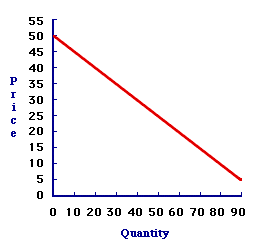
What kind of graph is this?
a)
Supply
b)
Demand
58.
What is Equilibrium?
a)
Price that buyers & sellers will accept
b)
Price that equals Goods
59.
A government payment to support a business or market
a)
Regulation
b)
Subsidy
c)
Excise Tax 
d)
Revenue
60.
Government intervention in the market that affects the price, quantity, or quality of a good
a)
Subsidy
b)
Regulation
c)
Excise Tax
d)
Operating Cost
61.
Too many "cooks in the kitchen" is an example of?
a)
Law of Supply
b)
Diminishing Marginal Return
62.
When a business has made enough money to pay its costs and begin to make a profit, it has reached its
a)
break-even point
b)
variable-cost margin
c)
fixed cost
d)
selling price
63.
Businesses calculate break-even in units so they know
a)
how much profit they will earn after they break even
b)
which products they should purchase for resale
c)
which costs are variable and which are fixed
d)
how many products they must sell to break even
64.

Which of these best defines equilibrium in a market?

a)

a situation in which quantity supplied is greater than quantity demanded

b)

a situation in which quantity demanded is greater than quantity supplied

c)

a situation in which quantity supplied and quantity demanded are equal

d)

a situation where a minimum price is set

65.
What is the Equilibrium Price?
a)
1
b)
2
c)
3
d)
4
66.
What is the Equilibrium Quantity?
a)
50
b)
60
c)
70
d)
80