wayground logo

Free Printable Worksheets

Font size

S
M
L
XL
Worksheets

Astronomy Basics

Total questions: 104

Worksheet time: 1hrs 28mins

Name
Class
Date
1.

Which of the following is a yellow main sequence star?

a)

Canopus

b)

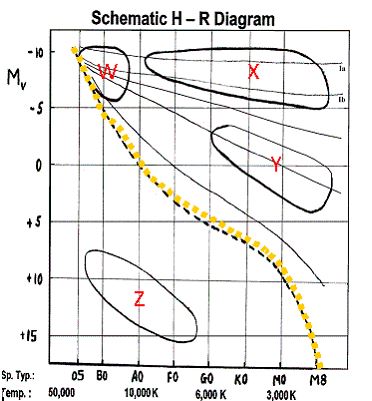
Procyon

c)

Altair

d)

Procyon B

2.

Which of the following is a blue main sequence star?

a)

Spica

b)

Sirius B

c)

Rigel

d)

Mira

3.

Which of the following is a red main sequence star?

a)

Aldebaran

b)

Tau Ceti

c)

Bernard's Star

d)

Polaris

4.

Supergiant stars are those of at least 100 times the mass of our Sun. Which of the following is a white supergiant star?

a)

Deneb

b)

Canopus

c)

Mizar

d)

Rigel

5.

Which of the following is a red supergiant star?

a)

Polaris

b)

Pollux

c)

Mira

d)

Betelgeuse

6.

What are the four types of stars that can be found on the HR Diagram?

a)

main sequence, giant, supergiant, white dwarf

b)

main sequence, giant, supernova, white dwarf

c)

main sequence, nebula, supergiant, black hole

d)

main sequence, giant, neutron star, black dwarf

7.

White dwarfs are ____________ than giants.

a)

cooler and dimmer

b)

cooler and brighter

c)

warmer and dimmer

d)

warmer and brighter

8.
Which of the following is not an accepted use of an H-R diagram?
a)
Visual way to “graph” and categorize stars based on their characteristics
b)
Allows astronomers to recognize patterns in types of stars
c)
Allows us to track the life cycle of stars as they change over time
d)
Allows us to determine the distance of stars with great accuracy
9.
Absolute magnitude is defined as...
a)
the brightness of an object in space, measured as if you’re 10 parsecs away from the object.
b)
Total energy emitted by a space object per unit time.
c)
the brightness of an object in space, as it appears from Earth
d)
the color of an object in space, described on a number scale.
10.
If an object has a luminosity of 7.5, this means...
a)
the object is 7.5 times brighter than the sun.
b)
the object is 7.5% brighter than the sun
c)
the object has a redder color than the sun.
d)
the object is 7.5 times smaller than the sun.
11.
The effective temperature of a star is related to its...
a)
solar system
b)
luminosity
c)
absolute magnitude
d)
color
12.
Spectral class is a way of describing a star’s
a)
size
b)
luminosity
c)
age
d)
color
13.
The color index of a star provides information about that star’s
a)
age
b)
luminosity
c)
absolute magnitude
d)
temperature
14.
An open cluster has ___________ stars.
a)
less than 100
b)
more than 100,000
c)
less than 50
d)
more than 500
15.
A globular cluster has ___________ stars.
a)
less than 100
b)
more than 100,000
c)
less than 50
d)
more than 500
16.
This is an H-R Diagram of a star cluster.  Which of the following is true about the stars in Area 1 (bound by the red box)
a)
These stars are red giants.
b)
These stars are white dwarfs.
c)
These stars are main sequence stars.
d)
These stars are in the first half of their life span.
17.
This is an H-R Diagram of a star cluster.  The stars that are not in Area 1 or Area 2 are part of the...
a)
main sequence
b)
white dwarf group
c)
blue giant group
d)
instability strip
18.
These are H-R Diagrams of different star clusters.  Which one of these clusters is oldest and how do you know?
a)
The right; It has the highest proportion of stars that have become red giants.
b)
The middle; it has the highest proportion of stars in the main sequence.
c)
The right; It has the highest proportion of brown dwarf stars.
d)
The left; it has the highest number of blue giants.
19.
In which region of the H-R Diagram would you be likely to find Blue Giants?
a)
W
b)
X
c)
Y
d)
Z
20.
In which region of the H-R Diagram would you be likely to find the oldest stars?
a)
W
b)
X
c)
Y
d)
Z
21.
In which region of the H-R Diagram would you be likely to find stars fusing hydrogen to make helium in their cores?
a)
W
b)
X
c)
Y
d)
The orange dashed line
22.
In which region of the H-R Diagram would you be likely to find stars that are in hydrostatic equilibrium?
a)
W
b)
X
c)
Y
d)
The orange dashed line
23.
In which region of the H-R Diagram would you be likely to find the brightest, reddest stars?
a)
W
b)
X
c)
Y
d)
The orange dashed line
24.
What is the primary difference between a star of spectral class K0 in the Y region, compared to a star of spectral class K0 in the X region?
a)
temperature
b)
color
c)
brightness
d)
color index
25.
The luminosity of a star correlates most closely with a star's...
a)
size
b)
color
c)
spectral class
d)
temperature
26.
Which corner of the H-R diagram has the stars with the shortest life spans?
a)
upper left
b)
upper right
c)
lower left
d)
lower right
27.
As a whole, Giants are considered hotter than White Dwarfs.
a)
True
b)
False
28.
In the diagram given, what happens as we move to the left?
a)
Stars Get Larger
b)
Stars get Colder
c)
Stars get hotter
29.
Which star is the coldest?
a)
Yellow Star
b)
Red Star
c)
Orange Star
d)
Blue Star
30.
Compared to the rest of the stars, our sun is considered...
a)
Extremely Large and Cold
b)
Small with a medium temperature
c)
Medium size with medium temperature
31.
Which category is our Sun located in?
a)
White Dwarfs
b)
Supergiants
c)
Main Sequence
d)
Giants
32.
The category that contains the most stars is...
a)
Main Sequence
b)
Supergiants
c)
Giants
33.
Look at the H-R diagram. Which star is
sort of cool, dim (not too much light), and red?
a)
Betelguse
b)
Sirius B
c)
Procyon B
d)
Barnard's star
34.
Which star has the lowest temperature?
a)
A
b)
B
c)
C
d)
D
35.
Which spectral class does our star, the sun, belong to?
a)
M
b)
K
c)
G
d)
F
36.
What else does the H-R Diagram tell us besides the luminosity and temperature?
a)
Size, color and element make up
b)
Location and distance from Earth
c)
Constellation structures
37.
Lightyear is used by scientist to measure what?
a)
Distance
b)
Time
c)
Energy
38.
Which one is the correct order from hottest to coolest stars?
a)
blue, yellow,orange, red
b)
red, orange, yellow, blue
c)
blue, red, yellow, orange
d)
yellow, blue, orange, red
39.
Which star has the lowest temperature?
a)
A
b)
B
c)
C
d)
D
40.
Look at the H-R diagram. Which star is
sort of cool, dim (not too much light), and red?
a)
Betelguse
b)
Sirius B
c)
Procyon B
d)
Barnard's star
41.

What is the HR diagram?

a)

A diagram that plots stars based on their distance from Earth.

b)

A diagram that plots stars based on the color & size.

c)

A diagram that plots stars based on the brightness & color.

d)

A diagram that plots stars based on the

42.
Based on this diagram which type of stars would belong to spectral class M and have the lowest luminosity?
a)
Main Sequence Stars
b)
Giants
c)
Super Giants
d)
White Dwarfs
43.
Which of the following best describes a star?  A star is a celestial body ---
a)
composed of rock and metal with a very high density
b)
that is too big to be an asteroid, but too small to be a planet.
c)
that rotates on an axis and revolves around the Sun
d)
composed of gases that emit light due to nuclear reactions
44.
What are the three types of galaxies?
a)
Spiral, Elliptical, Ambiguous
b)
Whirlpool, Ellipse, Irregular
c)
Spiral, Elliptical, Irregular
d)
Swirly, Fuzzy, Uh...
45.
Analyze this HR Diagram. Which group of stars is considered to have lower than average luminosity as well as a higher than average temperature?
a)
Giants
b)
Main Sequence
c)
White Dwarfs
d)
Super Giants
46.
Black holes can be found in the Universe. When examining a black hole with a special telescope, scientist determined that a specific black hole was emitting waves with a wavelength of 1.41x10⁻¹² Hz. The special telescope most likely detects:
a)
microwaves
b)
visible light
c)
x-rays
d)
gamma rays
47.
Analyze this HR Diagram. Which group of stars is considered to have higher than average luminosity as well as a lower than average temperature?
a)
Giants
b)
Main Sequence
c)
White Dwarfs
d)
Super Giants
48.
Which of these observations of Proxima Centuri's Star is most likely accurate?
a)
Proxima Centuri's Star is less bright than the sun and has a surface temperature below 3,400 K
b)
Proxima Centuri's Star is less bright than the sun and has a surface temperature above 3,400 K
c)
Proxima Centuri's Star is brighter than the sun and has a surface temperature below 4,000 K
d)
Proxima Centuri's Star is brighter than the sun and has a surface temperature above 4,000 K
49.
Stars are formed in a large cloud of gas and dust called a
a)
cumulonimbus cloud
b)
nebula
c)
neutron star
d)
black hole
50.
Which of these is NOT a type of spectral analysis
a)
Emission
b)
Absorption
c)
Continuous
d)
Exoplanetary
51.
Emission spectra come from
a)
Dense gases
b)
Hot, low density gases
c)
Cold, low density gases
d)
Lukewarm, thin gases
52.
Continuous spectra come from
a)
Dense gases
b)
Hot, low density gases
c)
Cold, low density gases
d)
Lukewarm, thin gases
53.
Absorption spectra come from
a)
Dense gases
b)
Hot, low density gases
c)
Cold, low density gases
d)
Lukewarm, thin gases
54.
What is the part of the spectroscope that spreads out the light by passing through narrow slits?
a)
The prism
b)
Diffraction grating
c)
The detector
d)
It doesn't spread out, it bends
55.
Which drawing represents the process by which an emission line is formed?
a)
A
b)
B
c)
C
d)
D
56.
A lab sample of gas is shown at the top. Which of these would be present in the sample?
a)
Beryllium
b)
Manganese
c)
Strontium
d)
Titanium
57.

The rainbow in order from hottest to coolest or greater to least energy.

a)

Violet, blue, green, yellow, orange, and red.

b)

blue, orange, red, violet, green, and yellow.

c)

red, yellow, green, blue, violet, and orange.

58.

Doppler Shift

a)

a change in frequency in the wavelength

b)

a white light

c)

none of these

59.

Blue shift moves towards us

a)

True

b)

False

60.
a)

refracting

b)

reflection

c)

cassegrain

61.
a)

cassegrain

b)

refracting

c)

reflection

62.
What type of data can you collect using a spectroscope?
a)
composition and motion of stars
b)
size and composition of stars
c)
motion and size of stars
d)
mass and composition of stars
63.
What does a reflecting telescope use to collect light?
a)
a mirror
b)
a prism
c)
a spectroscope
d)
a lens
64.
What does a refracting telescope use to collect light?
a)
a mirror
b)
a prism
c)
a spectroscope
d)
a lens
65.

Which type of parallax angle indicates that the star is further away from Earth? (Think thumb thing)

a)

large angle

b)

small angle

c)

equal angle

d)

right angle

66.

What is the motion of the observed star?

a)

Moving toward Earth

b)

Moving away from Earth

c)

Orbiting around Earth

d)

Not moving at all

67.
Why does our star have a bright apparent magnitude but a dim absolute magnitude?
a)
Large star far away from Earth
b)
Medium star far away from Earth
c)
Medium star close to Earth
d)
Large star close to Earth
68.
What is a star's brightness as it appears from Earth called?
a)
Parallax
b)
Absolute magnitude
c)
Light-year
d)
Apparent magnitude
69.
What is the longest stage during a star's life cycle?
a)
main sequence
b)
red super giant
c)
protostar
d)
supernova
70.
Which one is NOT a type of galaxy?
a)
spiral
b)
ellipitical
c)
irregular
d)
rectangular
71.
What do astronomers observe about the rate of the universe's expansion?
a)
It is slowing down
b)
It is constantly changing
c)
It is not expanding
d)
It is speeding up
72.
Which device was used to discover cosmic background microwave radiation?
a)
a reflecting telescope
b)
a spectroscope
c)
a radio telescope
d)
a refracting telescope
73.
The existence of the cosmic background radiation implies that
a)
the big bang model is wrong.
b)
the universe began in a hot, dense state.
c)
the universe did not have a moment of creation.
d)
the universe began in a cold, low-density state. 
74.
When we look at the sun, what layer are we viewing?
a)
photosphere
b)
chromosphere
c)
corona
d)
convection zone
75.

What type of galaxy tends to orbit other, larger, galaxies?

a)

Spiral

b)

Elliptical

c)

Irregular

d)

Irrational

76.

What is an object you would see in the kuiper belt?

a)

asteroids

b)

comets

c)

people

d)

stars

77.
A low mass main sequence star expands into a red giant and...
a)
will grow more than 100 times it's original size.
b)
collapses into a black hole.
78.

What type of energy is produced from fusion in the sun?

a)

radiowaves

b)

gamma waves

c)

ultraviolet light

d)

visible light

79.

Why does the core of a massive star collapse once iron is created.

a)

Nuclear fusion is increased, causing gravity to increase.

b)

Iron is magnetic, and pulls magnetic particles in the star towards its iron core.

c)

Nuclear fusion stops, so gravity takes over.

d)

Dark energy in the universe crushes the star.

80.

Scientist believe that _____ radiation is leftover from the Big Bang.

a)

radio wave

b)

gamma ray

c)

infrared wave

d)

cosmic microwave background

81.

The phenomenon, that as a light source moves away from an object, it will cover more area of that object and appear less bright can be explained by ______.

a)

red shift

b)

Hubble's Law

c)

parallax

d)

inverse square law of light

82.

When sunlight is split by a prism or diffraction grating it appears to emit a ___ spectra.

a)

absorption

b)

dark-line

c)

continuous

d)

bright-line

83.

Upon closer examination, sunlight (and all stars) actually emit ___ spectra.

a)

bright-line (or emission)

b)

absorption (or dark-line)

c)

continuous

d)

multiple

84.

Spectroscopy can be used to study

a)

the atmosphere of Mars.

b)

the age of stars.

c)

spectroscopes.

d)

the Moon.

85.

Spectroscopy can also be used to study

a)

galaxies.

b)

the surface of Mercury.

c)

stellar composition.

d)

UFO's.

86.

A spectroscope may be connected to a ___ to record an object's spectra.

a)

telescope

b)

CCD (charged coupled device)

c)

spectrometer

d)

spectrograph

87.

If an object like a star is moving away from Earth, the spectral lines are observed to be

a)

smaller or thinner & red-shifted.

b)

smaller or thinner & blue-shifted.

c)

wider or broader & blue-shifted.

d)

wider or broader & red-shifted.

88.
What position is to the perihelion of planet 1? 
a)
 position A
b)
position B
c)
position C
d)
position D
89.
What position is close to the aphelion of planet 2? 
a)
 position A
b)
position B
c)
position C
d)
position D
90.
According to Newton, the two factors that combine to keep the planets in orbit are 
a)
gravity and orbital speed.
b)
orbital speed and mass
c)
mass and inertia.
d)
gravity and inertia.
91.
What shape are the orbits of most comets? 
a)
long, narrow ellipses
b)
circles
c)
 nearly circular ellipses
d)
spherical
92.
Who invented calculus to help him understand the way objects moved in space?
a)
Johannes Kepler
b)
Tycho Brahe
c)
Isaac Newton
d)
Nicolaus Copernicus
93.
What percentage of the universe can we directly see?
a)
4%
b)
10%
c)
40%
d)
100%
94.
the average distance between the Earth and the sun; approximately 150 million kilometers
a)
astronomical unit
b)
light year
c)
parsec
d)
electromagnetic spectrum
95.
Which EM wave has the lowest frequency?
a)
radio
b)
xray
c)
gamma
d)
infrared
96.
Which EM wave has the longest wavelength?
a)
light
b)
radio
c)
ultraviolet
d)
red
97.

What is the name of the object shown?

a)

SN UDS10Wil

b)

MACS J1149.5+2223

c)

GW151226

d)

H2356-309

98.

What is the name of the object shown?

a)

SN UDS10Wil

b)

MACS J1149.5+2223

c)

GW151226

d)

H2356-309

99.

What is the name of the object shown?

a)

SN UDS10Wil

b)

MACS J1149.5+2223

c)

GW151226

d)

H2356-309

100.

What is the name of the object shown?

a)

GOODS-S 29323

b)

JKCS 041

c)

NGC 2623

d)

3C 273

101.

What is the name of the object shown?

a)

GOODS-S 29323

b)

JKCS 041

c)

NGC 2623

d)

3C 273

102.

What is the name of the object shown?

a)

GOODS-S 29323

b)

JKCS 041

c)

NGC 2623

d)

3C 273

103.

What is the redshift for SN UDS10Wil?

a)

1.9

b)

3.4

c)

17.3

d)

1021

104.

What type of object is MACS J1149.5+2223?

a)

Super Nova

b)

Black Hole

c)

Diverging Galaxy Cluster

d)

Merging Galaxy Cluster