
NEW
Font size
 Worksheets
Forces and Newton's Laws of Motion
Total questions: 39
Worksheet time: 21mins
Which force is done by a person or machine?
Applied force
Normal force
Gravitational force
Buoyant force
Which force is due to a fluid pushing back on an object?
Applied force
Normal force
Gravitational force
Buoyant force
Which force is the one that pushes back on an object (opposite gravity)?
Applied force
Normal force
Gravitational force
Buoyant force
Which force is due to a massive object like the earth?
Applied force
Normal force
Gravitational force
Buoyant force
Which is the force that opposes motion (think ice skates on ice, shoes on the floor etc.)?
Tension force
Spring force
Air resistance
Friction force
Which force is a special type of friction due to air?
Tension force
Spring force
Air resistance
Friction force
Which force is due to objects such as a rope, pulley, cable or wire?
Tension force
Spring force
Air resistance
Friction force
Which force is due to a stretched or compressed spring (better not miss this one!)?
Tension force
Spring force
Air resistance
Friction force
An object in free fall will accelerate at 9.8 m/s2 until it reaches a point where it is no longer possible to accelerate. What is this called?
Wind speed
Terminal velocity
Friction force
Air resistance

Is this object balanced or unbalanced? What direction is it accelerating?
Balanced, not accelerating
Unbalanced, accelerating left
Unbalanced, accelerating down
Unbalanced, accelerating right

Is this object balanced or unbalanced? What direction is it accelerating?
Balanced, not accelerating
Unbalanced, accelerating left
Unbalanced, accelerating down
Unbalanced, accelerating right

Is this object balanced or unbalanced? What direction is it accelerating?
Balanced, not accelerating
Unbalanced, accelerating left
Unbalanced, accelerating down
Unbalanced, accelerating right

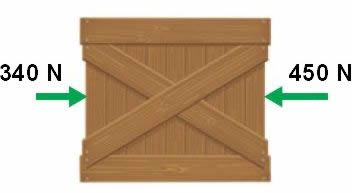
What is the net force of this object?
0 N
1 N
30 N
225 N

What is the net force of this object?
750 N
450 N
550 N
0 N

What is the net force of this object?
10 N
1000 N
1375 N
1125 N
Which of the following is Newton's First Law of Motion (Law of Inertia)?
The property of matter that resists change in motion or direction unless acted upon by an unbalanced force
An unbalanced net force on an object will cause acceleration
For every force, there is an equal and opposite force
Which of the following is Newton's Third Law of Motion (Law of Action/Reaction)?
The property of matter that resists change in motion or direction unless acted upon by an unbalanced force
An unbalanced net force on an object will cause acceleration
For every force, there is an equal and opposite force
Which of the following is Newton's Second Law of Motion (F=ma)?
The property of matter that resists change in motion or direction unless acted upon by an unbalanced force
An unbalanced net force on an object will cause acceleration
For every force, there is an equal and opposite force
An object experiences 20 m/s2 acceleration and has a mass of 7 kg. Find the force. F=ma
13 N
140 N
27 N
3 N
An object experiences 10 m/s2 acceleration when pushed with 200 N of force. Find the object's mass. F=ma
210 kg
2000 kg
190 kg
20 kg
A 20 kg object experiences the following forces: 98 N normal force, 98 N gravitational force, 110 N applied force and 10 N frictional force. What is the object's acceleration? (Hint: you need to find net force first and it may be easier to draw the free body diagram.) F=ma
6 m/s2
30 m/s2
5 m/s2
0 m/s2
According to Newton's Third Law, a fly hitting a windshield experiences
the same force as the windshield.
less force than the windshield.
more force than the windshield.
According to Newton's Third Law, a bowling ball hitting bowling pins experiences
the same force as the pins.
less force than the pins.
more force than the pins.
According to Newton's Third Law, a bicycle hitting a parked car experiences
the same force as the car.
less force than the car.
more force than the car.
According to Newton's Third Law, Earth has a gravitational force pulling on you right now and you have an equal attraction of gravity on the earth. Why doesn't the earth accelerate toward you?
The earth is much more massive and requires much more force to make it move
The forces are not equal
The earth does accelerate towards you
Gravity is an Illuminati conspiracy

What is the net force on an object experiencing 100 N of applied force to the left and 50 N of friction?
150 N
50 N
5000 N
2 N
If an object has a mass of 20 kg and a velocity of 4 m/s, what is the momentum of the object?
80 kgm/s
4 kgm/s
5 kgm/s
.2 kgm/s

