
NEW
Font size
S
M
L
XL
 Worksheets
SPS8abcd Woodfin
Total questions: 66
Worksheet time: 5hrs 47mins
Name
Class
Date
1.
An ice skater at rest pushes against a sled at rest, causing both the skater and sled to move away from each other with different accelerations. This is an example best described by
a)
Newton’s first law of motion for objects at rest.
b)
Newton’s first law of motion for objects in motion.
c)
Newton’s second law of motion.
d)
Newton’s third law of motion.
2.
What is the definition of "weight"?
a)
the force in which gravity pulls on an object
b)
the time it takes to get on a ride
c)
the amount of matter in an object
d)
the size of an object
3.
An empty truck and a fully loaded truck are next to each other at a traffic light. When the light turns green, the lighter truck increases speed more quickly. Which of these best explains this situations
a)
Newton's first law
b)
Newton's second law
c)
Newton's third law
d)
Conservation of momentum
4.
Our balloon rocket experiment launched the balloon on the straw with air blowing out of the balloon and the balloon traveling in the opposite direction. Which of Newton's laws is this?
a)
first
b)
second
c)
third
d)
fourth
5.
If you travel to Mars, where gravity is 38% of Earth's gravity, what will happen to your mass and weight?
a)
Your mass and weight will both be greater than on Earth.
b)
Your mass and weight will both be less than on Earth.
c)
Your mass will be the same, but your weight will be less than on Earth.
d)
Your mass will be less than on Earth, but your weight will be the same.
6.

A ____________ is a push or a pull on an object.
a)
friction
b)
force
c)
magnet
d)
gravity
7.

What is the net force?
a)
10 N
b)
0 N
c)
25 N
d)
1 N
8.

If these teams are pulling with the same amount of force what will happen?
a)
The boy in blue will win.
b)
They will not move at all.
c)
The boy in red will win.
d)
Both will fall down.
9.
The sum of all forces acting on an object.
a)
Contact Force
b)
Balanced Force
c)
Unbalanced Force
d)
Net Force
10.

Balanced or Unbalanced?
a)
Balanced
b)
Unbalanced
11.
The force that pulls objects towards Earth.
a)
Gravity
b)
Friction
c)
Inertia
d)
Force
12.
The tendency of an object at rest to stay at rest unless it is acted upon by a force is called ___________________
a)
inertia
b)
motion
c)
gravity
d)
lubricant
13.

What is the net force?
a)
400 N Up
b)
400 N Down
c)
- 400 N Down
d)
800 N Down
14.
A force acting in the opposite direction of an object in motion
a)
Gravity
b)
Buoyant
c)
Friction
d)
Normal
15.
According to Newton’s first law of motion, a moving object that is not acted on by an unbalanced force will
a)
remain in motion.
b)
eventually come to a stop.
c)
change its momentum.
d)
accelerate.
16.
Acceleration is caused by a force acting on a mass.
a)
Newton’s first law of motion
b)
Newton’s second law of motion
c)
Newton’s third law of motion
17.
Unit of mass
a)
m/s 2
b)
m/s
c)
newtons
d)
kg
18.
45 m/s2 is the...
a)
Mass
b)
Force
c)
Acceleration
d)
weight
19.
If an object was accelerating at 10 m/s^2, and a force of 10 newtons was required to accelerate it, what was the object's mass?
a)
1 kilogram
b)
10 kilograms
c)
2 kilograms
d)
5 kilograms
20.
What is the formula for force?
a)
F=M/A
b)
F=A/M
c)
F=M*A
d)
F=M*F
21.
Newton's third law states that any action will have a(n) _______ and ______ reaction
a)
Equal and similar
b)
Equal and opposite
c)
Equal and different
d)
Greater and opposite
22.
You hit a wall with a stick. The equal but opposite reaction is _____
a)
the wall pushes against you
b)
the stick pushes against you
c)
you push against the stick
d)
the wall pushes against the stick
23.
What is the speed of an object that travels 20 meters in 4 seconds?
a)
80 m/s
b)
0.2 m/s
c)
5 m/s
d)
24 m/s
24.

What law of motion does this picture represent?
a)
Newtons 1st law
b)
Newtons 4th law
c)
Newtons 3rd law
d)
Newtons 2nd law
25.
Who invented the 3 Laws of Motion?
a)
Sir Francis Bacon
b)
Sir Isaac Newton
c)
Johannes Kepler
d)
Galileo Galilei
26.
What is the unit to MEASURE force?
a)
Kilogram
b)
Meter
c)
Pascal
d)
Newton
27.

Which object will hit the ground first?
a)
Paperclip
b)
Bowling Ball
c)
Both will hit at the same time.
28.
Objects falling at the same rate have the same _______________.
a)
distance
b)
gravity
c)
acceleration
d)
mass
29.
Joe throws the ball from the pitcher's mound to home plate. Jen drops a ball down to the pitcher's mound. Which ball will hit the ground first?
a)
Joe's ball
b)
Jen's ball
c)
both balls
d)
neither one
30.
A shot put has a mass of 12kg and an acceleration of 2 m/s2. Calculate the force. F= ma
a)
.16 N
b)
6 N
c)
24 N
d)
24kg
31.
____ is done when a force is applied over a distance.
a)
energy
b)
work
c)
force
32.
A simple machine is a device that helps to reduce the amount of _____ required to work.
a)
force
b)
energy
c)
work
33.
A simple machine that is made up of an incline plane wrapped around a cylinder. It is often used to hold things together.
a)
lever
b)
screw
c)
wedge
34.
A simple machine that can split things apart or hold a door open.
a)
wedge
b)
screw
c)
lever
35.
A ______ is a grooved wheel with a rope running along the groove.
a)
lever
b)
pulley
c)
screw
36.
How much work is done if I use 10 Newtons to move an object 3 meters?
a)
30 Newtons
b)
13 meters
c)
30 Joules
d)
30 meters
37.
How much work is done if I use 5 Newtons to move an object 2 meters?
a)
10 Newtons
b)
10 meters
c)
10 Joules
d)
7 Joules
38.

How could I reduce the effort force needed to lift the load?
a)
move the fulcrum away from the load
b)
move the fulcrum closer to the load
c)
place the fulcrum in the middle
39.

This device
a)
wedge
b)
lever
c)
incline plane
d)
wheel and axle
40.

Lightbulb
a)
wedge
b)
pulley
c)
incline plane
d)
screw
41.
How much work is done in holding a 15 N sack of potatoes while waiting in line at the grocery store for 3 minutes?
a)
15 J
b)
45 J
c)
0 J
d)
5 J
42.
A person weighing 600 N gets on an elevator. The elevator lifts the person 6 m in 10 seconds. How much power was used?
a)
360 W
b)
60 W
c)
3600 W
d)
600 W
43.

800 Newtons of force moving a distance of 20 meters will be how much work done?
a)
40 J
b)
1,600 J
c)
400 J
d)
16,000 J
44.

If the weight of the block is 10N, how much force does one have to apply to lift it using this pulley (MA=2)?
a)
2N
b)
5N
c)
10N
d)
15N
45.
Calculate the amount of work done if you use a 100N force to push a 50 kg box 5 m across the kitchen floor.
a)
250 J
b)
500 J
c)
5000 J
d)
50,000 J
46.

What is the mechanical advantage of the block and tackle used to lift the bale of cotton?
a)
1
b)
2
c)
3
d)
4
47.
Using a lever, Joe is able to lift a 10,000 N car off of the ground with a force of 1000 N. What is the mechanical advantage of the lever?
a)
1
b)
10
c)
100
d)
1000
48.

This 2000 N weight is raised 1 meter by pulling 4 meters of rope. What force was required to pull the rope?
a)
500 N
b)
1000 N
c)
2000 N
d)
8000 N
49.

To lift this 2000 N weight to a height of 1 meter by hand, a mover did 2000 joules of work. Assuming the pulleys are frictionless, how much work does he do when using this block-and-tackle device?
a)
500 J
b)
1000 J
c)
2000 J
d)
4000 J
50.

Jeff is a landscaping contractor and lifts a rock weighing 600 pounds by wedging a board under the rock. Jeff weighs 150 pounds and puts all of his weight on the lever. How much mechanical advantage did the lever provide to Jeff in lifting the rock?
a)
0
b)
2
c)
4
d)
8
51.
Calculate the mechanical advantage of a pulley if it lifted a 2000N car if a 600N force was applied to it. Select the nearest answer.
a)
1
b)
3
c)
10
d)
15
52.

Calculate the average speed (in meter/sec) if a cheetah runs 180 meters in 10 seconds.
a)
198 m/sec
b)
170 m/sec
c)
12 m/sec
d)
18 m/sec
53.

What is happening at D?
a)
Stationary
b)
Accelerating
c)
Fast steady speed; moving away from the starting position
d)
Slower steady speed; moving away from the starting position
54.

What is happening at E?
a)
Stationary
b)
Accelerating
c)
Fast steady speed; moving away from the starting position
d)
Steady speed; returning to start position
55.
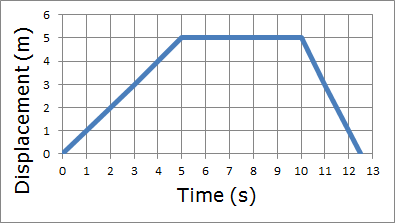
According to the graph how far does the person travel in the first 5 seconds?
a)
2 m
b)
10 m
c)
0 m
d)
5 m
56.
Find the velocity of a truck that travels 75 miles north in 2.5 hours.
a)
187.5 mph north
b)
30 mph north
c)
300 mph north
d)
200 mph north
57.

A roller coasters accelerates from an initial velocity of 6.0 m/s to a final velocity of 70 m/s over 4 seconds. What's the acceleration?
a)
24 m/s2
b)
18 m/s2
c)
16 m/s2
d)
16 m/s
58.
Changes in our speed, direction or both are called _________.
a)
gravity
b)
changes
c)
acceleration
d)
deceleration
59.
Shona cycles at an average speed of 8km/h. How far has she traveled if she cycles for 4 hours?
a)
55km
b)
32km
c)
43km
d)
32miles
60.
It took 3.5 hours for a train to travel the distance between two cities at a velocity of 120 miles/hr. How many miles lie between the two cities?
a)
34 miles
b)
420 miles
c)
120 miles
d)
360 miles
61.
A car accelerates from 15 m/s to 60 m/s in 30 seconds. What is its acceleration?
a)
2 m/s2
b)
3 m/s2
c)
1.5 m/s2
d)
0.75 m/s2
62.
If the speed of an object does not change, the object is traveling at
a)
constant speed
b)
average speed
c)
increasing speed
d)
decreasing speed
63.
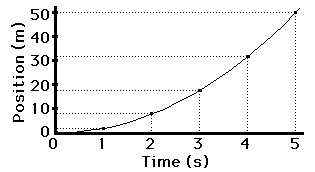
The picture of the position vs. time graph shows an object that is...
a)
accelerating/speeding up
b)
moving at a constant speed
c)
not moving
d)
accelerating/slowing down.
64.

Determine the motion of the car.
a)
at rest
b)
moving at constant speed
c)
speeding up
d)
slowing down
65.
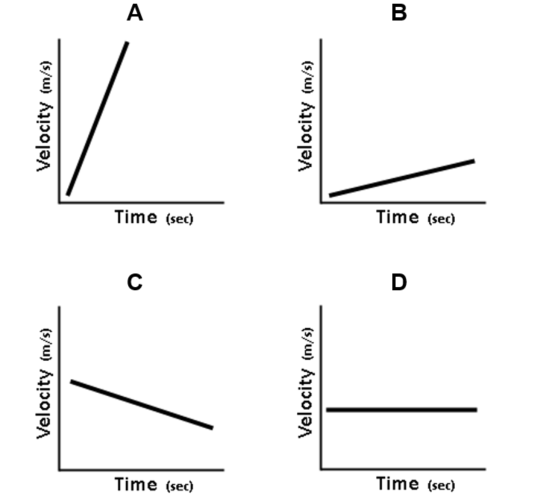
Which graph represents zero acceleration (constant velocity)?
a)
A
b)
B
c)
C
d)
D
66.
In each of the following cases, determine where the car has no acceleration ?
a)
A car shortly after a stoplight turns green.
b)
A car approaching a red light
c)
A car with the cruise control set at 80 km/h
d)
A car turning a curve at a constant speed
Reset

