wayground logo

Free Printable Worksheets

Font size

S
M
L
XL
Worksheets

Quarter 3 Review

Total questions: 32

Worksheet time: 51mins

Name
Class
Date
1.
If the number of protons changes, does the atom change its identity?
a)
YES!
b)
NO!
2.

True/False: Compounds are made of two or more different elements.

a)

True

b)

False

3.

What particle uniquely identifies an element?

a)

Number of Valence Electrons

b)

Number of Protons

c)

Number of Electrons

d)

Atomic Mass

4.
Is water an element or a compound?
a)
Element
b)
Compound
5.
A compound consists of two or more elements bound together.
a)
True
b)
False
6.
Is Iron (Fe) an element or a compound?
a)
Element
b)
Compound
7.
Which thing in this picture represents a gas? 
a)
ice cubes
b)
bubbles 
c)
soda
8.
Which form of matter has a definite shape like this picture?
a)
liquid
b)
solid
c)
gas
d)
clay
9.
Which form of matter take the shape of a container like this juice?
a)
liquid
b)
solid
c)
glass
d)
gas
10.
Which form of matter fills the space like it has in the balloon?
a)
liquid
b)
string
c)
solid
d)
gas
11.
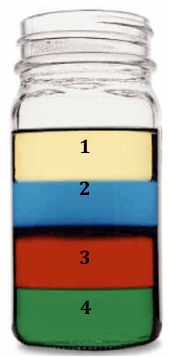
Put the liquids in order from most dense to least dense?
a)
4, 3, 2, 1
b)
1, 2, 3, 4
c)
3, 4, 2, 1, 
d)
4, 3, 1, 2
12.
Why does ice float?
a)
Liquid water is less dense than solid water.
b)
Solid water is less dense than liquid water.
c)
Gaseous water is less dense than solid water.
d)
Liquid water is less dense than gaseous water.
13.
In general what is the most dense form of matter?
a)
solid
b)
liquid
c)
gas
d)
plasmas
14.
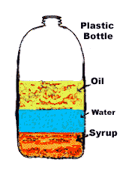
Which liquid is the least dense?
a)
oil
b)
water
c)
syrup 
d)
plastic bottle
15.
Bobby observed that a metal trash can was covered with rust.  What type of weathering caused the rust on the trash can?
a)
Mechanical weathering 
b)
Wind weathering
c)
Chemical weathering
d)
Erosion weathering
16.
Which diagram represents mechanical weathering?
a)
G
b)
F
c)
H
d)
J
17.
What is the weathering process in which rocks are broken down into smaller pieces (sediments) and do not change the rock composition?
a)
Acid weathering 
b)
Gravity weathering
c)
Chemical weathering
d)
Mechanical weathering
18.

What is the process of moving sediments from location to another?

a)

Deposition

b)

Erosion

c)

Weathering

d)

Compaction

19.

Which of these is an example of erosion?

a)

Light shinning onto a mountain

b)

Rain breaking down rock

c)

Wind blowing away sediment

d)

All of the above

20.

What is the difference between weathering and erosion?

a)

Erosion breaks down the rocks, and weathering carries the broken pieces away.

b)

Erosion carries broken pieces away, and weathering builds the pieces back up into another land mass.

c)

Weathering carries broken pieces away, and erosion builds the pieces back up into another land mass.

d)

Weathering breaks down rocks, and erosion carries the broken pieces away.

21.

_____________ is the dropping off/ depositing of rocks.

a)

Metamorphosis

b)

Deposition

c)

Weathering

d)

Erosion

22.
How much salt water covers the earth?
a)
55%
b)
65%
c)
75%
d)
85%
23.
Forms of precipitation are-
a)
only sleet and snow
b)
rain, sleet, hail, and snow
c)
only dew and rain 
d)
only snow and rain
24.
Precipitation occurs because 
a)
the droplets evaporate in the air
b)
the droplets are too light for the air to hold
c)
the droplets are too heavy for the air to hold
25.
The ________ is the driving force of the earth's surface.
a)
sun
b)
moon 
c)
stars
26.
The water cycle has no start or end
a)
true
b)
false
27.
What is it called when water is formed from a liquid to a water vapor?
a)
EVAPORATION
b)
PRECIPITATION
c)
TRANSPIRATION
28.
What is it called when plants give off water vapor as a waste product?
a)
condensation
b)
evaporation
c)
sublimation
d)
transpiration
29.
Which represents the distribution of water on Earth?
a)
3% freshwater, 97% salt water
b)
97% freshwater, 3% salt water
c)
71% freshwater, 29% salt water
d)
29% freshwater, 71% salt water
30.
Where is most of the freshwater found on Earth?
a)
lakes
b)
glaciers
c)
oceans
d)
rivers
31.

What percent of Earth's freshwater is available for humans to use?

a)

3

b)

less than 1

c)

97

d)

10

32.
The process where rain water soaks into the ground through soil and rocks is called __________.
a)
precipitation
b)
infiltration
c)
evaporation
d)
condensation