wayground logo

Free Printable Worksheets

Font size

S
M
L
XL
Worksheets

Waves Quiz

Total questions: 32

Worksheet time: 1hrs 29mins
Name
Class
Date
1.
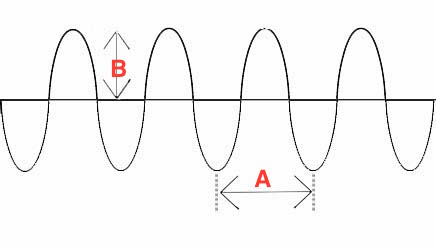
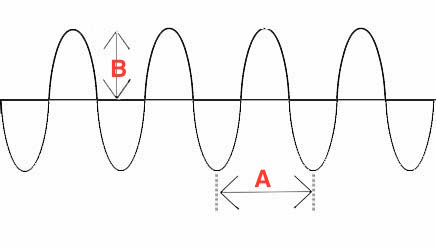
What property of this wave is represented by the letter "A"
a)
amplitude
b)
crest
c)
trough
d)
wavelength
2.
What property of the wave is represented by the letter "B"?
a)
amplitude
b)
crest
c)
trough
d)
wavelength
3.
The highest point on a wave is:
a)
the crest
b)
the trough
c)
the top
d)
the coast 
4.
The lowest point on a wave is the:
a)
Amplitude
b)
Crest
c)
Trough
d)
Wavelength
5.
The number of wavelengths that pass a point each per second is:
a)
frequency
b)
period
c)
longitudinal 
d)
transverse wave 
6.
Which is the correct equation for calculating the speed of a wave?
a)
T = 1/f
b)
Speed= Wavelength x Period
c)
Speed = Wavelength/Frequency
d)
Speed= Wavelength x Frequency
7.
When the frequency of a wave increases, what happens to the wavelength?
a)
The wavelength is not directly affected by the frequency of a wave.
b)
The wavelength increases.
c)
The wavelength decreases.
d)
More specific information is needed to form a conclusion about the wavelength.
8.
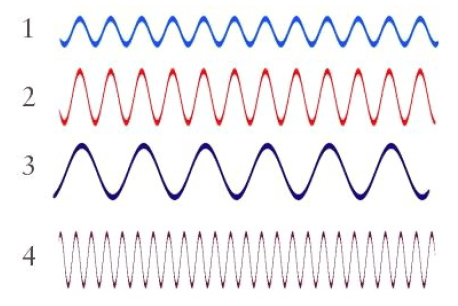
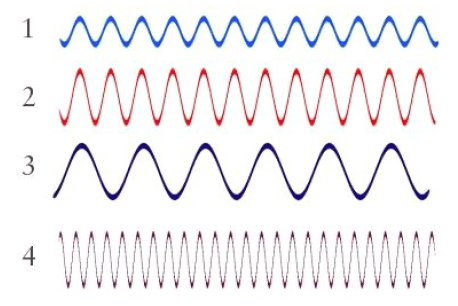
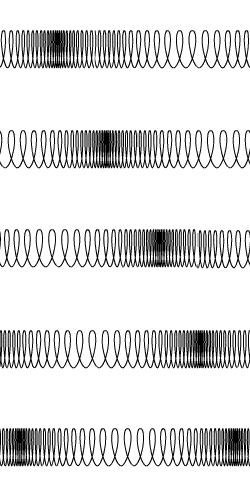
Which wave in the diagram has the greatest frequency?
a)
1
b)
2
c)
3
d)
4
9.
Which wave in the diagram has the greatest wavelength?
a)
1
b)
2
c)
3
d)
4
10.
1.  A wave has frequency of 50 Hz and a wavelength of 10 m. What is the speed of the wave?
a)
500 m/s
b)
50 m/s
c)
5 m/s
d)
0.5 m/s
11.
1.  A wave has frequency of 5 Hz and a speed of 25 m/s. What is the wavelength of the wave?
a)
25 m
b)
125 m
c)
5 m
d)
25 m/s
12.
What type of waves have compressions and rarefactions?
a)
longitudinal
b)
transverse
13.
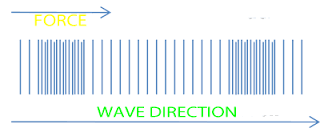
What type of wave is this?
a)
Longitudinal
b)
Transverse
14.
Which part of a longitudinal wave is where particles are packed closely together?
a)
compression
b)
rarefaction
c)
crest 
d)
amplitude
15.

What is transferred from place to place by waves?

a)

matter

b)

energy

c)

particles

d)

light

16.

If the amplitude increases, the energy of the wave:

a)

increases

b)

decreases

c)

stays the same

17.

What happens when you increase the amplitude of a sound?

a)

it makes the sound louder

b)

it makes the sound travel faster

c)

it makes the sound softer

d)

it changes the pitch or note of the sound

18.

What kind of wave is pictured below?

a)

compressional wave

b)

transverse wave

c)

longitudinal wave

d)

mechanical wave

19.

If a wave has a greater frequency, what happens to the wavelength?

a)

increases

b)

decreases

c)

stays the same

20.

This sound has high pitch, which means it has a(n):

a)

Higher frequency

b)

Lower frequency

c)

Higher amplitude

d)

Lower amplitude

21.

How are the frequency of a wave and the period related?

a)

They both equal the wavelength.

b)

They are both the inverse of the wavelength.

c)

They are the inverse of each other

d)

They are both related to the amplitude.

22.

Longitudinal waves move __________ to the energy of the wave (select all that apply).

a)

Parallel

b)

Perpendicular

c)

At a 90 degree angle

d)

In the same direction

23.

Transverse waves move __________ to the energy in the wave (select all that apply).

a)

Parallel

b)

Perpendicular

c)

In the same direction

24.

The areas of a longitudinal waves where particles are spread far apart from each other are called:

a)

rarefactions

b)

compressions

c)

amplitude

d)

wavelength

25.
the maximum distance that the particles of the medium carrying the wave  move away from their rest position
a)
frequency
b)
wavelength
c)
hertz
d)
amplitude
26.
Wave __________ is the number of complete waves that pass a given point in a certain amount of time.
a)
Frequency
b)
Wavelength
c)
Amplitude
d)
Compression
27.
The material through which a wave travel 
a)
trough
b)
medium
c)
crest
d)
vibration
28.
A disturbance that transfers energy from place to place
a)
Energy
b)
Wave
c)
Force
d)
Motion
29.

What is the frequency of the wavelength?

a)

8 Hz

b)

0.5 Hz

c)

0.25 Hz

d)

4 Hz

30.

What is the wavelength?

a)

1 m

b)

3 m

c)

2 m

d)

9.5 m

31.

What is the net force (direction and magnitude) acting on the box?

a)

30N, right

b)

30N, left

c)

5N, left

d)

25N, left

32.

The similarities of bone structure in the diagram provide evidence of what?

a)

The organisms probably use there forelimbs for the same thing.

b)

The organisms evolved from a common ancestor.

c)

The organisms have the same DNA.

d)

All vertebrate species have identical forelimbs.