
 Worksheets
IB Topic 6 (4-6)
Total questions: 86
Worksheet time: 3hrs 23mins
Which term describes the physical movements in the thorax which bring fresh air to the alveoli and remove stale air?
gas exchange
respiration
ventilation
circulation
Which of the following is/are processes of all living organisms?
ventilation
homeostasis
metabolism
respiration
Which of the following is/are true for inhalation?
internal intercostal muscles contract
ribcage moves up and out
volume in the thorax decreases
air enters when pressure in the thorax is below atmospheric pressure
Which of the following is/are true for exhalation?
internal intercostal muscles contract
abdominal muscles relax
diaphragm muscle relaxes and is dome-shaped
the pressure in the thorax increases above atmospheric pressure
Which of the following is/are correct adaptations of alveoli for fast gas exchange?
thin cell wall gives a short diffusion distance
moist inner surface to dissolve O2 and CO2
gas exchange maintains concentration gradients between alveoli and blood
close to blood capillaries gives a short diffusion distance

Ventilation maintains a high concentration of oxygen in the alveoli.
Which one of the following maintains a low concentration of oxygen in blood capillaries that are close by?
respiration
perspiration
circulation
evaporation
Which of the following is/are true of Type 1 pneumocytes?
They are thin and permeable cells
They secrete a chemical called surfactant
There is a single layer of these cells in alveoli walls
They help to dissolve gases
Which of the following is/are true of Type 2 pneumocytes?
The surfactant that they secrete increases surface tension
They prevent the sides of alveoli from sticking together
They help gases to dissolve
They are found on the inner surface of alveoli
Which of the following is/are true of the lung disease emphysema?
It is caused by bacteria
Damaged cells release trypsin enzyme
Elastic fibres in alveoli membranes are digested
Alveoli walls break down
Which of the following is/are true of the lung disease emphysema?
The diffusion distance between alveoli and blood increases
Alveoli become larger
Cilia are damaged so less bacteria can enter the lungs
Alveoli cannot recoil as easily so it is more difficult to exhale

What is the main reason for placing an oxygen mask on a patient, who has a severe lung disease?
It makes them feel less tired
It increases the concentration gradient for oxygen between the alveoli and blood capillaries
It allows aerobic respiration to occur
It allows oxygen to diffuse faster into the alveoli from blood capillaries

Which of the following muscles relax during inhaling?
A only
B only
A and C
B and C|
Which of the following muscles relax during exhaling?
A only
B only
A and C
B and C
Which of the following is/are reason(s) that alveoli are adapted for fast gas exchange?
thin cell membrane
many large sacs create a large surface area
impermeable walls
close to blood capillaries

The fatty substance that lines the inner surface of the alveoli and prevents alveoli from collapsing.
pleural fluid
ciliated mucus
surfactant
mucus
Who is more likely to develop COPD?
Aunt Jane who works at a day care
Cousin Jessica who is being treated for sinusitis
Grandma who had influeza last year
Uncle John who smokes a pack of cigarettes a day
Given the following structures:
1. larynx
2. nasal cavity
3. pharynx
4. trachea
Which of the following is the correct order that air would flow during inhalation.
1,2,3,4
2,3,1,4
2,1,3,4
4,2,3,1

Which of the following is/are true of the lung disease emphysema?
It is caused by bacteria
It is non-life threatening
Elastic fibres in alveoli membranes are digested
It is when the alveoli walls break down

What part of the neuron receives incoming messages from other cells?
nucleus
cell body
dendrites
synaptic terminals

What structure(s) aid in speeding up synaptic transmission across the axon?
Nodes of Ranvier
dendrites
myelin sheath
both Nodes of Ranvier and the myelin sheath
The central nervous system
consists of the brain and spinal cord
consists of the nerves that communicate motor and sensory signals throughout the rest of the body

Structure B represents
a sensory receptor
an interneuron
a motor neuron
a sensory neuron

During which stage of this action potential do sodium ions (Na+) flow through the sodium channels from the outside of the membrane to the inside of the membrane?
threshold
depolarization
repolarization
refractory period

During which stage of the action potential does the membrane return to its resting state?
undershoot to threshold
depolarization
rising phase of the action potential
falling phase of the action potential
An action potential
is another name for a nerve impulse
is an all or none response to the depolarization of the membrane of the nerve cell
cannot occur unless the nerve cell is at its resting potential
all of these answers are correct
What is released by the presynaptic membrane into the synaptic cleft?
neurotransmitters
excitatory neurotransmitters
inhibitory neurotransmitters
all of these are released by the presynaptic membrane
The sodium-potassium pump
uses diffusion to attain -70mV
uses ATP to create a membrane differential along the axon
is stimulated by neurotransmitters
is an example of passive transport across a membrane
The operation of the sodium-potassium "pump" moves:
sodium & potassium ions into the cell
sodium & potassium ions out of the cell
sodium ions out of the cell & potassium ions into the cell
sodium ions into the cell & potassium ions out of the cell
After depolarization what happens to restore resting potential?
Sodium channels open & sodium ions diffuse out of the neuron.
Potassium channels open and potassium ions diffuse into the neuron.
Potassium channels open and potassium ions diffuse out of the neuron.
Sodium channels open and sodium ions diffuse into the neuron.


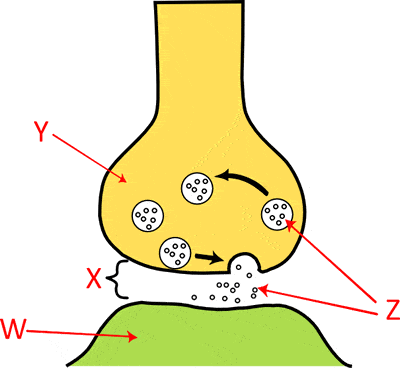

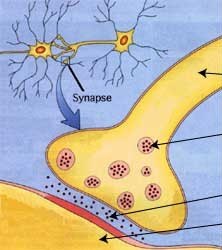
The location of neurotransmitters
axon terminals
dendrites
Schwann cells
cell body
Z
Axon Terminal Button
Neurotransmitters
Dendrite
Synapse
X
Axon Terminal Button
Neurotransmitters
Dendrite
Synapse

What chemical is activated by the action potential in the presynaptic neuron that causes the vesicles containing neurotranmitters to move toward the synaptic cleft?
calcium
potassium
sodium
phosphorus
Which of the following restores the resting membrane potential in a neurone?
I. Na+ channels opening
II. K+ channels closing
III. The Na+/K+ ATP pump
I and II only
II and III only
I and III only
III only
Which one of the following is involved in maintaining a resting membrane potential?
Na+ channels open and Na+ diffuses into the neuron
Na+ channels close and Na+ cannot diffuse out of the neuron
Na+ channels open and Na+ diffuses out of the neuron
Na+ channels close and Na+ cannot diffuse into the neuron
Which one of the following is involved in maintaining a resting membrane potential?
K+ channels open and K+ diffuses into the neuron
K+ channels close and K+ cannot diffuse out of the neuron
K+ channels open and K+ diffuses out of the neuron
K+ channels close and K+ cannot diffuse into the neuron
What is essential for conduction of nerve impulses to be saltatory?
Reaching the threshold potential in dendrites
Pumping potassium ions into the neuron
Pumping sodium ions into the neuron
Wrapping of myelin around the axon
Why is the speed of an impulse increased if a neurone is wrapped in myelin?
potassium ions flow out of the neurone faster
myelin insulates the neurone so the temperature increases
the impulse can jump from node to node
it allows neurones to touch each other

The pancreas produces _____ when your blood sugar level is high.
Thyroxin
Melatonin
Glucagon
Insulin

Which hormones are secreted from the pancreas?
glucagon & leptin
glucagon & melatonin
thyroxin & insulin
insulin & glucagon
Which hormone is involved in biological clock and seasonal activities?
insulin
melatonin
leptin
thyroxin
Where does thyroxine come from?
Thyroid gland
Ovary
Brain
Adrenal gland
What does insulin affect?
Stomach and intestines
Blood and heart
Liver, muscle and fat tissue
Lungs
Leptin is secreted by......
cells in the adipose tissue
cells in the hypothalamus
cells in the pancreas
cells in the thyroid
Which hormone is associated with jet lag?
insulin
thyroxin
melatonin
leptin
Which are TRUE about insulin? (2)
it is secreted by alpha (α) cells in the pancreas
it is secreted by beta (β) cells in the pancreas
it causes an uptake of glucose into cells all over the body
it causes enzymes to convert glycogen and amino acids into glucose
What are 3 effects of insulin?
An increase in the rate at which glucose is used in respiration
To trigger conversion of glucose to glycogen
To trigger glucose to fatty acids and fats
To reduce the rate of respiration
Which of the following statements is TRUE regarding the regulation of blood glucose levels?
The hypothalamus monitors blood glucose levels
The beta (β) cells in the pancreatic islets of Langerhans monitor blood glucose levels
Abnormally high levels or concentrations of blood glucose is called hypoglycemia
Abnormally low levels or concentrations of blood glucose is called hyperglycemia

What do you call the fusion of egg and sperm cell?
menses
homeostasis
fertilization
ovulation

Where does fertilization usually take place?
ovary
oviduct
uterus
vagina

What is the mystery part?
Vagina
Uterus
Cervix
Ovaries

Epididymis
Prostate gland
Bladder
Seminal gland

Ovary
Oviduct
Uterus
Cervix

Which of the following is TRUE about ovulation?
Estrogen levels reach a 'critical' peak, stimulating the secretion of LH
Estrogen levels reach a 'critical' peak, stimulating the secretion of FSH
Progesterone levels reach a 'critical' peak, stimulating the secretion of LH
Progesterone levels reach a 'critical' peak, stimulating the secretion of FSH

The ovarian follicle development is stimulated by......
FSH
LH
Estrogen
Progesterone

Which hormone stimulates the build up of the endometrium?
FSH
LH
Estrogen
Progesterone

Ovulation is trigged by a surge in.....
FSH
LH
Estrogen
Progesterone

cervix
endometrium
ovary
vagina

epididymis
sperm duct
seminal vesicle
urethra

Where is testosterone made?
Prostate gland
Pituitary gland
Testis
Seminal vessicle

A - FSH; B - LH; C - Progesterone; D - Estrogen
A - Estrogen; B - Progesterone; C - LH; D - FSH
A - Progesterone; B - Estrogen; C - FSH; D - LH
A - FSH; B - LH; C - Estrogen; D - Progesterone
The following is true of FSH....
It is secreted by the pituitary gland and stimulates the development of several immature egg cells in the ovary
It stimulates the build up of the endometrium for possible implantation of an embryo should fertilization occur
It continues the build up of the endometrium, further preparing for the possible implantation of an embryo should fertilization occur
It is secreted by the pituitary gland and stimulates ovulation, release of the mature egg cell.

The following is a good example of a positive (+ve) feedback system.....
Estrogen leading to an increase in FSH receptors in the follicles, increasing estrogen production further
Progesterone inhibiting further secretion of LH & FSH
Estrogen and progesterone inhibiting FSH secretion
Estrogen levels peaking resulting in LH being secreted
Thyroxin regulates _______.
sleep patterns
metabolism
blood sugars
sperm production
Which is NOT a response to an abnormally high concentration of blood glucose (hyperglycemia)?
Water is drawn from the cells and tissue fluid by osmosis back into the blood
Blood volume increases, so water is excreted by the kidneys to maintain the correct concentration of blood
The body becomes dehydrated and the circulatory system is deprived of fluid, resulting in blood pressure being unable to be maintained
Convulsions and coma occur
What is the correct order of events in fertilization?
fusion of gametes, acrosome reaction and then cortical reaction
cortical reaction, fusion of gametes and then acrosome reaction
acrosome reaction, fusion of gametes and then cortical reaction
fusion of gametes, cortical reaction and then acrosome reaction
How does the body respond to an increase in body temperature?
I. Vasoconstriction of skin arterioles
II. Shivering
III. Vasodilation of skin arterioles
I only
I and II only
II and III only
III only
Which of the following is/are a role of testosterone in males?
I. Pre-natal development of male genitalia
II. Maintenance of sex drive
III. Increase in mental development
II only
I and II only
II and III only
I, II, and III
The acronym GnRH, FSH and LH stand for:
Gonadotropin-retracting hormone, follicle stimulating hormone, luteinising hormone
Gonado- releasing hormone, follicle stimulus hormone, looting hormone
Gonadotropin-reacting hormone, follicle stopping hormone, lutenising hormone
Gonadotropin-releasing hormone, follicle stimulating hormone, lutenising hormone
Where are hormones produced (FSH, LH):
The hypothalamus
The anterior pituitary gland
The brain
The reproductive system
Progesterone is released by the female in order to:
Increase ovulation
Promote thick endometrium for implantation
Decrease ovulation
promote loss of endometrial lining
The corpus luteum remains after the ovum has been released. The purpose of this tissue is to:
Produce estrogen
Produce progesterone
Produce LH
Produce FSH
Identify the correct order of events:
Spermatozoa--> mitosis-->spermatogonia--> meiosis I and II
Meiosis I and II--> spermatogonia--> spermatozoa-->mitosis
Mitosis-->spermatoza--> Meiosis I and II--> spermatogonia
Spermatogonia--> mitosis--> meiosis I and II--> spermatozoa

