wayground logo

Free Printable Worksheets

Font size

S
M
L
XL
Worksheets

Topics from Days 1-4 for everyone

Total questions: 100

Worksheet time: 3hrs 37mins
Name
Class
Date
1.
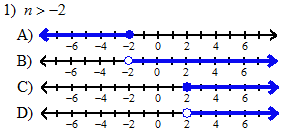
 Match the graph with the given solution.
a)
A
b)
B
c)
C
d)
D
2.
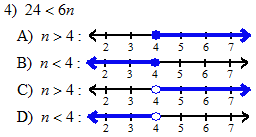
 Solve and then match the correct solution & graph.
a)
A
b)
B
c)
C
d)
D
3.
a)
greater than
b)
less than
c)
less than or equal to
d)
greater than or equal to
4.
a)
greater than
b)
less than
c)
less than or equal to
d)
greater than or equal to
5.
a)
greater than
b)
less than
c)
less than or equal to
d)
greater than or equal to
6.
a)
greater than
b)
less than
c)
less than or equal to
d)
greater than or equal to
7.
 Which inequality can be represented by the graph?
a)
x < 5
b)
x > 5
c)
x ≤  5
d)
x ≥ 5
8.
 Which inequality can be represented by the graph?
a)
x < 5
b)
x > 5
c)
x ≤  5
d)
x ≥ 5
9.
What inequality is graphed? 
a)
x > 2 and x ≤ -3
b)
x > 2 and x < -3
c)
x > 2 or x ≤ -3
d)
x > 2 or x < -3
10.
When graphing an inequality, you use an open dot when you use which symbol?
a)
<, >
b)
≤, ≥ 
11.
When you graph an inequality, you used a closed dot when you use which symbols?
a)
≤, ≥ 
b)
<, >
12.
Pick the correct letter for:
6 > x
a)
A
b)
B
c)
C
d)
D
13.

Which of the following is a compound inequality with "or"

a)
b)
c)
14.

0≤x<3

a)
b)
c)
15.

x≤-3 or x>2

a)
b)
c)
16.

2≤x≤4

a)
b)
c)
17.

What inequality is being represented?

a)

5<x<9

b)

5≤x≤9

c)

5<x≤9

d)

5≤x<9

18.
Express the following in Interval Notation
-8 ≤ x < 8
a)
[-8, 8]
b)
[-8,8)
c)
(-8, 8]
d)
(-8, 8)
19.
Express the following in Interval Notation
-9 < x ≤ -4
a)
[-9, -4]
b)
(-9,-4]
c)
[-9, -4]
d)
(-9,-4)
20.
Express the following in Interval Notation
 -9 < x ≤ -4
a)
[-9, -4]
b)
(-9,-4]
c)
[-9, -4]
d)
(-9,-4)
21.
Express the following interval in Set notation:
[3, 5]
a)
3 ≤ x ≤ 5
b)
3 < x ≤ 5
c)
3 ≤ x < 5
d)
3 < x < 5
22.
Express the following interval in Set notation:
(-7, 15]
a)
-7 ≤ x ≤ 15
b)
-7 < x ≤ 15
c)
-7 ≤ x < 15
d)
-7 < x < 15
23.
Express the following interval in Set notation:
(-63, -62)
a)
-63 ≤ x ≤ -62
b)
-63 < x ≤ -62
c)
-63 ≤ x < -62
d)
-63 < x < -62
24.
Write the following in interval notation
 x < 8
a)
(8, ∞)
b)
(8, -∞)
c)
(-∞, 8)
d)
[-∞, 8]
25.
Write the following in interval notation
x < 3 or x ≥ 5
a)
(3, -∞) or (∞, 5]
b)
[-∞, 3) or [5, ∞]
c)
(-∞, 3) or [5, ∞)
d)
(3, -∞] or [∞, 5]
26.
Write the following in interval notation
x > 6 and x ≤ 10
a)
(-∞, 6) and (10, ∞)
b)
[6, 10)
c)
(-∞, 6] and [10, ∞)
d)
(6, 10]
27.
Look at the Graph. Write the inequality in interval notation.
a)
[-4, -1)
b)
(-4, -1)
c)
(-4, -1]
d)
[-4, -1]
28.

Write the inequality in interval notation.

a)

[-4, -1)

b)

(-4, -1)

c)

(-4, -1]

d)

[-4, -1]

29.
What is the slope of the line represented by the equation y = 3x + 6?
a)
6
b)
3
c)
2
d)
1/2
30.
What is the slope of the line represented by the equation y = 7 - x?
a)
7
b)
0
c)
1
d)
-1
31.
What is the slope of the line represented by the equation y = -9?
a)
0
b)
-9
c)
9
d)
1
32.
What is the y-intercept of the line represented by the equation y = 6x?
a)
6
b)
0
c)
-6
d)
1
33.
The graph of x = -1 would be a horizontal line.
a)
True
b)
False
34.
Which equation represents the graph pictured?
a)
y = -2x - 6
b)
y = 2x - 6
c)
y = 1/2x - 6
d)
y = -1/2x - 6
35.
Which equation represents the graph pictured?
a)
y = 2x + 10
b)
y = 10x + 2
c)
y = 1/2x + 10
d)
y = 1/2x + 2
36.
Which equation represents the graph pictured?
a)
y = -2
b)
x = -2
c)
y = -2x
d)
y = x - 2
37.
Which equation represents the graph pictured?
a)
y = 3
b)
x = 3
c)
y = 3x
d)
y = x + 3
38.
simplify 5x3 2x2
a)
10x5
b)
3x
c)
10x6
d)
7x5
39.
Simplify to an equivalent expression BUT leave in exponent form.
                                   43⋅45
a)
48
b)
168
c)
415
d)
1615
40.
Simplify:   x⋅ x5
a)
x ⋅ x ⋅ x ⋅ x ⋅ x ⋅ x ⋅ x 
b)
x7
c)
x10
d)
x ⋅ x
41.
Simplify:  3x3 ⋅ 3x
a)
32x4
b)
3 ⋅ x ⋅ x ⋅ x ⋅3 ⋅ x 
c)
9x4
d)
3x4
42.
Simplify:   6x2 ⋅ 2y4 ⋅ x
a)
36x316y4
b)
6x3y4
c)
12x3y4
d)
8x3y4
43.
Evaluate the expression using the quotient rule.
a)
122
b)
130
c)
622
d)
630
44.
Division Law states: keep the base the same and do this to the exponents.
a)
multiply
b)
add
c)
subtract
d)
divide
45.
Evaluate the expression using the quotient rule.
a)
214 z13
b)
22/z7
c)
214/ z7
d)
2z7
46.
a)
a8b13
b)
a2b7
c)
a15b30
47.
-6k + 7k=
a)
k
b)
-k
c)
12k
d)
-12k
48.
n -10 +9n -3=
a)
-3
b)
9n-3
c)
n
d)
10n -13
49.
12r - 8 -12
a)
8
b)
12r + 4
c)
12r -20
d)
-8
50.
-2x + 11 + 6x
a)
8x+11
b)
4x +11
c)
4x
d)
15x
51.

Simplify this expression....

a)

10a

b)

7a

c)

5a2

d)

5a

52.

2 (x + 4)

a)

2x + 4

b)

2x + 8

c)

2x + 6

d)

10x

53.

3x (y + 4)

a)

3x3y + 4x

b)

3xy + 4x

c)

3xy + 12x

d)

3x + 3y + 12

54.

6 (x + y + 7)

a)

6x + 6y + 42

b)

12xy + 42

c)

6x + 6y + 7

d)

6x6y + 42

55.

Evaluate the function when x = 4

a)

f(4) = 2(4) - 5 = 3

b)

f(4) = 2(4) - 5 = -1

c)

f(4) = ½(4) + 1 = 3

d)

f(4) = 4

56.
What is the value of f(0)?
a)
-2
b)
2
c)
4
d)
0
57.
Using the pictured graph, what is f(-3)? 
a)
-3
b)
-1
c)
1
d)
3
58.

How do you read f(x)?

a)

f x

b)

f of x

c)

f parenthesis x

d)

f with an x inside parenthesis

59.
f(x) is the same thing as ______.
a)
y
b)
x
c)
input
d)
an equation
60.
What is the definition of function?
a)
Has inputs and outputs
b)
Every input has only ONE output
c)
Inputs have different outputs every time
d)
x-values and y-values
61.

What is the domain of the graph shown?

a)

{-2, -1, 0, 1, 2, 3, 4}

b)

{2, 3, 4}

c)

2 ≤ y ≤ 4

d)

-2 ≤ x ≤ 4

62.

Does the graph show a function?

a)

Yes

b)

No

63.

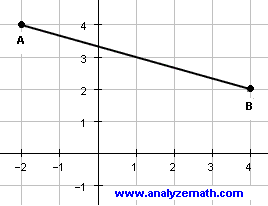
What are the x and y intercepts of the graph?

a)

x intercept: 4, y intercept 3

b)

x intercept: 3, y intercept 4

c)

x intercept: 4, y intercept -3

d)

x intercept: -4, y intercept 3

64.

For the set of ordered pairs (x, f(x)): (2, 10), (4, 20), (7, 35), (11, 55), what is the function f(x)?

a)

f(x) = x + 8

b)

f(x) = 10x

c)

f(x) = 7x - 12

d)

f(x) = 5x

65.

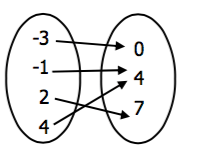
Which mapping diagram is not a function?

a)
b)
c)
d)
66.

Which graph is not a function?

a)
b)
c)
d)
67.

What is the test to determine if a graph represents a function?

a)

Horizontal line test

b)

Vertical line test

c)

Heidelberg Uncertainty Test

d)

Obi Wan Kenobi Test

68.
What is the range?
a)
{-3, -1, 2, 4}
b)
{0, 4, 7} 
c)
{0, 4, 4, 7}
d)
{7, 4, 0}
69.
What is the Domain of this linear function?
a)
-3 < x ≤ 5
b)
x = -1
c)
5 < x ≤ -3
d)
-2 < x ≤ 6
70.
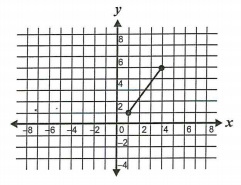
What is the range of the graph?
a)
1 ≤ x ≤ 5
b)
1 < x < 5
c)
1 ≤ y ≤ 5
d)
1 < y < 5
71.
What is the domain of the graph?
a)
{x| -∞ ≤ x ≤ ∞}
b)
(-∞,∞)
c)
-3 ≤ x ≤ 3
d)
-15 ≤ y ≤ 9
72.
All of the y values or outputs are called what?
a)
Domain
b)
Range
73.
All of the x values or inputs are called what?
a)
Domain
b)
Range
74.

A set of ordered pairs is called what?

a)

the domain

b)

a relation

c)

a function

d)

the range

75.

What is the domain of a relation?

a)

the set of all x-values

b)

the set of all y-values

76.

Which is the set of all y-values or the outputs?

a)

Domain

b)

Range

c)

Relation

d)

Function

77.
Is this graph a function or not a function? 
a)
Function 
b)
Not a Function 
78.

Use the table to determine G(2).

a)

20

b)

16.25

c)

12.50

d)

-3

79.

-6x = 30

a)

x = - 5

b)

x = 24

c)

x = 5

d)

x = 36

80.

t / (-8) = -5

a)

t = 3

b)

t = -40

c)

t = -3

d)

t = 40

81.
n - 4 = 12
a)
n = 16
b)
n = 8
c)
n = 4/12
d)
n = 12/4
82.
1/2 n = 10
a)
n = 10
b)
n = 5
c)
n = 20
d)
n = 12
83.

  y3=8\frac{y}{3}=8  

a)

 y=38y=\frac{3}{8}  

b)

 y=83y=\frac{8}{3}  

c)

y = 24

d)

y = 83

84.
Solve for x:
a)
x = 20
b)
x = 7
c)
x = 10
d)
x = 3
85.
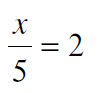
Solve for the missing variable:
a)
m = 5
b)
m = 1/5
c)
m = 25
d)
m = 55
86.
-16+ x= -15
a)
2
b)
0
c)
-1
d)
1
87.

 x2=10\frac{x}{2}=-10  

a)

-20

b)

20

c)

-5

d)

5

88.
-4x+1=21
a)
x=120
b)
x=5
c)
x=30
d)
x=-5
89.
Solve 2x - 3 = 1 
a)
3
b)
2
c)
1
d)
-2
90.
11b+7=40
a)
2
b)
1
c)
4
d)
3
91.
9 = 2s + 1 
a)
4
b)
-4
c)
3.5
d)
5
92.
Solve.   2x + 10 = 16
a)
6
b)
3
c)
26
d)
13
93.

 x4+11=20\frac{x}{4}+11=20  

a)

9

b)

36

c)

 94\frac{9}{4}  

d)

 414\frac{41}{4}  

94.
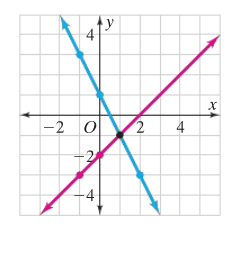
What is the solution?
a)
(1, -1)
b)
(-1, 1)
c)
(0, -2)
d)
(0, 1)
95.
Give the solution to the system.
a)
(3,1)
b)
(1,3)
c)
(-1,3)
d)
(1, -3)
96.
Parallel Lines never intersect because...
a)
they have the same slopes. 
b)
they have the same y-intercept.
c)
they have different slopes.
d)
they have different y-intercepts. 
97.
If a system of linear equations has one solution, what does this mean about the two lines? 
a)
Parallel lines
b)
the same line 
c)
Intersecting lines
98.
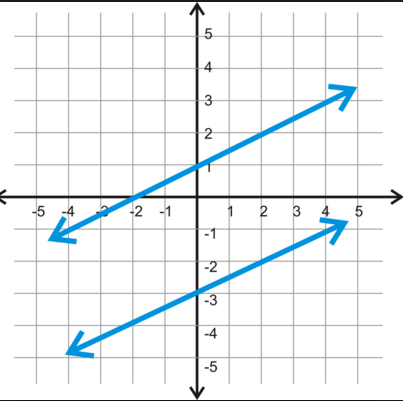
How many solutions will this system have? 
a)
No solution
b)
One Solution
c)
I Don't Know
d)
Infinitely Many Solutions
99.
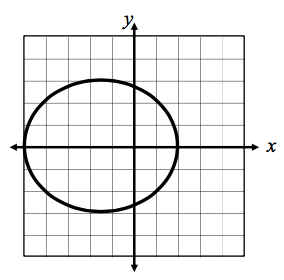
Determine the number of solutions to the given linear-quadratic system.
a)
0 solutions
b)
1 solution
c)
2 solutions
d)
3 solutions
100.
How many solutions does the system have?
a)
1 solution
b)
2 solutions
c)
no solutions
d)
infinite solutions