
 Worksheets
Cell Transport Review
Total questions: 40
Worksheet time: 10hrs 0mins


This image is an example of a phospholipid. Which part of a phospholipid is HYDROPHOBIC?
the phosphate "head"
the lipid "tails"
This image is an example of a phospholipid. Which part of a phospholipid is HYDROPHILIC?
the phosphate "head"
the lipid "tails"

What is C pointing to?
A carbohydrate
A phosphate
A protein
A lipid
Which of the following is not another name for the cell membrane?
Lock-and-key model
Fluid Mosaic Model
Plasma membrane
Phospholipid Bilayer
Which of the following cells has a cell membrane?
Plant Cell
Animal Cell
Bacteria Cell
All of the above
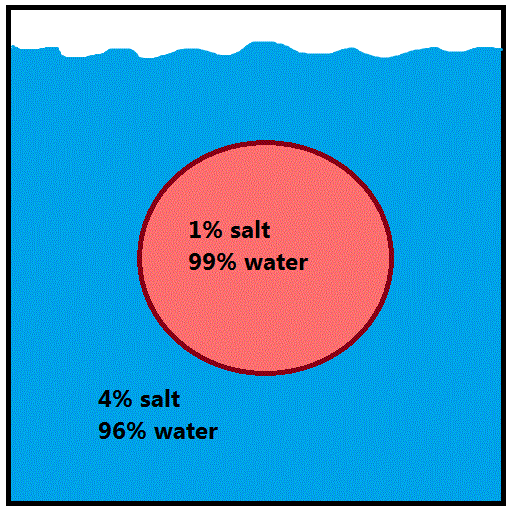
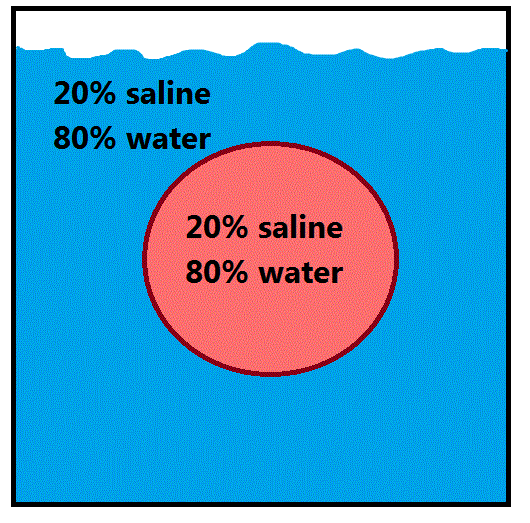

A student (rudely :() salts Mr. Slug. Why did Mr. Slug die?
There was more water outside the slug so the water moved in
There was more water inside the slug so the water moved out
Mr. Slug didn't die - there's equal concentrations of water on both sides
A saltwater fish (like Nemo!) cannot survive in a freshwater aquarium. Why is this?
The water concentration is higher in the aquarium water and therefore water will move into the fish cells
The water concentration is higher inside the fish and so water will exit the fish cells
The water concentration is equal in both the fish and water so nothing will happen
Which of the following accurately describes passive transport?
Molecules move from an area of high concentration to an area of low concentration, using no energy
Molecules move from an area of high concentration to an area of low concentration, using energy
Molecules move from an area of low concentration to an area of high concentration, using no energy
Molecules move from an area of low concentration to an area of high concentration, using energy
Which of the following accurately describes active transport?
Molecules move from an area of high concentration to an area of low concentration, using no energy
Molecules move from an area of high concentration to an area of low concentration, using energy
Molecules move from an area of low concentration to an area of high concentration, using no energy
Molecules move from an area of low concentration to an area of high concentration, using energy
What would happen if a doctor accidently used freshwater as an IV solution? IV solutions are given straight into the blood stream.
Red blood cells would shrink because the water concentration is higher inside the cell than the blood stream.
The cells would not be affected.
Red blood cells would swell and burst because the water concentration is higher in the blood stream.
Salt would prohibit the movement of water in and out of the cells.
Walking into the office you smell coffee brewing. It is strongest near her office where the coffee maker is and the molecules spread out filling the hallways. This is best described as ________________
Diffusion
Active transport
Exocytosis
Osmosis
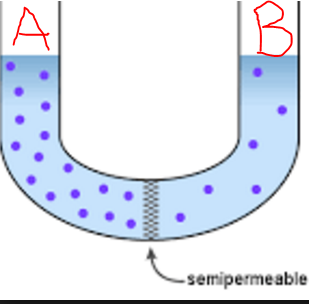
During DIFFUSION, which way would the molecules move through the semi-permeable membrane?
shrink
swell

In the cell pictured, where would water move?
Into the cell, causing it to swell
Out of the cell, causing it to shrink
In and out of the cell equally, causing the shape to stay the same

In the cell pictured, which way would water move?
Into the cell, causing the cell to swell
Out of the cell, causing the cell to shrink
In and out of the cell equally, keeping the shape the same

In the cell pictured, which way would water move?
Into the cell, causing the cell to swell
Out of the cell, causing the cell to shrink
In and out of the cell equally, keeping the shape the same

What type of solution is this healthy looking red blood cell in?
Isotonic
Hypertonic
Hypotonic


This picture is a representation of what type of transport?
Osmosis because it is diffusing through a protein from an area of high concentration to low concentration.
Facilitated diffusion because it is diffusing through a protein from an area of high concentration to low concentration.
Facilitated diffusion because it is diffusing through a protein from an area of low concentration to high concentration.
Simple diffusion because it is diffusing through a protein from an area of high concentration to low concentration.

In the picture, the dye molecules are moving from an area of high to low concentration. The picture below is an example of _________________.

