
Font size
 Worksheets
Spring 2020 Midterm US2
Total questions: 60
Worksheet time: 5hrs 0mins
-Escape from religious persecution
-Hope for freedom and equality
-Hope for better economic conditions
-Escape from political turmoil and war
Based on the bullets above, what was the most likely topic of discussion?
Goals of US Naturalization policies
Objectives of the Second Great Awakening
Reasons for immigrating to the United States
Principles of the Sons of Liberty
John D. Rockefeller's Standard Oil Company and Andrew Carnegie's steel company are examples of
government privatization of essential resources
the public benefiting from business leaders that reformed domestic industries
the rise of trusts and monopolies
the impact of labor leaders on government
His invention enabled people to talk directly with each other across large distances
Eli Whitney
Thomas Edison
Alexander Graham Bell
Samuel Gompers
Use the quote to answer the following question:
"While the law [of competition] may be sometimes hard for the individual, it is best for the race, because it insures the survival of the fittest in every department.
We accept and welcome, therefore, as conditions to which we must accommodate ourselves, great inequality of environment, the concentration of business, industrial and commercial, in the hands of the few, and the law of competition between these, as being not only beneficial, but essential for the future progress of the race."
Source: Wealth and its Uses
Which of the following would have supported the quote above?
Union leaders such as Samuel Gompers and Eugene V. Debs
Business owners such as Andrew Carnegie and John D. Rockefeller
Presidents such as Abraham Lincoln and Andrew Johnson
Progressives such as Ida Tarbell and Upton Sinclair
Which of the following had the greatest impact on the economy, politics, and culture of the United States during the late 1800s and early 1900s?
Immigrants from Asia and Southern and Eastern Europe
Immigrants from South Africa and Asia
Immigrants from Canada and Mexico
Immigrants from Western and Northern Europe

Which of the following best completes the graphic organizer above?
Alcatraz Island and Liberty Island
Ellis Island and Angel Island
Stanton Island and Jekyll Island
Long Island and Manhattan Island

Conditions like those shown in the image contributed most directly to which of the following?
THe passage of laws restricting immigration to the United States
A decline in efforts to AMericanize immigrants
The weakening of labor unions such as the American Federation of Labor
The lack of laws protecting the poor, children, homeless, etc.
-The Lynchburg, Virginia Tobacco Workers Strike
-The Union Pacific Railroad Strike
-The Pullman Strike
Based on the list above, what would me the most likely topic of discussion?
Tactics of anti-immigration groups such as the KKK and the Know Nothings
Tactics of Civil Rights groups such as the NAACP, CORE, and SNCC
Tactics of labor unions such as the American Federation of Labor and the Congress of Industrial Organizations
Tactics of socialist groups such as the Democratic Socialist Party of America
Two of the Major goals of developing inspections stations at Ellis Island and Angel Island was to
Teach immigrants the English Language
Process and isolate immigrants from the American population
Provided free child care and education to immigrants
Insure political and cultural safety in America

The principal message of the political cartoon is that Standard Oil Company...
uses its size to lower the proces of its products
protected the nation from foreign competition
used its economic power to influence government decisions
employed violence to gain an unfair advantage
"He was a ruthless rascal! His trust crushed many man's dreams while it filled his pockets with money. His determination to 'pay no man a profit' made him the baron of America's oil market"
The above quote is referring to
Theodore Roosevelt
Huey Long
John D. Rockefeller
Thomas Edison

Taking the above map into consideration, what was built between Omaha, Nebraska, and Sacramento, California?
The Erie Canal
The Transcontinental Railroad
The country's first paved highway
A series of toll roads to raise money for the states is went through
What two inventions made business in America more efficient?
Telephone
Steel
Light Bulb
A and C
B and C
What famous American controlled the banking and finance industry?
John D. Rockefeller
Andrew Carnegie
Andrew Mellon
J.P. Morgan
Standard Oil was an example of a ________________________ monopoly
Horizontally integrated
Vertically integrated
Laterally Integrated
Conditionally integrated
Who founded U.S. Steel
John D. Rockefeller
Andrew Carnegie
Andrew Mellon
JP Morgan
As a supporter of the "Gospel of Wealth", Andrew Carnegie believed that
the Bible showed the way to great wealth
making money was God's reward to the strongest individual
wealthy people should spend their money any way they pleased
the rich had a moral responsibility to use their wealth to improve society
Political Machines took advantage of what major groups?
The Immigrants and the Poor
The Immigrants and Big Businesses
The Poor and the Chinese
The Chinese and the Big Businesses
Read the quotation below. Which Progressive Era president was the most likely author of this quotation?
"We demand that big business give the people a square deal; in return, we must insist that when anyone engaged in big business honestly endeavors to do right he shall himself be given a square deal."
William McKinley
Theodore Roosevelt
Howard Taft
Woodrow Wilson

Why did President Wilson establish the Federal Reserve System?
to help the federal government keep the budget balanced
to give trusts more opportunities to expand their businesses
to create banks that could collect the new federal income tax
to regulate the money supply and prevent future economic panics

Which progressive reform allows citizens of a state to propose and pass a law without involving their state legislature?
initiative
recall election
referendum
secret ballot

This muckraker exposed Rockefeller's ruthless tactics and called to break up monopolies; wrote "The History of Standard Oil"
Jacob Riis
Ida Tarbell
Upton Sinclair
Florence Kelley
What type of business did the Sherman Antitrust Act try to bust up/break up?
Monopolies/Trusts
Small Business
Meat Packaging
Joint-Stock Companies

Which is NOT a Progressive Era President (hint-this is the guy in the picture)?
Woodrow Wilson
Theodore Roosevelt
William Taft
William Jennings Bryan

Which President was a Conservationist and protected land?
William McKinley
Woodrow Wilson
Theodore Roosevelt
William Taft

Which election SPLIT the Republican Party & allowed the Democrat Woodrow Wilson to WIN the election?
Election of 1900
Election of 1904
Election of 1908
Election of 1912
Early 1900's Progressive Reformers sought to increase public participation in the government by...
Expansion of the "Spoils" system
Direct Election of Senators
Creation of Electoral College
Formation of Federal Reserve

Which Amendment says "The manufacture, sale, or transportation of intoxicating liquors is hereby prohibited."?
16th Amendment
17th Amendment
18th Amendment
19th Amendment

This poster was intended to
Overcome opposition to participation in the impending 2nd World War
Promote the acquisition of new territories abroad.
Advocate the ratification of the Treaty of Versailles.
Contain the spread of Soviet-dominated communism.
Use the following quote to answer the following question...
This is the Covenant of the League of Nations that you hear objected to, the only possible guarantee against war. I would consider myself recreant to every mother and father, every wife and sweetheart in this country, if I consented to the ending of this war without a guarantee that there would be no other. . . . For, I tell you, my fellow citizens, I can predict with absolute certainty that within another generation there will be another world war if the nations of the world do not concert the method by which to prevent it.
The excerpt best reflects and effort by Woodrow Wilson to
promote the acquisition of new territories abroad.
contain the spread of Soviet-dominated communism.
encourage the United States to avoid political entanglements in Europe.
make the world safe for democracy.
Which two wars were part of the American Imperialism? (MUST PICK TWO)
Spanish-American War
Vietnam War
World War I
Civil War
Philippine-American War
Which development caused the United States to change the foreign policy supported by President Wilson in the quotation?
Russia and China withdrew its military forces from the conflict.
German submarines attacked U.S. merchant ships and the Zimmerman Telegram.
The Central Powers began to use poison gas on the battlefield.
Hitler’s use of mass production to kill off the Jewish population
Use the following list to answer the question:
* “Hawaiian Planters Urge American Annexation”
*“U.S. and Germany Negotiate for Control of the Samoan Islands”
*“U.S. Gains Control of Wake Island and Guam”
Which conclusion can best be drawn from these headlines?
The Anti-Imperialist League strongly influenced Congress.
Respect for native cultures motivated United States foreign policy.
United States territorial expansion increased in the Pacific Ocean.
Construction of a railroad to Alaska was a major policy goal.

The map most directly reflects the following:
migration of African Americans to the North and West during World War I
migration of Dust bowlers to the North and West during the Great Depression
migration of Southern farmers during the Civil War
migration of big business during the 1920’s
Which two foreign policies were designed to keep European countries from influencing the Western Hemisphere? (MUST PICK TWO)
George Washington's Farewell Address
The Roosevelt Corollary
The Neutrality Act
Containment Policy
The Monroe Doctrine
What was the Great Migration during the First World War?
The increased number of European migrants coming to America, hoping to escape the war.
The mass exodus of Midwestern farmers looking for factory jobs in war industries.
The mass exodus of African Americans from the South looking for factory jobs in war industries.
The massive transition of women to do work once solely carried out by men.

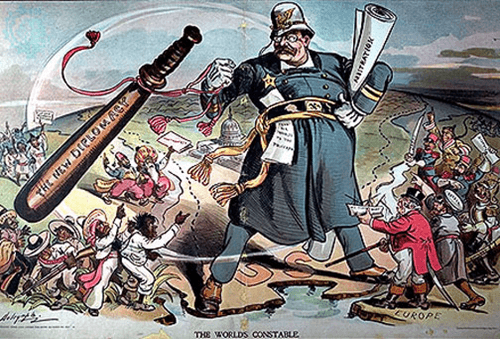
Which action by the United States government best reflects the philosophy expressed in this poster?
The Intolerable Acts
The Espionage and Sedition Acts
American Expansionism and Imperialism
The Communist Red Scare
A major purpose of President Woodrow Wilson’s Fourteen Points was to
ask Congress to enter World War I
make the world safe for democracy post World War I
provide an aid program for rebuilding war-torn nations.
retaliate for sinking the Lusitania.
In a United States history textbook, the terms The Spanish-American War, Roosevelt Corollary, and the building of the Panama Canal would most likely be found in a chapter entitled
Reconstruction (1865–1877)
Industrialization (1870–1900)
American Imperialism (1898–1905)
Progressive (1900–1917)
What were the two sides in World War I called?
Allied Powers and Central Powers
Americans and Communists
British and Russians
Allied Powers and City Powers

The Harlem Renaissance was a movement of African American artists who
Worked in the South
Calling for segregation
Urged African Americans to leave the country
Exploring their heritage and encouraging African Americans to be prideful of black culture.

A “return to normalcy” after World War I meant….
Increased US involvement in Europe
No longer selling alcohol in the United States
Going back to life as it had been before the war
Limiting immigration

Henry Ford produced a more affordable car primarily because his company….
Paid workers lower wages than his competitors.
Used foreign-made parts.
Developed a faster and less expensive method of production called the assembly line.
Offered a variety of options to buyers

During the 1920s, controversies concerning national Prohibition and the behavior of “flappers” were all signs of disagreement over…
The return to normalcy
Changing culture and lifestyles
Causes of the Great Depression
The benefits of new technology

The __________________________ ended prohibition and was passed in 1933.
18th Amendment
19th Amendment
20th Amendment
21st Amendment
Why did the economy experience a "boom" after WWI?
African Americans were moving back to the farms to grow cotton and soybeans
Consumers were preparing for a war and needed to bring extra supplies
New technologies and consumer goods were being developed and people wanted to buy them
Foreign trade grew after WWI
What new technology became widespread in homes by the end of the 1920's and brought news, entertainment, and advertisements to the family home?
refrigerators
telephones
radios
electric fans

Period in the 1920s when suspected communists and other radicals were arrested due to the fear of the spread of communism.
Red Scare
Teapot Dome Scandal
Scopes Trial
KKK
Secret organization that hated African Americans, Jews, Catholics, and immigrants.
Ku Klux Klan
Kool Kids Klub
Kit Kat Kandy
Anti-Defamation League

