wayground logo

Free Printable Worksheets

Font size

S
M
L
XL
Worksheets

Burk final BiologyS1 Dr Stockwell

Total questions: 207

Worksheet time: 4hrs 51mins

Name
Class
Date
1.
Anything living or nonliving that can cause a disease is known as a?
a)
Antibiotic
b)
Foe
c)
Pathogen
2.

What is an illness caused by a virus, protist, fungi, or bacteria called?

a)

Gluteus maximus

b)

Pathogen

c)

sickle cell anemia

d)

Disease

3.
A substance that is used to PREVENT viral diseases is called?
a)
Vaccine
b)
Neosporin
c)
Hydrogen Peroxide
4.
A nonliving disease causing particle that contains DNA or RNA
a)
Fungi
b)
Virus
c)
Bacteria
5.
What does a VIRUS need to replicate?
a)
Host Cell
b)
Pathogen
c)
Computer
6.
Unicellular, Prokaryotic organism is known as a?
a)
Virus
b)
Bacteria
c)
Fungi
7.
Bacteria reproduce through the process of?
a)
Host cells
b)
regeneration
c)
Binary fission
8.
The type of bacteria that is spiral shaped is called: 
a)
Coccus
b)
Bacillus
c)
Spirillium
d)
Capsule
9.
The picture here is a :
a)
Eubacteria
b)
Eukaryote
c)
Virus
d)
Fungus
10.
During Lysogenic Infections..
a)
the host cell is copied many times over
b)
the host cell is destroyed
c)
the host cell is unaffected
d)
the virus dies
11.
What cycle involves newly formed viruses being released from a bursting host cell?
a)
Lytic Cycle
b)
Lysogenic Cycle
c)
Bacterial Cycle
d)
Nitrogen Cycle 
12.
Which of the following is not a way to prevent or treat viruses?
a)
antibiotics
b)
antiviral medications
c)
vaccines
d)
wash your hands
13.
Name this bacteria shape
a)
cocci
b)
spirilla
c)
bacilli
d)
spaceship
14.
Name this bacteria shape
a)
cocci
b)
bacilli
c)
spirilla
d)
sphere
15.
Bacteria cells are classified as
a)
Eukaryotes
b)
Prokaryotes
c)
Viruses
d)
A Host
16.
How could you describe the size of a virus?
a)
Smaller than bacteria
b)
Larger than a parasite
c)
About the size of a dime
d)
Smaller than a proton
17.
Bacteria are prokaryotes which means they
a)
have a nucleus on their capsule
b)
do not contain a nucleus
c)
can live in environments with and without oxygen
18.
The outer covering of a bacteria cell is called the
a)
flagella
b)
cytoplasm
c)
cell wall 
19.
How do bacteria move?
a)
flagella
b)
cilia
c)
they don't
20.

Capsule:

a)

single-celled microorganism

b)

likely to cause disease

c)

blocks the growth and reproduction of bacteria

d)

protects the bacteria

21.

Cyanobacteria are ________.

a)

eubacterial heterotrophs

b)

photosynthetic autotrophs

c)

salt-loving archaebacteria

d)

chemosynthetic autotrophs

22.
What is found in the cytoplasm of bacteria cells?
a)
The DNA
b)
The Nucleus
c)
the protein coat
d)
the flagellum
23.
You have a cold, but your doctor will not give you an antibiotic, because
a)
antibiotics do not kill viruses.
b)
colds are not infectious.
c)
antibiotics make colds worse.
d)
antibiotics provide bacteria with food.
24.
When should you get a vaccine?
a)
Before you get sick
b)
After you get sick
c)
Only when you are a baby
d)
Only when you are old
25.
Captures energy from the sunlight and uses it to produce food in a plant cell
a)
Chloroplast
b)
Ribosomes
c)
Nucleus
d)
Cell Wall
26.
Controls what comes into and out of a cell.
a)
Cell Membrane
b)
Cell Wall
c)
Cytoplasm
d)
Vacuoles
27.
Gel-like fluid where the organelles are found.
a)
Cytoplasm
b)
Lysosomes
c)
Golgy Bodies
d)
Endoplasmic Reticulum
28.
Control Center of the cell; contains DNA.
a)
Mitochondria
b)
Nucleus
c)
Nucleolus
d)
Chromatin
29.
Ridged outer layer of a plant cell.
a)
Cell Membrane
b)
Cell Wall
c)
ER
d)
Ribosomes
30.
Uses chemical to break down food and worn out cell parts.
a)
Lysosomes
b)
Golgi Bodies
c)
Vacuoles
d)
Cytoplasm
31.
Receives protein and materials from the ER, packages them, and distributes them.
a)
Golgi Bodies
b)
Mitochondria
c)
Endoplasmic Reticulum
d)
Large Central Vacuole
32.
Produces the energy a cell needs to carry out its functions.
a)
Mitochondria
b)
Ribosomes
c)
Lysosomes
d)
Golgi Bodies
33.
Assembles amino acids to create proteins.
a)
Ribosomes
b)
Nucleus
c)
Vaculoes
d)
Chromatin
34.
Stores food, water, wastes, and other materials.
a)
Vacuoles
b)
Mitochondria
c)
Chloroplasts
d)
Golgi Bodies
35.
Has passageways that carry proteins and other materials from one part of cell to another.
a)
Endoplasmic Reticulum
b)
Cytoplasm
c)
Ribosomes
d)
Lysosomes
36.
Tiny strands inside the nucleus that contain the instructions for directing the cell's functions.
a)
Chromatin
b)
Nucleolus
c)
Ribosome
d)
Mitochondria
37.
All of the living and nonliving things in an area that interact with each other are called a/an ______.
a)
community
b)
habitat
c)
population
d)
ecosystem
38.
The non-living part of an ecosystem
a)
Abiotic 
b)
Biotic
39.
What is the original source of almost all energy in most ecosystems?
a)
carbohydrates
b)
sunlight
c)
water
d)
carbon
40.

An organism that produces its own food supply from inorganic compounds is called a(an)

a)

heterotroph or consumer

b)

parasite

c)

detritivore

d)

autotroph or producer

41.
The image provided is an example of a(n):
a)
Carnivore
b)
Herbivore
c)
Producer
d)
Autotroph
42.
A symbiotic relationship in which both organisms benefit
a)
competition
b)
mutualism
c)
commensalism
d)
energy pyramid
43.
A living relationship between two species in which one organism is harmed is called...
a)
mutualism
b)
commensalism
c)
parasitism
d)
niche
44.
What does a food web represent?
a)
All connections of energy flow throughout all organisms in a habitat.
b)
The specific ways that mutualism is carried out.
c)
A single pathway or energy flow between organisms. 
d)
How carnivores get their food. 
45.
The bear in the photo is an example of a(n):
a)
Producer
b)
Autotroph
c)
Consumer
d)
Insect
46.
Which of the following would be the definition of a detritivore?
a)
Animals that eat insects.
b)
Organisms that feed on rocks, recycling the nutrients back into the ground.
c)
Organisms that eat only pants
d)
Things that feed on dead organisms, recycling the nutrients back into the ground.
47.
A collection of organisms that belong to different populations but all live in the same area and interact with one another.
a)
Population
b)
Ecosystem
c)
Community
d)
Ecosphere
48.
The general name for organisms like animals and fungi that get their energy from consuming other organisms.
a)
Producers
b)
Consumers
c)
Detritivores
d)
Carnivores
49.
Organisms that feed on both living producers and other consumers.
a)
Carnivores
b)
Omnivores
c)
Herbivores
d)
Detritivores
50.
An organism at the second trophic level would be considered a...
a)
Top carnivore
b)
Producer
c)
Herbivore
d)
Carnivore
51.
Different populations living and interacting with each other in the same area
a)
Biome
b)
Ecosystem
c)
Community
d)
Niche
52.
Organisms that look similar and can produce fertile offspring
a)
Species
b)
Fish
c)
Community
d)
Trees
53.
An area where an organism finds food, shelter and water in a specific arrangement
a)
niche
b)
biosphere
c)
biome
d)
habitat
54.
The energy pyramid shows the energy available to each trophic level in an ecosystem; 
a)
10% is passed on to upper levels, & the rest is lost as heat
b)
how many organisms are in every trophic level
c)
where the world the ecosystem is located
d)
how biogeochemical cycles recycle matter
55.
Which of the following is the smallest unit of life that can carry out all life functions?
a)
the mitochondria
b)
the vacuoles
c)
the nucleus
d)
the cell
56.
Chloroplasts in plant cells allow the plant to perform a function that animal cells cannot do.  What is the main function of the chloroplasts found in plant cells?
a)
to absorb light energy and manufacture food
b)
to remove waste materials by active transport
c)
to manufacture chemical energy from food
d)
to control the shape of the cell
57.
Which cell structure is found in plant and animals cells and controls what can come into or leave a cell?
a)
cell membrane
b)
cytoplasm
c)
nucleus
d)
vacuole
58.

Which organelle contains DNA and directs activities of the cell?

a)

mitochondria

b)

chloroplasts

c)

nucleus

d)

ribosome

59.

What stage of the cell cycle is shown by this snapshot?, hint there is the creation of 2 new cells

a)

metaphase

b)

anaphase

c)

telophase

d)

cytokinesis

60.
Alternative forms of a gene are called
a)
Alleles
b)
Homozygous
c)
DNA
d)
Genetics
61.
The physical appearance of an organism based on traits
a)
Genotype
b)
Phenotype
c)
Meiosis
d)
Genetics
62.
The allele combinations
a)
genetics
b)
mitosis
c)
genotype
d)
phenotype
63.
This trait will always be expressed if present because it will mask the expression of others
a)
stem cells
b)
heterozygous
c)
dominant
d)
recessive
64.
Hair colour is an example of
a)
genotype
b)
phenotype
65.
How tall you are is an example of
a)
genotype
b)
phenotype
66.
Which of the following is heterozygous
a)
FF
b)
tt
c)
Gg
d)
RR
67.
Which of the following is homozygous recessive?
a)
rr
b)
AA
c)
TT
d)
Ff
68.
Which of the following is homozygous dominant?
a)
Jj
b)
Rr
c)
MM
d)
ee
69.
How many letters does a genotype contain?
a)
1
b)
2
c)
3
d)
4
70.
A section on a chromosome that has genetic information for one trait is called a
a)
gene
b)
allele
c)
phenotype
d)
genotype
71.
the study of heredity
a)
Botany
b)
Astronomy
c)
Genetics
d)
Ecology
72.
How much of your DNA do you inherit from your mom?
a)
10%
b)
25%
c)
50%
d)
it varies
73.

Sexual reproduction does what to genetic variation?

a)

Increases

b)

Decreases

c)

Makes identical copies

74.

All human have _________ chromosomes

a)

23

b)

46

c)

Diploid

d)

Haploid

75.
Mitosis produces cells with haploid or diploid number of chromosomes?
a)
Haploid
b)
Diploid
76.
Body cells have diploid or haploid number of chromosomes?
a)
Haploid
b)
Diploid
77.
How many cells are produced in Mitosis?
a)
1
b)
2
c)
3
d)
4
78.
Are the cells in Mitosis identical or unique?
a)
Identical 
b)
Unique
c)
It's random
79.

which of the following is NOT a somatic cell?

a)

nerve cell

b)

muscle cell

c)

white blood cell

d)

sperm cell

80.

A gamete is also known as________ cell?

a)

body

b)

somatic

c)

nomadic

d)

sex

81.

What is the pair of sex chromosomes in Males?

a)

Y

b)

X

c)

XY

d)

XX

82.
In which phase do chromosomes move away to opposite sides of the cell?
a)
Prophase
b)
Metaphase
c)
Anaphase
d)
Telophase
83.
What type of cells are produced in meiosis?
a)
Body Cells
b)
Gametes
c)
Hair cells
d)
Liver cells
84.
How many cells are produced in meiosis?
a)
1
b)
2
c)
3
d)
4
85.
Are the cells produced in meiosis identical or unique?
a)
Identical
b)
Unique
c)
It's random
86.

Select ALL stages of Interphase

a)

G1

b)

S

c)

G2

d)

Mitosis

87.

The following describes_________________________ during mitosis. The chromosomes line up along the middle of the cell and the spindle fibers attach to each chromosome at the centromere.

a)

prophase

b)

metaphase

c)

anaphase

d)

telophase

88.

The first phase of mitosis is called _______________ .

a)

telophase

b)

metaphase

c)

anaphase

d)

prophase

89.

Uncontrolled cell division which usually leads to tumors and disease is called:

a)

Metaphase

b)

Cytokinesis

c)

Cancer

d)

Diabetes

90.
Which part of the Cell Cycle takes the longest?
a)
Interphase
b)
Mitosis
c)
Prophase
d)
Cytokinesis
91.
Which of the following represents chromosome # during fertilization?
a)
n+n=2n
b)
n=n
c)
2n=n+n
d)
2n=2n
92.

PMAT helps us remember the correct order of the phases of Mitosis. Which of the following has the phases of Mitosis in the correct Order

a)

Interphase, Mitosis, Cytokinesis

b)

Prophase, Metaphase, Anaphase, Prophase

c)

Anaphase, Telophase, Prophase, Telophase

d)

Prophase, Metaphase, Anaphase, Telophase

93.
DNA molecule segment is : TTACGCAAG
The mutated DNA segment is TTCGCAAG. This is an example of ___ mutation.
a)
Substitution
b)
Deletion
c)
Insertion
d)
Inversion
94.

A mutation is defined as:

a)

A change in the cell's structure

b)

Anything that changes in an embryo

c)

Any change in the physical features of a human

d)

A change in the DNA sequence

95.
What mutation has occurred here? 
T-G-A-C-C-A
T-G-A-G-C-A
a)
Substitution
b)
Deletion
c)
Insertion
d)
Frameshift 
96.

Genetic mutations can be...

a)

beneficial, harmful, or neutral

b)

beneficial only

c)

harmful only

d)

neutral only

97.

Which organelle is DNA usually found in?

a)

cell membrane

b)

vacuole

c)

chloroplast

d)

nucleus

98.

What are the building blocks of proteins called?

a)

DNA

b)

RNA

c)

Ribosomes

d)

Amino Acids

99.
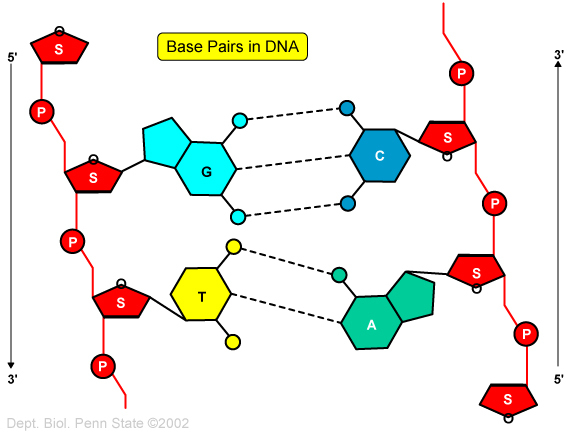
What pairs with Adenine (A)? 
a)
Guanine (G)
b)
Cytosine (C)
c)
Adenine (A)
d)
Thymine (T)
100.
What pairs with Thymine (T)?
a)
Adenine (A)
b)
Thymine (T)
c)
Guanine (G)
d)
Cytosine (C) 
101.
What pairs with Guanine (G)?
a)
Adenine (A)
b)
Thymine (T)
c)
Cytosine (C)
d)
Guanine (G)
102.
What pairs with Cytosine (C)?
a)
Guanine (G)
b)
Cytosine (C)
c)
Adenine (A)
d)
Thymine
103.
Which of the following best describes a DNA molecule?
a)
double helix
b)
contains ribose
c)
made of amino acids
d)
contains Uracil
104.
Why is DNA important?
a)
it is very small and very complicated
b)
it's in everything
c)
it serves as the blueprint for traits of all living things
d)
because we eat it every day for energy
105.

What is the only factor linked to an increase in likelihood of Down syndrome in a baby?

a)

genetics

b)

maternal age

c)

vaccines

d)

witchcraft

106.
What do experts say is the most common form of Down Syndrome?
a)
Trisomy 47
b)
Trisomy 46
c)
Trisomy 21
d)
Trisomy 23
107.

Which type of skin cancer is the most likely to spread?

a)

Basal cell carcinoma

b)

Melanoma

c)

Squamous cell carcinoma

108.
The DNA nucleotide is composed of three parts. Which two components make up the nucleotide backbone?
a)
ribose sugar and base
b)
ribose sugar and phosphate group
c)
nitrogen base and deoxyribose sugar
d)
deoxyribose sugar and phosphate group
109.

Hemoglobin is classified as which type of biomolecule...

a)

Protein

b)

Carbohydrate

c)

Lipid

d)

Nucleic Acid

e)

None of the above.

110.
Nitrogenous bases are joined by which type of bond?
a)
polar bonds
b)
ionic bonds
c)
covalent bonds
d)
hydrogen bonds
111.
Moving particles without using a cell's energy
a)
Homeostasis
b)
Cellular Respiration
c)
Exocytosis
d)
Passive Transport
112.
Moving particles while using a cell's energy
a)
Osmosis
b)
Diffusion
c)
Photosynthesis
d)
Active Transport
113.
A type of active transport that releases particles that were enclosed from a cell when the membrane of the vesicle fuses with that of the cell membrane
a)
Exocytosis
b)
Osmosis
c)
Mitosis
d)
Endoyctosis
114.
A type of active transport that brings particles into a cell when the cell membrane encloses a particle to make a vesicle
a)
Diffusion
b)
Passive Transport
c)
Active Transport
d)
Endocytosis
115.
A type of passive transport that occurs when water crosses a cell membrane; like water entering raisin cells
a)
Osmosis
b)
Diffusion
c)
Mitosis
d)
Endocytosis
116.
The fluid mosaic model shown above describes the structure and function of
a)
chloroplasts.
b)
chromosomes.
c)
nuclei.
d)
cell membranes.
117.

Cholesterol is an important component of the cell membrane because __________ .

a)

it makes the membrane more fluid and adds to its flexibility

b)

it aids in diffusion

c)

it aids in cell recognition

d)

it transports large, polar molecules

118.
My cells are Shriveled!    What state are my cells in?
a)
Hypertonic
b)
Hypotonic
c)
Isotonic
d)
Diffusion 
119.
A solute traveling DOWN its concentration gradient using a protein channel does this by ________ diffusion.
a)
Facilitated
b)
Active
c)
Osmosis
d)
Endocytosis
120.
____ is the molecule that provides energy for active transport.
a)
DNA
b)
ADP
c)
ATP
d)
RNA
121.
This picture represents what type of cell transport?
a)
endocytosis
b)
exocytosis
c)
osmosis
d)
passive transport
122.
Which is true about active transport?
a)
It requires energy
b)
it does not require energy
c)
It moves substances down the concentration gradient
d)
it moves material from high to low concentration
123.
When a cell is placed in a hypertonic solution water
a)
moves from the inside of the cell to the solution
b)
moves from the solution to the inside of the cell
c)
moves equally in and out of the cell
d)
none of these
124.
Active transport requires ______, moves materials from __________________, and goes _______ the concentration gradient.
a)
No energy, low to high, against
b)
ATP, high to low, with
c)
ATP, low to high, with
d)
ATP, low to high, against
125.
A cell will __________________ in a hypotonic solution.
a)
swell and perhaps burst (lyse)
b)
shrink
c)
the size of the cell will not change
d)
the size of the cell will change from large to small and from small to large
126.

what is true of a volcano

a)

has an opening on the surface of a planet or moon that allows material warmer than its surroundings to escape from its interior

b)

can cause secondary succession

c)

will emit dangerous gasses and toxic chemicals into the atmosphere

d)

that it allows earth's matter to recycle itself

127.
When something is 'water fearing' it is....
a)
Hydrophobic
b)
Hydrophilic 
c)
Hydroelectric 
d)
Hydrochloric
128.
Which part of this phospholipid is hydrophobic?
a)
fatty lipid tails
b)
head
c)
all of it is hydrophobic
d)
none of it is hydrophobic
129.

of the three different types of endocytosis which one is cell drinking?

a)

pinocytosis

b)

receptor mediated endocytosis

c)

phagocytosis

130.

of the three different types of endocytosis which one will take in hormones

a)

pinocytosis

b)

receptor mediated endocytosis

c)

phagocytosis

131.

of the three different types of endocytosis which one is cell eating?

a)

pinocytosis

b)

receptor mediated endocytosis

c)

phagocytosis

132.
Ridged outer layer of a plant cell.
a)
Cell Membrane
b)
Cell Wall
c)
ER
d)
Ribosomes
133.
What part of the cell makes proteins?
a)
Mitochondrion
b)
Ribosomes
c)
Nucleus
d)
Vacuole
134.

When these bond together, they form a protein

a)

Amino Acids

b)

Peptide Bonds

c)

Ribose

d)

Nucleotides

135.

Which of the following is needed for the process of photosynthesis?

a)

Water

b)

Oxygen

c)

Starch

d)

Carbon dioxide

136.
Plants need ________from the air for photosynthesis
a)
oxygen
b)
soil
c)
carbon dioxide
d)
sugar
137.
The products of photosynthesis are
a)
water and carbon dioxide
b)
oxygen and water
c)
sugar and cabon dioxide
d)
oxygen and sugar (glucose)
138.
After photosynthesis, plants store their energy as _________ .
a)
chlorophyll
b)
pigment
c)
glucose (sugar)
d)
Oxygen
139.

Which type of biological macromolecule is the main component of the plasma membrane?

a)

carbohydrate

b)

lipid

c)

protein

d)

nucleic acid

140.

This image is an example of a phospholipid. Which part of a phospholipid is HYDROPHILIC?

a)

the phosphate "head"

b)

the lipid "tails"

141.

Explain how the behavior of the elk changed in response to the wolves.

a)

They did not change their behavior and therefore most elk died.

b)

The elk stayed away from the areas the wolves were. As a result, the trees were able to grow again.

c)

All the elk left the park and did not return.

d)

The wolves were not able to capture the elk.

142.

What is a tropic cascade?

a)

an ecological process triggered by the removal or addition of a top predator that causes changes throughout the food chain.

b)

an ecological process triggered by the removal or addition of a top predator that causes no changes throughout the food chain.

c)

an ecological process triggered by the removal or addition of a vegetation that causes no changes throughout the food chain.

d)

an ecological process triggered by the removal or addition of a primary consumer that causes changes throughout the food chain.

143.

The following karyotype is from what chromosomal disorder?

a)

Downs

b)

Turners

c)

Klinefelter

d)

Sickle cell

144.
Adenine bonds with ______________.
a)
Guanine
b)
Thymine
c)
Cytosine
d)
Adenine
145.
Guanine bonds with ______________.
a)
Adenine
b)
Guanine
c)
Cytosine
d)
Thymine
146.
Which 2 molecules form the sides (backbone) of the DNA ladder?
a)
deoxyribose sugar and adenine
b)
deoxyribose sugar and a hydrogen bond
c)
deoxyribose sugar and the nucleus
d)
deoxyribose sugar and phosphate
147.
A process in which DNA has the unique ability to make an exact copy of itself.
a)
Replication
b)
Translation
c)
Transcription
148.
What is the difference between DNA and RNA in terms of bases?
a)
RNA contains uracil in place of thymine
b)
RNA contains uracil in place of adenine
c)
RNA contains uracil in place of guanine
d)
RNA contains uracil in place of  cytosine
149.
Which type of RNA takes the instructions from the nucleus to the cytoplasm?
a)
mRNA
b)
tRNA
c)
rRNA
d)
RNA polymerase
150.
What is the product of translation?
a)
DNA
b)
mRNA
c)
tRNA
d)
proteins
151.
How many nucleotides make a codon?
a)
1
b)
2
c)
3
d)
6
152.
This transport protein is used to move Oxygen throughout the body (to and from red blood cells).  
a)
hemoglobin
b)
collagen
c)
insulin
d)
antibodies
153.
A change in the genetic code = ____
a)
trait
b)
genotype
c)
phenotype
d)
mutation
154.

What is the place where two bones meet?

a)

bones

b)

tendons

c)

ligament

d)

joint

155.

What is the name for the connector that attaches muscle to bone?

a)

ligament

b)

tendon

c)

joint

d)

bones

156.

What is the name for the connector that attaches bone to bone?

a)

ligament

b)

tendon

c)

joint

d)

cartilage

157.

The disease of Scurvy affected what protein?

a)

collagen

b)

hemoglobin

c)

porin

d)

melanin

158.

Which of the following proteins have decreased production resulting in diarrhea?

a)

melanin

b)

lactase

c)

kinesin

d)

acetaldehyde dehydrogenase

159.

which nitrogenous bases form triple bonds

a)

A

b)

T

c)

G

d)

C

160.

which nitrogenous bases form double hydrogen bonds

a)

A

b)

T

c)

G

d)

C

161.
What genetic disorder causes the body to produce unusually thick mucus in the lungs and intestines? 
a)
Cystic Fibrosis
b)
Sickle Cell
c)
Down Syndrome
d)
Hemophilia
162.
A process of changing a gene to treat cystic fibrosis is
a)
Human Genome Project
b)
genome
c)
biotechnology
d)
gene therapy
163.
Being a sickle cell carrier gives you a level of resitance to what disease?
a)
Malaria
b)
Typhoid fever
c)
Anemia
d)
Flu
164.

The chromosomes that are not involved in determining the sex of an individual are called __________.

a)

sex chromosomes

b)

mutations

c)

autosomes

d)

homologous

165.

The 2 male sex chromsomes are _____.

a)

XY

b)

XX

166.

SELECT ALL THAT APPLY:

a)

Male

b)

Female

c)

No chromosomal abnormalities

d)

Trisomy 21

167.

SELECT ALL THAT APPLY:

a)

Male

b)

Female

c)

No chromosomal abnormalities

d)

Trisomy 21

168.
What quantities vary between isotopes of an element?
a)
protons, electrons, and atomic mass
b)
protons, electrons, and atomic number
c)
neutrons and electrons
d)
neutrons and atomic mass
169.
If the number of electrons in an atom changes you make a(n) __________________.
a)
ion
b)
isotope
c)
new element
d)
isomer
170.

How do you calculate mass number?

a)

Mass x percent

b)

Protons + Electrons

c)

Protons + Neutrons

d)

Neutrons + Protons + Electrons

171.
The coefficient in  3H2O is
a)
6
b)
2
c)
3
d)
5
172.

Which of the following are Subscripts in this Chemical Formula: 3Fe2O4

a)

3,4

b)

3,2

c)

2,4

d)

6

173.

which of the following is true of the law of conservation of matter?

a)

matter can neither be created nor destroyed

b)

matter can be created or destroyed

c)

the number of reactant atoms must be the number of product atoms

d)

an element can never change into another element

174.

Which of the following is true of the pH scale

a)

the right hand side of the scale is acidic

b)

the right hand side of the periodic table is alkaline

c)

bleach is acidic

d)

sodium hydroxide is basic

e)

soda is acidic and contains sulfuric acid

175.

Which of the following is true of the pH scale

a)

pH stands for the presence of hydrogen

b)

acidic substances taste sour

c)

basic substances have a high pH number

d)

a characteristic of a base is that it feels slippery

e)

the pH of the human body is 3.45 to 3.55

176.
Bacteria are prokaryotes.
a)
True
b)
False
177.
Bacteria are unicellular
a)
True
b)
False
178.

Which of the following does a plant cell ONLY have?

a)

Vacuole

b)

Chloroplast

c)

Centrosome

d)

Nucleus

179.
The H+ ion is a(n)
a)
acid
b)
base
c)
neutral
180.

How do scientists believe plant and animal life will be affected by increasing levels of acidity in the ocean?

a)

there will be more food for them to eat, making it easier to survive

b)

there will be less diversity in plants and animals, making survival more difficult

c)

the earth will correct the problem itself and the oceans' biodiversity will remain the same

d)

the plants and animals will adapt to the increasing acidity and continue to thrive in the oceans

181.

Burning carbon-based fossil fuels releases what gas into the atmosphere?

a)

acid gas

b)

chlorine gas

c)

oxygenated hydrogen

d)

carbon dioxide

182.

What is the name of the section in the brain that maintains the body temperature at a constant value?

a)

Hypothalamus

b)

Cerebellum

c)

Cerebro

d)

Brain stem

183.

What can be done to increase the body’s ability to cool off ?

a)

change environment

b)

drink water

c)

swim in cool pool

d)

shiver

184.

What is a voluntary way to cool off the body

a)

change environment

b)

sweat

c)

shiver

d)

drink water

185.

what is an involuntary way to cool off the body?

a)

shiver

b)

sweat

c)

go into the air conditioning

d)

heater

186.

what is a involuntary way to heat up the body?

a)

shiver

b)

exercise

c)

drink hot tea

d)

turn on the heater

187.

what is a voluntary way to heat up the body?

a)

shiver

b)

exercise

c)

drink hot tea

d)

turn on the heater

188.

What should you do if someone is experiencing possible heat stroke

a)

call 911

b)

put ice packs on the armpits, neck, groin areas

c)

undress clothing

d)

change their environment to the cool air conditioning

189.

What temperature is normal for the human body?

a)

98.6 F

b)

101 F

c)

96.8 F

d)

104 F

190.

What is true of dehydration

a)

one of the first signs is a sense of thirst

b)

it is defined as a state of not having enough water inside the body.

c)

it can be caused by too much shiverring

d)

it will happen on a hot day

191.

What term best describes what goes on inside the alveoli?

a)

Exchange of gases

b)

Inhalation of oxygen

c)

Circulation of blood

d)

Exhalation of carbon dioxide

192.

Your heart is an involuntary muscle that is always working.

a)

True

b)

False

193.

How are arteries and veins different?

a)

One is bigger than the other.

b)

The arteries carry more blood than the veins.

c)

The arteries carry blood away from the heart while veins carry blood to the heart.

d)

The veins carry blood away from the heart while arteries carry blood to the heart.

194.
Major artery at the top of the heart sends oxygenated blood from the left ventricle to the rest of the body.
a)
aorta
b)
pulmonary artery
c)
inferior vena cava
195.
Pumps oxygen-poor blood to the lungs
a)
Right Ventricle
b)
Right Atrium
c)
Left Ventricle
d)
Left Atrium
196.
Receives oxygen-rich blood from the lungs
a)
Right Ventricle
b)
Left Ventricle
c)
Right Atrium
d)
Left Atrium
197.
Ionic bonds form between metals and ____.
a)
metalloids
b)
metals
c)
nonmetals
198.
What two types of atoms make a covalent bond?
a)
2 Nonmetals
b)
1 Nonmetal and 1 Metal
c)
2 Metals
d)
2 Noble Gases
199.
The atomic number tells you what?
a)
number of electrons
b)
number of protons
c)
number of neutrons
d)
both electrons and protons in an atom.
200.
A proton is....
a)
A negatively charged subatomic particle
b)
A positively charged subatomic particle
c)
A neutrally charged subatomic particle
d)
The only subatomic particle located in the nucleus
201.
A subatomic particle that orbits an atom's nucleus, has a negative charge, and has very little mass
a)
Proton
b)
Neutron
c)
Electron
d)
Isotope
202.

This forms when two or more different elements chemically combine.

a)

monoatomic elements

b)

diatomic element

c)

compound

203.

What is the atomic number of Nickel? (enlarge the periodic table)

a)

110

b)

28

c)

46

d)

78

204.

What is the overall charge of an atom normally on the periodic table

a)

0

b)

1

c)

-1

d)

8

205.

What is true of the elements in the atmosphere and what are the percentage compositions?

a)

Nitrogen at 78 percent

b)

Nitrogen at 21 percent

c)

Oxygen at 21 percent

d)

Oxygen at 78 percent

206.

Which are correct of the trace elements?

a)

Iodine is important in metabolism

b)

Magnesium is important in Hemoglobin

c)

Iron is important in Hemoglobin

d)

Magnesium is important for Photosynthesis

e)

WIthout Iodine we would not be able to use food

207.

Which of the following is true of the pumping of blood

a)

diastole is when the heart gets oxygen to its own tissues

b)

systole is squeezing of the heart

c)

diastole is when filling of the heart happens

d)

systole is when the heart relaxes