
 Worksheets
E.8.9A.5
Total questions: 21
Worksheet time: 2hrs 45mins
A mid-ocean RIDGE is located at the boundary of two tectonic plates. Which diagram correctly models the relative plate motion on each side of a mid ocean ridge?


Scientists recently discovered that rocks collected from the Franklin Mountains in West Tests and rocks collected from mountains in eastern Antarctica were exactly the same age. Further research showed that the rocks were chemically and geologically the same and came from the same magma source. This discovery provides evidence of--
coastal erosion
plate tectonics
ocean currents
glacial melting

The image shows a plate boundary. Arrows have been added to indicate the movement of the plates.What plate boundary feature is also shown?
A ridge formed by an inactive convergent boundary
A valley forming at an active divergent boundary
A fault forming at an active transform boundary
A volcano formed by an active transform boundary
Which of the following is NOT a tectonic boundary?
Convergent
Divergent
Sedergent
Transform
This landform can occur at a divergent plate boundary.
ocean trench
mid-ocean ridge
tall mountains
transform fault

Which of these events can ONLY happen on a DIVERGENT BOUNDARY?
Rift Valley
Mountain
A peninsula
An Insanely complex, long answer that you will click out of instinct.
Process in which one layer of the crust goes below another one into the mantle.
Seismic waves
Crust
Subduction
Asthenosphere
The upper most part of the mantle and the crust together form a hard layer colled the...
Lithosphere
Trench
Mid-ocean ridge
Asthenosphere
The soft layer that is in between the mantle and the outer core is called the...
Lithosphere
Mid-ocean ridge
Trench
Asthenosphere
Convergent boundaries are ____ processes, while divergent boundaries are ____ processes.
A: Destructive, B: Gravitational
A: Constructive, B: Destructive
A: Gravitational, B: Destructive
Which statement best describes the geologic process that is most likely responsible for the formation of mountains?
They are along a transform plate boundary that is no longer active, so erosion is creating deep valleys.
They are along a transform plate boundary in which plates are currently moving side by side, causing earthquakes and faults
They are along a plate boundary in which plates are currently converging, causing uplift and steep slopes.
They are along a plate boundary in which plates diverged in the distance past, allowing new rock to build up.

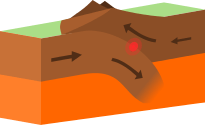
The diagram shows a model of the movement of two tectonic plates. When the plates collide, on plate often moves below the other plate. The rising magma that can result from this type of plate movement may produce-
fossil layers
volcanic islands
deep-sea sediment
seafloor spreading

The model below shows two continental plates. The folded mountains in this model form at which type of plate boundary?
Transform boundary
Divergent boundary
Subduction boundary
Convergent boundary

