wayground logo

Free Printable Worksheets

NEW

Font size

S
M
L
XL
Worksheets

Fascism, WWII, & Hitler

Total questions: 65

Worksheet time: 35mins

Name
Class
Date
1.
What is a dictator?
a)
Someone who helps a country in need
b)
Someone who gives control of the government to the people
c)
Someone who gains complete control of a country's government
2.
What was the name of Hitler's form of government which denied individual freedoms took complete power of the Germany?
a)
democracy
b)
fascism
c)
dictatorship 
d)
monarchy 
3.
Who became the dictator of Germany and led that country into WWII?
a)
Winston Churchill
b)
Benito Mussolini
c)
Adolf Hitler
4.
Who was Benito Mussolini?
a)
The fascist ruler of Italy
b)
The fascist ruler of Germany
c)
The fascist ruler of France
d)
The fascist ruler of England
5.
Who was the ruler of U.S.S.R?
a)
Joseph Stalin
b)
Winston Churchill
c)
Adolf Hitler
d)
Harry S. Truman
6.

Between WWI and WWII, Japan tried to solve the problem of its scarcity of natural resources by doing what?

a)

Exporting agricultural products in exchange for new technology.

b)

Establishing a policy of imperialism.

c)

Cooperating with the soviet union.

7.

What was one reason the Nazi programs and policies of the early 1930s appealed to many people in Germany?

a)

The people were frustrated with their current political and economic situation.

b)

Germany had been denied membership to the UN.

c)

Communism had been forced on them.

8.
What led to the rise of totalitarianism governments in Germany, Italy and Spain in the 1920s and 1930s.
a)
The success of the Communist in a command economy. 
b)
Severe economic problems that arose in Europe after WWI.
c)
The active support of the United States. 
d)
Movements demanding the reture of the old monarchies. 
9.
In what way did the Treaty of Versailles established conditions that led to the outbreak of World War II?
a)
It called for eliminating the League of Nations.
b)
It gave Germany too much power by letting them keep land conquered in World War I.
c)
It required France, England, and Russia reduce the size of their armies.
d)
It imposed harsh reparations on Germany, which led to economic and political instability
10.
Which of the following is an alternative title for government based on a dictatorship?
a)
Monarchy
b)
Communism
c)
Totalitarianism
d)
Republic
11.
Who was the military leader of Japan during WWII?
a)
Charles De Gaulle
b)
Winston Churchill
c)
Hideki Tojo
d)
Benito Mussolini
12.
What is totalitarianism?
a)
Aggressive preparation for war.
b)
A government that aims to totally control all aspects of citizens’ lives.
c)
A government in which power is shared between many political parties.
d)
A government chosen by the people through elections.
13.
They called him "il Duce", he was the first fascist leader of Italy. Who is he?
a)
Hitler
b)
Mussolini
c)
Marucci
d)
Mr. Clayton
14.
What group did Mussolini organize to attack communists and socialists?
a)
Brown Shirts
b)
Black Shirts
c)
White Shirts
d)
Red Hirts
15.
What aspect did Stalin's Collectivization/ Five Year Plan consist?
a)
geography
b)
manufacturing
c)
agriculture
d)
aviation
16.
What economic system is free-market and has no government interference?
a)
totalitarian
b)
communism
c)
fascism
d)
capitalism
17.
In the Soviet Union, Joseph Stalin governed by means of secret police, censorship, and purges. This type of government is called
a)
totalitarian
b)
democracy
c)
limited monarchy
d)
theocracy
18.
Restricting the amount of food and other goods people may buy during wartime to assure adequate supplies for the military
a)
holocaust
b)
nazism
c)
fascism
d)
rationing
19.
short for the National Socialist Party, this was Adolf Hitler's version of fascism. It included the racist idea of creating a German "master race"
a)
holocaust
b)
fascism
c)
rationing
d)
nazism
20.
Why did the Treaty of Versailles become a cause of WWII?
a)
The USA formed an alliance with Germany
b)
It allowed Germany to take over wherever it wanted
c)
Harsh reparations and anger from Germany
21.
What are reparations?
a)
Payments made for damages caused during a war
b)
paying a tax on imported goods
c)
repairing a friendship between two or more countries
22.
Which countries made up the Axis powers in WWII?
a)
Italy, Germany, Austria
b)
Italy, Germany, Japan
c)
Italy, Japan, Soviet Union
23.
Which countries listed made up the Allied side?
a)
USA, Japan, Germany, Great Britain
b)
USA, Soviet Union, Great Britain
c)
Soviet Union, Japan, France
24.
Why did the US get involved in the war?
a)
When the Japanese attacked Pearl Harbor on Dec 7, 1941
b)
When Germany flew planes into Hawaaii
c)
When Hitler invaded Poland
25.

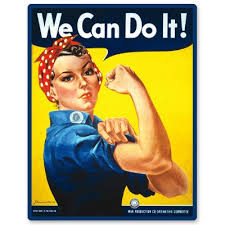
Who is this a image of and what did she a symbol of .....

a)

June the Fighter symbol of women's suffrage

b)

Susan the solider symbol of women working on airplanes

c)

Rosie the Riveter symbol of women working in factories during the war.

26.

What industry manufactured about 1/3 of military equipment during WWII

a)

steel industry

b)

ship-industry

c)

intercultural sector

d)

automobile industry

27.

At first, European leaders gave into Hitler's demands using what type of policy?

a)

aggression

b)

advancement

c)

internment

d)

appeasement

28.
The Nazi program of exterminating Jews under Hitler
a)
Holocaust
b)
Fascism
c)
Rationing
d)
Nazism
29.

The project code named the Manhattan Project was hiding what?

a)

The U.S. building Nuclear Weapons

b)

Internment Camps built to hold minorities

c)

Secret plant building new airplanes

d)

New submarine technology

30.
Japanese and Japanese Americans from the West Coast of the USA during WWII who were sent to camps called "War Relocation Centers" in remote portions of the nation's interior
a)
Cornelia Fort
b)
Japanese Internment
c)
Allied Powers
d)
Axis Powers
31.

In Roosevelt's speech after ____ ,he called it , " A day that will live in infamy."

a)

Normandy ,France

b)

Invasion of North Africa

c)

Pearl Harbor , Hawaii

d)

Bombing of Japan

32.

The day that Japan officially surrendered is called?

a)

Victory Day

b)

V-E Day

c)

D Day

d)

V-J Day

33.

Who was the leader of Great Britain during WW II?

a)

Churchill

b)

Hitler

c)

Stalin

d)

Roosevelt

34.

Who was the dictator of the Soviet Union during WWII?

a)

Adolf Hitler

b)

Winston Churchill

c)

Josef Stalin

d)

Franklin Roosevelt

35.

What battle, fought in June 1942, was the first major victory for the United States in the Pacific. It marked a turning point in the war with Japan.

a)

Coral Sea

b)

Leyte Gulf

c)

Midway

d)

Pearl Harbor

36.
What was the battle that was the "beginning of the end" of the war in Europe?
a)
Blitzkrieg
b)
D-Day
c)
V-J day
37.

Where did the largest land-sea-air invasion in world history take place?

a)

Hiroshima, Japan

b)

Normandy, France

c)

Nagasaki, Japan

d)

Berlin, Germany

38.
What is V-E day?
a)
Victory of everyone
b)
Victory in Europe
c)
Visiting of Exterminators
39.
What happened to Hitler?
a)
He was captured by the Allied soldiers and hanged
b)
Nothing.  He is still on the run
c)
He committed suicide in his bunker as the allies were closing in. 
40.
Why did Stalin and the Soviets end up on the Allied side of the war?
a)
They signed a non-agression pact, but Hitler did not follow it.
b)
They were always allies with the US
c)
Stalin was killed so they joined their minds. 
41.
How did the Allies, specifically the US, end the war on the Pacific front against Japan?
a)
Imprisoned all of the Japanese soldiers until they surrendered.
b)
Used a new type of grenade against the soldiers
c)
Dropped 2 atomic bombs on Hiroshima and Nagasaki
42.
What is V-J day?
a)
Victory over Japan
b)
Victory for Japan
c)
Victory of Jews
43.

The strategy of capturing some islands and going around others. That United States used in order to invade Japan.

a)

Double V

b)

Naplam

c)

Lend-Lease

d)

Island hopping

44.

What battle is the pacific theater was vital to gain in order the bomb Japan

a)

Okinawa

b)

Iwo Jima

c)

Normandy

d)

Midway

45.

The U.S. caused massive fires in Tokyo by dropping bombs filled with..

a)

amphtrac

b)

grease.

c)

napalm

d)

dynamite

46.

A key to the American success at Midway was.....

a)

the use of new sonar and radar technology.

b)

the use of long-range B-25 bombers launched from aircraft carriers

c)

breaking the Japanese Navy’s secret code.

d)

American submarines.

47.

What is the intent of this propaganda poster

a)

Hitler is extremely powerful right now and if Americans do not help Britain, Hitler will destroy America.

b)

America would rather stay neutral than make money by selling weapons.

c)

Americans will not go into war unless someone attacks them.

48.
What is the name of the international organization formed in 1945 to increase political and economic cooperation among member countries.
a)
Justice League
b)
League of Nations
c)
United Nations
49.
What were the Nuremberg Trials
a)
The trial of the Japanese because of the damage they caused during Pearl Harbor
b)
The trial of Hitler after WWII ended
c)
The trial for 22 high ranking Nazi officials because of their crimes
50.

Where was Hitler born?

a)

Germany

b)

Poland

c)

Berlin

d)

Austria

51.

In what war did Hitler fight in as a soldier?

a)

WW1

b)

WW2

c)

Vietnam War

d)

Battle Royale

52.

Why did Hitler hate Jews?

a)

There is no reason

b)

He does not like their culture.

c)

He thinks they are mean.

d)

He believes they caused Germany to lose WW1.

53.

What kind of school rejected Hitler?

a)

Trade

b)

Art

c)

Plumbing

d)

Wrestling

54.

What was the Nazi symbol?

a)

Cross

b)

Triangle

c)

Swastika

d)

Star

55.

What does Mein Kampf translate to?

a)

Hooray for Germany

b)

My Story

c)

Your Faith

d)

My Struggle

56.

What is the nickname when SS murderers killed over 1000 Nazis who were seen as threats to Hitler’s power in the Nazi Party.

a)

The Night of the Long Knives

b)

The Night of Murder

c)

Bring on the Long Knives

d)

The Night of Terror

57.

What was Hitler very good at?

a)

Playing football

b)

Giving speeches

c)

Painting

d)

Swimming

58.

Hitler's father changed their original last name to "Hitler." What was Hitler's "real" last name before it was changed?

a)

Meisterberger

b)

Hitlerlundy

c)

Luftaballoon

d)

Schicklgruber

e)

Finklmeyer

59.

How did Adolf Hitler view his teachers?

a)

He thought they were old and out of touch with kids.

b)

He thought some were good and some were bad.

c)

He adored and admired them.

d)

He thought they were mental and ended the day as lunatics.

60.

In 1918, Hitler was awarded the Iron Cross, First Class (a rare distinction) for doing what?

a)

Single-handedly capturing 15 enemy soldiers.

b)

Delivering a message through heavy enemy fire.

c)

Surviving a mustard gas attack

d)

Saving the regiment dog, Foxl, who entered no-man's land chasing a cat.

61.
What was going on in Germany in the 1930's that allowed the people to turn to a person like Hitler to lead them?
a)
The Great Depression
b)
Civil War
c)
Massive attacks from outside nations
d)
A period of great economic growth
62.

By September of 1923 how many marks equaled 1 US dollar?

a)

100

b)

4 million

c)

1 million

d)

4 billion

63.

In March of 1933 the Nazis passed an act which passed powers of legislation to Hitler’s cabinet for four years, making him virtual dictator. What was this act?

a)

The Conscription Act

b)

The Enabling Act

c)

The Nazi Legislation Act

d)

The Dawes Act

64.

What event allowed Hitler to suspend civil liberties in Germany?

a)

a communist rebellion

b)

an assassination attempt on his life

c)

a fire in the Reichstag building

d)

a vote that caused his party to lose its majority in the Reichstag

65.

What did the Munich Agreement allow Germany to do?

a)

It allowed Germany to print large sums of money.

b)

It allowed Germany to increase the size of its navy.

c)

It allowed Germany to depart Jews from large cities in Germany.

d)

It allowed Germany to take the Sudetenland, the German populated borderlands of Czechoslavakia.