
 Worksheets
Cold War-World History
Total questions: 68
Worksheet time: 39mins
How did the Marshall Plan aim to contain the spread of communism?
It built up the western European armed forces.
It helped rebuild and strengthen European economies.
It forced Americans to take loyalty oaths to avoid losing their jobs.
It created a military alliance among western European and North American nations.

In a speech regarding the divide in Europe over communism, Winston Churchill stated that a(n) ___________ descended over the continent.
steel wall
iron wall
steel curtain
iron curtain

Doing whatever it takes to to gain an advantage, even if it means nuclear war, and win is referred to as
containment
brinkmanship
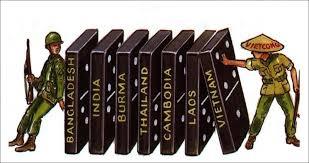
the domino theory
Cold War

Which nations emerged as the world's superpowers after World War II and into the period of the Cold War?
China
Russia
United States
Soviet Union (USSR)

Nations that fell under the influence of the Soviet Union and established communist regimes were referred to as
communist republics
socialist nations
Soviet republics
satellite nations

The organization that was formed to combat communism and protect member nations from a communist attack was the
United Nations
Warsaw Pact
NATO
CIA

The nation created after World War II as a homeland for displaced Jews was
Palestine
the Soviet Union
Czechoslovakia
Israel

The organization that the Soviet Union created in response to the defense alliance created by the United States consisting of communist allies to the USSR was
NATO
the United Nations
the satellite nations
the Warsaw Pact
The Cold War is BEST defined as...
a great struggle for world dominance after WWII
A series of bombing between the United States and Soviet Union
the struggle between democracy and communism around the world after WWII
a struggle between fascism and democracy around the world after WWII
President Truman created the Truman Doctrine which stated..
America would isolate themselves from the worlds problems again
America would help or aid anyone resisting the spread of communism
Russia would make a deal with America to only spread communism to Asia
America made a deal with Great Britain to go to war with Soviet Union
What happened to Germany after World War II
It was left to become it's own new nation again
It was taken over completely by Soviet Union
The allies helped it become a democratic nation
It was split in two, East communist and West democratic

Mao became one of the founders of the Chinese Communist Party.
True
False



Fidel Castro was the leader of what country?
Soviet Union
Venezuela
Cuba
Canada
Afghanistan
What type of government did Fidel Castro implement once he gained control of Cuba
Communist
Democratcic
Republican
Monarchy
Oligarchy
What was the Bay of Pigs event?
The final battle where Fidel Castro gained control of the Cuban government
An attempt by the U.S. government to overthrow Castro
A war between Cuba and Mexico
The name of the alliance between Cuba and the Soviet Union
A protest march led by Fidel Castro
Castro established the first communist state in the Western Hemisphere
True
False

Who was the leader of the Soviet Union during the Cuban Missile Crisis?
Nikita Khrushchev
Joseph Stalin
Mikhal Gorbachav
Fidel Castro
Who was the United States President during the Cuban Missile Crisis?
Harry Truman
Dwight Eisenhower
John F. Kennedy
Robert Kennedy
What is a significant reason why the Soviets put missiles in Cuba?
They didn't want to, but Castro asked them to
Because they intended to attack Florida
There weren't any missiles in Cuba
The Soviets disliked the presence of nuclear weapons that were targeted at them from sites in Western Europe and Turkey
What is a significant reason why the Soviets befriended Cuba?
To help a new Communist state
To test strength of new U.S. president, JFK
Khrushchev wanted to force JFK to bargain over U.S. missiles in Europe
All of the above
Upon discovering Soviet nuclear missiles in Cuba, Kennedy...
Ordered air strikes against the missile sites
Ordered a full-scale invasion of Cuba
Used diplomacy through the UN
Set up a naval blockade around the island

What event ended the policy of Détente?
Nuclear Non- Proliferation Treaty
Invasion of Afghanistan
The Carter Doctrine
Iranian Embassy siege
The Russian leader who was in office at the downfall of the Soviet Union
Gorbachev
Breshnev
Kruschev
Stalin
Which country did the Berlin Airlift take place?
Germany
France
U.S.
Russia
Who controlled West Germany after the vote?
The Allies (U.S., France, G.B.)
The Soviet Union
Shutting off of a port to keep people or supplies from moving in or out.
blockade
containment
perestroika
satellites
One goal of the Berlin Blockade was to
Raise taxes
Promote communism
Save money on resources
Force out the US and allies out of Berlin
Who launched the first man made satellite into space?
The USA
The USSR
__________________ was the name of the satellite launched in 1957.
Explorer
Mercury 1
Sputnik
Luna 1
Who was the first man to set foot on the moon?
Buzz Aldrin
John Glenn
Neil Armstrong
None of these
Which president vowed that the US would go to the moon?
JFK
LBJ
Eisenhower
Nixon
In what year did the moon landing occur?
1965
1969
1970
1975

Which event inspired this comic?
The moon landing
The launching of Sputnik
The Soviet Nuclear Program
The US dominance in Space
The Russian leader who was in office at the downfall of the Soviet Union
Gorbachev
Breshnev
Kruschev
Stalin
Reagan’s foreign policy called for
making an alliance with the Soviet Union.
limiting American intervention in the affairs of other nations.
protecting the island of Cuba from invasion.
taking on a strong anti-communist role in the world.

President Ronald Reagan and Soviet leader Mikhail Gorbachev signed a missile treaty in hopes of?
Reducing tensions associated with the threat of nuclear war
Providing an exchange of weapons for war hostages
Allowing secret weapons technologies to be shared
Establishing an official cease-fire
Which of the following would be identified as a cause of the collapse of the Soviet Union?
The expensive arms race in the USSR became an enormous burden on the struggling economy
The Soviet government used their military strength to put down any resistance
The United States promised to provide economic assistance to the Soviet Union if they broke up
Winston Churchill coordinated Operation "Sea Lion"
The Strategic Defensive Initiative or SDI
was a plan the United States developed as a nuclear defense system
an idea proposed by the Soviet Union to limit the amount of work that needed to be done
was scrapped by the British because the cost was too high
was developed by the French as a way to increase their ability to make fresh backed goods
The Berlin Wall fell in
1989
1988
1990
1991
The Soviet Union officially fell in
1991
1992
1989
1990
As a result of a struggling Soviet system
many of the countries in Eastern Europe staged revolutions against their communist governments
people increased their personal holdings in land
a majority of people started to see the Soviet nation as a power entity
their economy grew exponentially

What Year Did The Berlin Wall Go Up
1969
1956
1961
1962

Who Controlled East Germany
France
U.S.A
Soviet Union
Britain

Who Controlled West Germany
France
Britain
USA
Soviet Union
Why Did The Berlin Wall Fall?
In 1989, political changes in Eastern Europe and civil unrest in Germany put pressure on the East German government to loosen some of its regulations on travel to West Germany.
In 1979, Military changes in Eastern Europe and civil unrest in Germany put pressure on the East German government to loosen some of its regulations on travel to West Germany.
In 1989, political changes in Western Europe and civil unrest in Germany put pressure on the East German Military to loosen some of its regulations on travel to West Germany.
In 1989, political changes in Eastern Europe and civil unrest in Germany put pressure on the West German government to loosen some of its regulations on travel to East Germany.
The primary goal of Mikhail Gorbachev’s policy of perestroika for the Soviet Union was the
restriction of trade
censorship of the press
restructuring of the economy
establishment of five-year plans
Which leader’s policies included glasnost and perestroika?
Fidel Castro
Nikita Khrushchev
Mikhail Gorbachev
Deng Xiaoping

