wayground logo

Free Printable Worksheets

Font size

S
M
L
XL
Worksheets

Terminal Velocity

Total questions: 61

Worksheet time: 45mins

Name
Class
Date
1.

A parachutist of mass 75 kg jumps from a plane at a height of 4 000 m above sea level.

The parachutist falls through a distance of 2 400 m during the first 60 seconds. Calculate the average speed of the parachutist during this time.

a)

20 ms-1

b)

40 ms-1

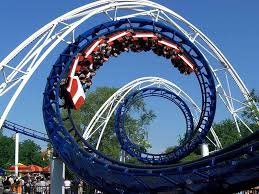
c)

67 ms-1

d)

80 ms-1

2.

Just after she jumps out of the plane (before the parachute opens). The relative forces will be

a)

Balanced

b)

Unbalanced

3.

Just after she jumps out of the plane (before the parachute opens). The relative forces will be

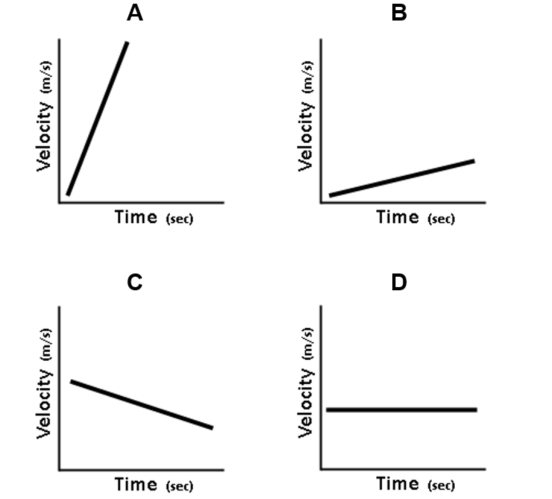
a)

Weight force is equal to the friction force

b)

Friction force is constant

c)

Weight force is greater that the friction force

d)

Friction force is greater than the weight force

4.

Just after she jumps out of the plane (before the parachute opens). The net force will be

a)

zero

b)

upward

c)

downward

5.

Just after she jumps out of the plane (before the parachute opens). The sky diver will have

a)

a constant speed

b)

a constant acceleration

c)

a constant velocity

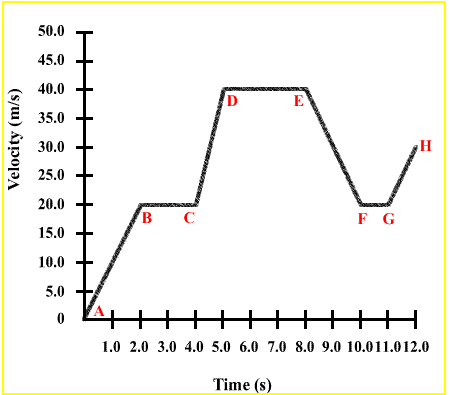
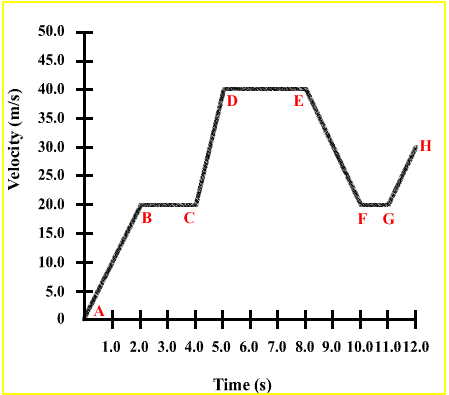
6.

After the 60 seconds, the parachutist pulls the cord and opens her parachute.

Explain how the parachute reduces the speed of the parachutist when it is just opened.

a)

The friction force decreases

b)

The weight force decreases

c)

The weight force increases

d)

The friction force increases

7.
Describe the motion at point a. on the graph.
a)
constant speed
b)
accelerating
c)
decelerating
d)
stationary
8.
If this was the journey of a parachutist, what is happening at point e. ?
a)
He is decelerating
b)
He is accelerating
c)
He has reached a faster constant speed
d)
He has reached a lower constant speed. 
9.

The graph shows the vertical speed of a parachutist. At which point did they open the parachute?

a)

A

b)

B

c)

C

d)

D

10.

If a skydiver changes from a vertical to a horizontal position during freefall:

a)

His terminal speed would increase

b)

His terminal speed would decrease

c)

His terminal speed would stay the same

11.

When a parachute canopy is opened more drag is created because:

a)

It has a large mass

b)

It has a large surface area

c)

It is travelling at terminal speed

d)

The person is now vertical

12.

If this graph were to show a parachutist jumping from a plane, how would you describe the forces acting at point B.

a)

His weight is bigger than air resistance

b)

Air resistance is bigger than his weight.

c)

His weight and air resistance are balanced.

13.

Identify true statements:

a)

The parachutist has just left the plane

b)

Weight is increasing

c)

There is no drag

d)

Weight is constant

e)

Deceleration

14.

Identify true statements:

a)

Drag is increasing

b)

Velocity is increasing

c)

There is no drag

d)

Weight is increasing

e)

Deceleration

15.

Identify true statements:

a)

Drag is increasing

b)

Velocity is increasing

c)

Terminal velocity

d)

Acceleration

e)

Maximum drag

16.

Identify true statements:

a)

The parachutist opens their parachute

b)

Deceleration

c)

Terminal velocity

d)

Weight is increasing

e)

Drag is constant

17.

Identify true statements:

a)

Drag is decreasing

b)

Velocity is increasing

c)

Drag is increasing

d)

Velocity is decreasing

e)

Weight is constant

18.

Identify true statements:

a)

Drag is increasing

b)

Velocity is increasing

c)

Terminal velocity

d)

Acceleration

e)

Drag is constant

19.

Terminal velocity.

Select the force arrows that apply:

a)
b)
c)
d)
e)
20.
A box sliding down an inclined plane attains a velocity of 27 m/s in 3 seconds from rest.  Find the acceleration.
a)
30 m/s
b)
24 m/s2
c)
9 m/s2
d)
81 km/hr
21.
A roller coasters accelerates from an initial velocity of of 6.0 m/s to a final velocity of 70 m/s over 4 seconds.  What's the acceleration?
a)
24 m/s2
b)
18 m/s2
c)
16 m/s2
d)
16 m/s
22.
A dog runs with an initial speed of 7.5 m/s on a waxed floor.  It slides to a stop in 15 seconds.  What is the acceleration?
a)
-7.5 m/s
b)
-7.5 m/s2
c)
-0.5 m/s2
d)
7.5 mi//hr
23.
How fast is the car traveling at 30 seconds?
a)
5m/s
b)
10m/s
c)
20m/s
d)
30m/s
24.
A car starts from rest at a stop light and reaches 20 m/s in 3.5 s. Determine the acceleration of the car.
a)
2.2m/s2
b)
7.0m/s2
c)
5.7m/s2
d)
70m/s2
25.
The picture of the position vs. time graph shows an object that is...
a)
accelerating/speeding up
b)
moving at a constant speed 
c)
not moving 
d)
accelerating/slowing down. 
26.
Acceleration is defined as the CHANGE in 
a)
time it takes for one place to move to another place. 
b)
velocity of an object.
c)
distance divided by the time interval 
d)
velocity divided by the time interval 
27.
Why does a car accelerate as it round a corner at a constant speed?
a)
Its direction changes
b)
It doesn't
c)
It slows down
d)
Its speeds up  
28.
Acceleration only takes place when things speed up. 
a)
True
b)
False
29.
In each of the following cases, determine where the car has no acceleration ?
a)
A car shortly after a stoplight turns green.
b)
A car approaching a red light
c)
A car with the cruise control set at 80 km/h
d)
A car turning a curve at a constant speed
30.
Determine the motion of the car.
a)
at rest 
b)
moving at constant speed
c)
speeding up
d)
slowing down
31.
Determine the motion of the car.
a)
at rest 
b)
constant velocity 
c)
speeding up
d)
slowing down
32.
A roller coasters accelerates from an initial velocity of of 6.0 m/s to a final velocity of 70 m/s over 4 seconds.  What's the acceleration?
a)
24 m/s2
b)
18 m/s2
c)
16 m/s2
d)
16 m/s
33.
Which graph shows the object standing still?
a)
A
b)
B
c)
C
d)
D
34.
Which graph demonstrates the greatest positive speed?
a)
A
b)
B
c)
C
d)
D
35.
Which graph represents zero acceleration (constant velocity)?
a)
A
b)
B
c)
C
d)
D
36.
Which graph represents the greatest acceleration?
a)
A
b)
B
c)
C
d)
D
37.

Select the description of motion from A - B.

a)

Slowing down away from the origin

b)

Speeding up away from the origin

c)

Constant velocity away from the origin

d)

Constant velocity towards the origin

38.

What segment of the graph shows no motion, or standing still?

a)

A - B

b)

B - C

c)

C - D

d)

None

39.

True or False: this graph shows several segments ALL with constant velocity.

a)

True

b)

False

40.

Describe motion of C - D.

a)

Constant velocity away from the origin

b)

Slowing down away from the origin

c)

Slowing down away from the origin and then slowing down towards the origin

d)

Slowing down away from the origin and then speeding up towards from the origin

41.

Describe the motion from B - C.

a)

Standing still

b)

Constant velocity of 60 m/min

c)

Constant velocity of 0 m/min

d)

Accelerating

42.

What kind of line on a P-T graph would create the segment B - C on this V-T graph?

a)

Straight, linear line

b)

Horizontal line

c)

Curved line

d)

Wouldn't happen

43.

Segment D - E would have come from what type of P-T graph line?

a)

Straight, linear

b)

Horizontal

c)

Curved

d)

Wouldn't happen

44.

What does a horizontal line (not on the x-axis) mean on a V-T graph?

a)

No movement

b)

Constant velocity

c)

Changing velocity

d)

Change in direction

45.

What is happening at 0 m/min in the middle of segment C - D?

a)

Nothing is happening

b)

Change in speed

c)

Change in position

d)

Change in direction

46.

Which segment shows an object speeding up towards the origin?

a)

A - B above the x-axis

b)

C - D below the x-axis

c)

C-D above the x-axis

d)

D - E

47.
What kind of acceleration is shown here?
a)
positive
b)
negative
c)
none
d)
varies
48.
What kind of acceleration is shown here?
a)
positive
b)
negative
c)
none
d)
varies
49.
What kind of acceleration is shown here?
a)
none
b)
positive
c)
negative
d)
varies
50.
What is the velocity?
a)
not moving
b)
increasing
c)
positive
d)
negative
51.
What is the velocity?
a)
positive
b)
negative
c)
decreasing
d)
increasing
52.
What is the velocity?
a)
0 m/s
b)
positive m/s
c)
negative m/s
d)
decreasing
53.
Is the speed constant or non-constant?
a)
constant
b)
non-constant
54.
Is the speed constant or non-constant?
a)
constant
b)
non-constant
55.
Is the speed constant or non-constant?
a)
constant
b)
non-constant
56.
Is the speed constant or non-constant?
a)
constant
b)
non-constant
57.
Which section of the graph shows decreasing velocity?
a)
CD
b)
DE
c)
EF
d)
GH
58.
Which section of the graph shows increasing velocity?
a)
AB
b)
BC
c)
DE
d)
EF
59.
Which section of the graph shows constant velocity?
a)
AB
b)
BC
c)
EF
d)
GH
60.
Which section of the graph shows acceleration?
a)
AB
b)
BC
c)
EF
d)
FG
61.
Which section of the graph shows deceleration?
a)
AB
b)
BC
c)
EF
d)
GH