
NEW
Font size
 Worksheets
Replication, Transcription and translation
Total questions: 20
Worksheet time: 14mins
If a strand of DNA had bases in the following order - ATCCGTC, what would be the replicated complementary strand?
UAGGCAG
ATCCGTC
TAGGCAG
TUGGCTG
If a strand of DNA had bases in the following order - ATCCGTC, what would be the transcribed mRNA sequence?
TAGGCAG
UAGGCAG
TUGGCUG
None of the above are correct
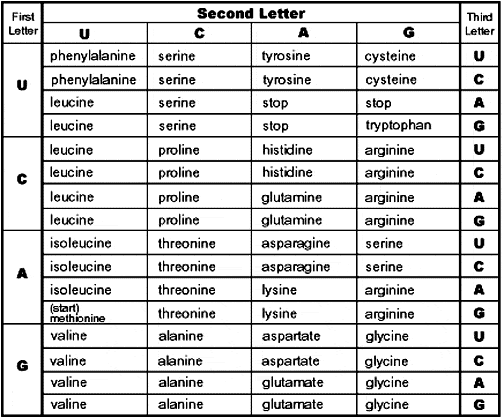
Use the codon chart to determine the amino acid sequence: (Hint: mRNA must be used to determine the AA sequence!)
ATT CGC ATC
TAA GCG TAG
AUU CGC AUC
UAA GCG UAG
tyrosine, alanine, stop
stop, alanine, tyrosine
start, arginine, methionine
Isoleucine, arginine, isoleucine
Which of the following base pairs with adenine in RNA?
thymine
guanine
uracil
cytosine
How would the complementary strand of DNA appear in the original strand of DNA contained the bases TAGC respectively?
UACG
GCAT
TACG
ATCG
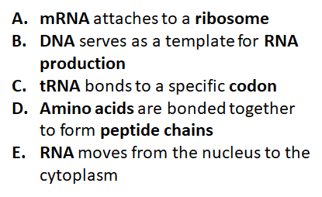
What is the correct order for the following events that occur during protein synthesis?
B,E,A,C,D
B,A,E,C,D
D,A,E,C,B
C,B,A,E,D
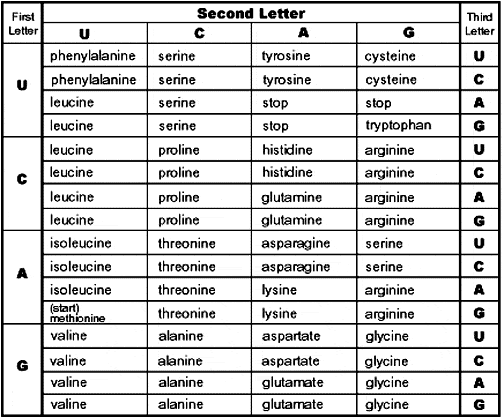
Which of the following polypeptides are coded for by the mRNA sequence
5' AUG GUU AAA 3'
Val, Lys, Phe
Met, Asp, Phe
Met, Val, Lys
Ile, Gln, Lys

Starts with 1 strand of DNA and creates 2 new identical DNA strand.
replication
transcription
translation
Uses the enzyme helicase to break hydrogen bonds between the 2 strands of DNA.
replication
transcription
translation
Starts with 1 strand of DNA and creates 1 strand mRNA.
replication
transcription
translation


the region of a chromosome to which the microtubules of the spindle attach during cell division.
chromatid
karyotype
telemere
centromere
a 5-carbon sugar found in the backbone of DNA
ribose
deoxyribose
lactose
ribosome

