wayground logo

Free Printable Worksheets

NEW

Font size

S
M
L
XL
Worksheets

Ecology

Total questions: 40

Worksheet time: 41mins

Name
Class
Date
1.

Which of the following is abiotic?

a)

Soil

b)

Cat

c)

Bacteria

d)

Mushroom

2.
Which of the following is biotic?
a)
Fire
b)
Bacteria
c)
Planet
d)
Soil
3.
Organisms that look similar and can produce fertile offspring
a)
Species
b)
Fish
c)
Community
d)
Trees
4.
The study of how living things interact with one another and with their environment.
a)
Biology
b)
Lithology
c)
Ecology
d)
Farmacology
5.
Two or more members of a particular species living and interacting in the same area
a)
Community
b)
Population
c)
Organisms
d)
Biosphere
6.
Different populations living and interacting with each other in the same area
a)
Biome
b)
Ecosystem
c)
Community
d)
Niche
7.
Examples of a producer
a)
frog
b)
algae
c)
worm
d)
mouse
8.
Which one is NOT an example of a decomposer?
a)
mushroom
b)
leaves
c)
mold
d)
worm
9.
What is a herbivore?
a)
an animal that gets energy from eating other animals
b)
an organism that gets energy from eating only plants
c)
an animal that gets energy by eating both plants and other animals
d)
an animal that eats only herbs
10.
Where do all life forms get their energy?
a)
Earth's Core
b)
Water
c)
Plants
d)
The Sun
11.
What is this called?
a)
Food Web
b)
Food Chain
c)
Abiotic Factors
12.

Which of these organisms is the secondary consumer?

a)

Owl

b)

Mouse

c)

Grass

d)

Grasshopper

13.

Place the levels of environment in the correct order.

a)

biome, biosphere, population, organism, ecosystem,community

b)

organism, ecosystem, biosphere, population, community, biome

c)

organism, population, community, ecosystem, biome, biosphere

d)

population, community, organism, biome, ecosystem, biosphere

14.

What is the hawk in the food web?

a)

Producer

b)

Primary consumer

c)

Secondary consumer

d)

Tertiary consumer

15.

How much energy is transferred between trophic levels?

a)

25%

b)

20%

c)

10%

d)

90%

16.

Which of these is an autotroph?

a)

Consumer

b)

Producer

c)

Decomposer

17.

Volcano erupting would be an example of what type of succession?

a)

Primary

b)

Secondary

c)

Tertiary

18.
relationship in which two species live closely together
a)
resource
b)
mutualism
c)
succession
d)
symbiosis
19.
What is the term for each step in the transfer of energy and matter within a biological community?
a)
energy path
b)
food web
c)
trophic level
d)
food pyramid
20.
As you move upward, from level to level, in an energy pyramid, energy _____.
a)
increases
b)
decreases
c)
stays the same
d)
increases exponentially
21.

water exits from the leaves of a plant and is evaporated.

a)

precipitation

b)

concentration

c)

transpiration

d)

evaporation

22.

What is the greenhouse effect?

a)

It is a phenomenon where the sun’s rays are absorbed by clouds.

b)

It is a phenomenon that occurs when heat escapes into space.

c)

It is when heat is trapped by gases, then sent back to earth’s surface.

d)

It describes the atmosphere’s composition.

23.

In the woods, there are ducks and mice. They both compete for grasshoppers as the only source of food in that area at that time. The ducks outcompete the mice, and the mice die out in that area. This is an example of:

a)

Neutralism

b)

Commensalism

c)

The competitive exclusion principle

d)

Mutualism

24.

Barnacles are animals that cannot move. In order to get food, they attach to whales and catch any floating plankton in the water. The whale is neither helped nor harmed in the interaction. What type of symbiosis is this?

a)

Mutualism

b)

Commensalism

c)

Parasitism

d)

Neutralism

25.

In the wild, some alligators gets their teeth cleaned by birds. The birds gets their food from the alligators' teeth.

What type of symbiosis is this?

a)

Mutualism

b)

Commensalism

c)

Parasitism

d)

Neutralism

26.

In an ecosystem, there are populations of moose, rabbits, grass, and pine trees. Suddenly, a fire blazes through the area, which kills all of the populations. As the months go on, new species of grass begin to take root. This attracts animals, and eventually the ecosystem is restored.


What type of ecological succession happened?

a)

Primary succession

b)

Secondary succession

c)

Tertiary succession

d)

None of the above

27.

What Biome is covered in permafrost (frozen subsoils)?

a)

Tropical Rain Forest

b)

Desert

c)

Tundra

d)

Tropical Savanna

28.

What Biome has a lot of biodiversity and can be found at the equator (0 degrees latitude)?

a)

Tropical Rain Forest

b)

Desert

c)

Tundra

d)

Tropical Savanna

29.
In the energy pyramid here, how much of the energy in the producers gets passed to the herbivores?
a)
10%
b)
20%
c)
80%
d)
90%
30.
Nitrogen makes up _____ percent of the atmosphere.
a)
66%
b)
78%
c)
90%
31.
a relationship between two in which one species, the predator, feeds on the other species, the prey
a)
chemosynthesis
b)
predation
c)
cellular respiration 
d)
commensalism
32.
A food chain is illustrated below:
The arrows represented most likely indicate
a)
A. Energy released from metabolism into the environment as heat.
b)
B. Oxygen released from metabolism produced by cellular respiration.
c)
C. The absorption of energy from the environment that has been created.
d)
D. The transport of glucose away from the organism through photosynthesis.
33.

The job or role of a plant or an animal in the ecosystem.

a)

carnivore

b)

niche

c)

consumer

d)

habitat

34.
At what stage does this population reach it's carrying capacity on the Demographic Transition Model
a)
1
b)
2
c)
3
d)
4
35.
An important attribute of a K-strategist species is _____
a)
Nurture their young
b)
Exponential Growth
c)
Opportunistic
d)
Relatively low body mass
36.
The diagram below depicts the water cycle.  Which process is represented by the number 2?
a)
precipitation
b)
evaporation
c)
surface runoff
d)
condensation
37.
An increase in the atmospheric levels of carbon dioxide (CO2) is the biggest contributor to which of the following?
a)
El Nino
b)
global warming
c)
wind storms
d)
ozone depletion
38.
Overpopulation occurs when a population exceeds its carrying capacity.  White-tailed deer are considered to be an overpopulated species in the central United States.  What is one consequence of white-tailed deer exceeding their carrying capacity?
a)
People don't see deer as often in urban areas.
b)
The deer are less healthy and more prone to disease.
c)
There are more predators to eat the deer.
d)
The deer have stopped breeding.
39.
Which of these is a MAJOR cause of acid rain?
a)
spraying pesticides on crops
b)
burning fossil fuels for energy
c)
dumping sewage in river systems
d)
using uranium to generate electricity
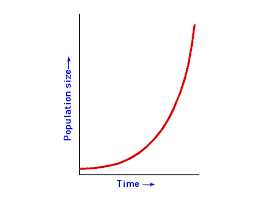
40.
What type of growth is shown in the diagram?
a)
exponential growth
b)
logistic growth 
c)
predator-prey cycle
d)
boom-bust curve