
 Worksheets
Midterm Review - Evolution & Classification
Total questions: 161
Worksheet time: 5hrs 22mins
What kingdoms have organisms that are prokaryotic? (hint: 2 correct answers)
animalia
fungi
eubacteria
archeabacteria
Archaebacteria is __________________?
Unicellular
Multicellular
Both unicellular and multicellular


All of the following have a nucleus except...
Bacteria
Animalia
Plantae (Plant)
Protista (Protist)
What kingdom has organisms that feed off dead or decaying organisms?
Plantae (Plant)
Fungi
Protista (Protist)
Archaebacteria

What are the kingdoms that are eukaryotic? (select all that apply)
animalia
Fungi
Protista
Plantae
Eubacteria
What kingdoms are prokaryotic?
animalia
fungi
eubacteria
archeabacteria


How many parents are there in sexual reproduction?
1 parent
2 parents
Eukaryotic
Autotrophic
Unicellular
Asexual Reproduction
Eukaryotic
Autotrophic
Multicellular
Asexual or Sexual Reproduction
Prokaryotic
Autotrophic
Unicellular
Asexual Reproduction
Normal Environment
Eukaryotic
Heterotrophic
Multicellular
Asexual Reproduction
What is the genus name here:
Canis lupus
Canis
lupus

Choose the correct way to write the scientific name for humans:
homo sapiens
Homosapiens
Homo sapiens
Homo Sapiens

The scientific name for water bear is Hypsibius dujardini. What is its genus?
Hypsibius
dujardini
water
tardigrade

The scientific name for water bear is Hypsibius dujardini. What is its species?
Hypsibius
dujardini
water
tardigrade


What language are scientific names written in?
Spanish
German
English
Latin
What is the science of organizing, classifying and naming living things.
taxonomy
taxadermy
taxicab
toxicology
Which classification level is the most specific?
Domain
Family
Species
Genus
Which level of classification is the broadest? (the largest)
Species
Class
Family
Kingdom
Who was the first scientist to develop a classification system for living organisms?
Aristotle
Carolus Linnaeus
Robert Hooke
Charles Darwin
A group of similar organisms that can mate and produce fertile offspring
genus
kingdom
phylum
species
What are the 3 subgroups in Aristotle's system of classification?
those that fly; those that swim; hose that walk, crawl, or run
those that fly; those that jump; those that swim
those that fly; those that floss; those that swim
those that fly; those that drive cars, those that walk, crawl, or run

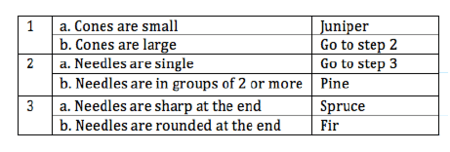


arachnids and insects?
following observations of the plant’s characteristics would be useful in determining its identity with a dichotomous key?


The more classification levels two organisms share, __________________.
the more closely related they are.
the more likely they are to evolve.
the more diverse they are.
I am trying to make a dichotomous key about snakes. Which statement should I include in my key?
The snake is scary.
The snake is gross.
The snake is black and yellow.
The snake is big.

Two students couldn't agree on whether the mushrooms on their pizza were plants or fungi. They conducted an experiment. Based on the data in the chart, which is the best conclusion?
Mushrooms belong to the Plant Kingdom because they can grow in light.
Mushrooms belong to the Plant Kingdom because they need water.
Mushrooms do not belong to the Plant Kingdom because they can grow in the dark.
Mushrooms do not belong to the Plant Kingdom because they need water.
If an organism is unicellular, which kingdom could it NOT be a part of?
Plantae
Protista
Eubacteria
Archaea
Do animals have cells with cell walls?
Yes
No
What kingdom is this organism in?
Single celled
No nucleus
Consumes food
Reproduces with one parent
Animalia
Protista
Eubacteria
Fungi
What kingdom is this organism in?
Single celled
Nucleus is present and seen
Consumes food
Reproduces with one parent
Plantae
Archaea
Animalia
Protista
What kingdom is this organism in?
Single celled
Nucleus is observable under a microscope
Consumes food or can make its own food
Reproduces with one parent
Protista
Animalia
Fungi
Plantae
Prior to the 1600’s, what was the classification system that was used to group organisms?
plants or animals
plants, animals, or bacteria
plants, animals, fungi, or protists
plants, animals, fungi, protists, or bacteria
Linnaeus developed an early version of classifying living things by categorizing the organisms as plants or animals. Why is the method of classification not appropriate for today’s understanding of biodiversity?
The world has millions of different plants and animals.
Plants and animals have many different characteristics
The model does not account for species that are neither plant or animal
The model does not include the interaction of species with their environment.

What is the Phylum name for humans?
sapiens
Mammalia
Chordata
Homo

Which bacteria has a heavy cover, is grouped in pairs, and is round?
Diplococcus pneumoniae
Diplococcus menigitidis
Staphylococcus aureus
Treponema pallidum

What are the characteristics of Diplococcus menigitidis?
It doesn't have a heavy cover, is grouped in chains, and is rod-like in shape.
It has a heavy cover, is grouped in clumps, and is round.
It doesn't have a heavy cover, is grouped in pairs, and is round.
It doesn't have a heavy cover, is grouped in chains, and is spiral.
Why would you classify mushrooms in the Fungi kingdom and not the Plantae kingdom?
It belongs in the fungi kingdom because it is unicellular and heterotrophic.
It belongs in the fungi kingdom because it is multicellular and can perform photosynthesis.
It belongs in the fungi kingdom because it can perform photosynthesis and does not have cell walls.
It belongs in the fungi kingdom because it has cell walls and is heterotrophic.
What can you infer about an organism with the name Felis catus?
It is in the same species as bobcats (Felis rufus).
It is closely related to chimpanzees (Pan troglodytes).
It is closely related to cougers because they are in the same genus (Felis concolor).
How are the Plantae and Animalia kingdoms SIMILAR?
Both plants and animals are eukaryotic and unicellular.
Both plants and animals are multicellular and autotrophic.
Both plants and animals are multicellular and eukaryotic.
Both plants and animals are eukaryotic and autotrophic.

What conclusion can you make based on the diagram?
The trilobite is well suited to today’s environment.
Ammonite was alive at the same time as trilobites.
All the fossils in the layers are the same.
The trilobite has gone extinct.

After Year 5, what can you conclude about the moth populations?
The moth populations stayed the same.
The white moth population was higher than the brown moth population.
The white moth population and the brown moth population were equal.
The brown moth population was higher than the white moth population.
Early ancestors of the giraffe had short necks. After millions of years, their necks grew long like they are today. Which is best supported by fossil record?
Fossil record shows that giraffes quickly evolved so that their neck became long. This variation was more useful to survival than short necks.
Fossil record shows the giraffe gradually evolved so that their neck became long. This variation was less useful to survival than short necks.
Fossil record shows the giraffe gradually evolved so that their neck became long. This variation was more useful to survival than short necks.
A population of cockroaches was sprayed with an insecticide (chemical used to kill bugs). Some cockroaches survived and produced a population of cockroaches that was resistant to this spray. What can BEST be inferred from this example?
species will adapt no matter what the environment
environment has no effect on the survival of an organism
some individuals had a gene mutation that helped them survive in the presence of the antibiotic. They were able to reproduce and pass on that trait.
insecticides cause mutations that are passed on to the next generation

What are the oldest fossils and why?
B, C- because they are closest to the top
A, B- because they are closest to the bottom
They are all the same age- because they are all found on layer 2
A, B- because they are found closest to the top

Fossil A is an ancient mollusk, an organism that needs water to survive. Why do you think that the mollusk went extinct in this particular sample of the fossil record?
When the ocean levels rose in layer 4, the mollusk went extinct because they cannot live in water
For some reason, the ocean disappeared causing the mollusk to thrive
For some reason, the ocean disappeared causing the mollusk to go extinct
When the ocean level rose in layer 4, the mollusk thrived because they need water

In which layer did fossil C come into existence? How do you know this?
Layer 1-Because that is the layer it is first seen
Layer 1- Because that is the last layer it is seen in
Layer 2- Because that is the layer it is first seen
Layer 2- Because that is the last layer it is seen in

The evolution of the horse is the most complete fossil record we have of a single organism. Using the picture, what can you conclude happened to the horse over time?
The horse grew larger and lost its toes
The horse shrank and lost its toes
The horse grew larger and gained toes
The horse shrank and gained toes
The key factor that impacted natural selection of the moths is...
predator prey
environmental factors
time
mutations
The peppered moth population turned mostly black because of
Global warming
Loss of trees in the environment
Industrial revolution
New tree species introduced in the area
"Survival of the Fittest" describes which theory
natural selection
gravity
heredity
string theory

A __________ is a branching diagram that shows evolutionary relationships.
branching tree (cladogram)
table
derived character
relationship tree
The law of superposition states
the oldest rock layer is on the top, the younger rock layer is on the bottom
rock layers are always in sequence from oldest to youngest
the youngest rock layer is on the bottom and the oldest is on the top
the oldest layer is on the bottom and the youngest is on the top when the layers are undisturbed

Scientists have collected millions of fossils of different organisms, and have developed a timeline of life on Earth. What do we call this?
Mutation
Natural Selection
The theory of evolution
Fossil Record
What most likely caused the finches on the Galapagos Islands to have beaks that were different from the finches on the mainland?
There were different types of predators on the island.
There were different types of food available on the island.
The finches had no water to drink.
The finches on the mainland could not fly high enough.
What do we call a change in a species over time?
Adaptation
Evolution
Extinction
Environmental influences
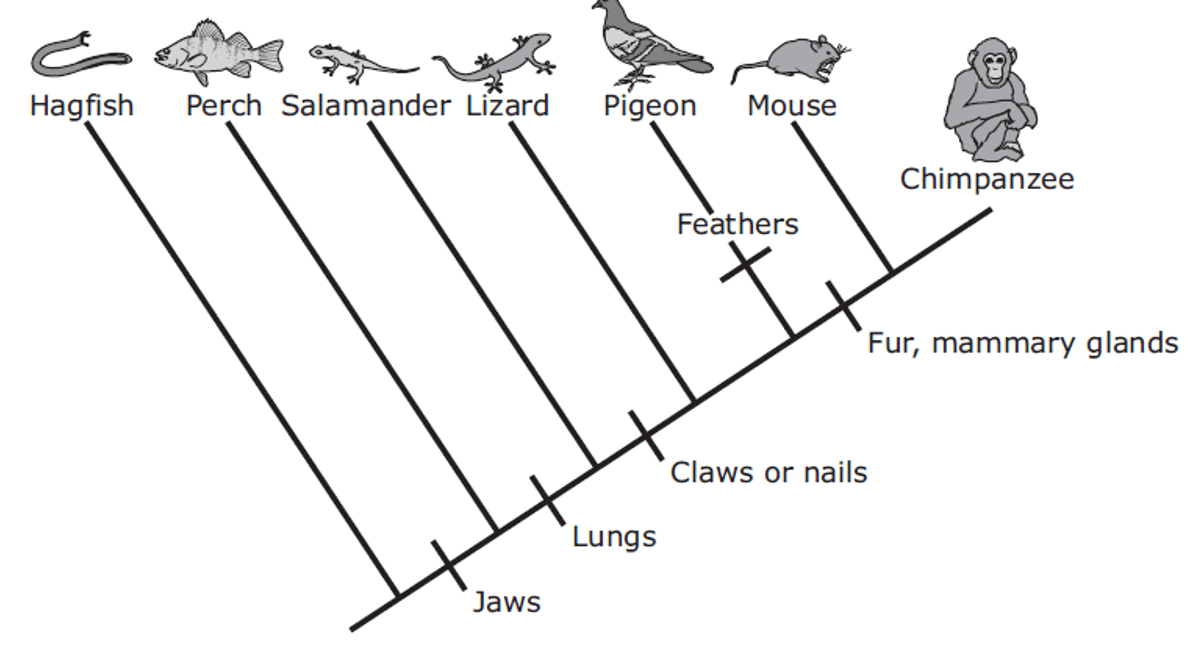
All the animals to the right of the salamander would have the common characteristic of...
Fur
Claws or nails
Lungs
Jaws
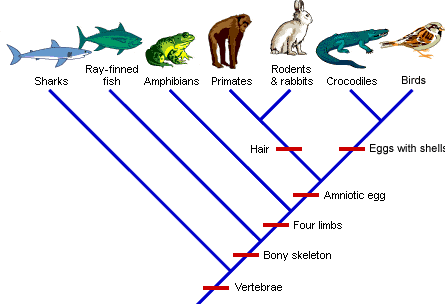
According to this cladogram, sharks are MOST closely related to which organism?
Amphibians
Ray finned fish
Crocodiles
Birds

Which of the following best describes the relationship between variations and adaptations?
All variations are adaptations, but not all adaptations come from variations
All adaptations are variations and all variations help organisms survive in their environment
Variations result from adaptations organisms make to the environment
Adaptations result from variations only if they help an organisms survive in their environment
If we look at a fossil record, we see that...
Not many species have gone extinct
Life on Earth is very diverse
Organisms have always stayed the same
Organisms that didn't adapt survived and reproduced.
Adaptations help a species survive in ________
a specific environment
every environment
A group of scientists are studying a species of animal. What is a question we can ask to determine if the study involves artificial selection or natural selection?
Does the animal choose their mate or does a human choose which animals to breed?
Which alleles are dominant in the different genotypes?
Which traits are being studied?
Over how many years does this study take place?
If a fossil record shows marine fossils on the bottom layer, but no marine fossils on the top layer, what can we conclude?
The ocean has gotten deeper
The water has receded (moved out or lowered)
All marine life has gone extinct
The climate has changed from hot to cold.

Which two birds would most likely eat large seeds and fruits?
Birds 1 and 2
Birds 1 and 4
Birds 2 and 3
Birds 2 and 4

The three birds on the right (insect eating, woodpecker type insect eating, and seed eating) all share a common ancestor. If a drought came through that killed most of the insect population in their environment, what might the result be?
The insect eating and woodpecker type insect eating birds will change their beaks so that they can eat seeds.
The birds that eat seeds will adapt so that they can eat small fish.
The population of birds that eat seeds will be least affected.
There are brown frogs and green frogs living together in a brown, muddy lake. As time passes, what do you expect to happen to the population of frogs?
There will be more and more brown frogs.
There will be an equal number of brown and green frogs.
There will be more green frogs.
There will be more frogs that cannot jump high.
If a pure white rabbit had a choice of the safest environment to live in, which should it choose -- a snow filled meadow or the forest in the summer? Why?
Snowy meadow because rabbits like cold weather.
Forest in the summer because they can hide behind trees.
Snowy meadow because it is more difficult for predators to see them since they are camouflaged with the snow.
Forest in the summer because rabbits like warm weather.
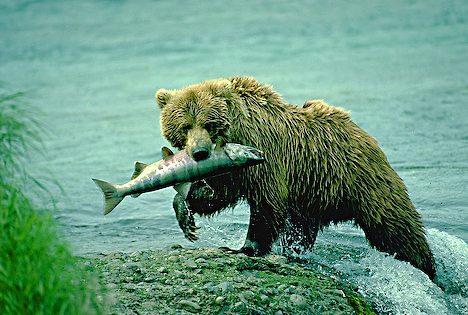
A grizzly bear survives because he is well-adapted to his environment. When he reproduces he passes on those traits to his offspring. this process is called
Natural Selection
Selective Breeding
Random mutations
Variations in a species

If Easter eggs were living species of organisms, their different colors would be considered:
Adaptations
Variations
Different species
Extinct species

The peppered moth's color camouflaged it on the light colored tree bark. It's color was an example of an
Variation
Dominant trait
Recessive trait
Adaptation

If a sick person takes an antibiotic but it doesn't kill all of the bacteria causing the sickness, what might explain this?
Variations in the bacteria allowed some organisms to be less affected by the antibiotic?
Bacteria cannot be killed by antibiotics
You cannot cure a bacterial infection
Bacteria do not cause sicknesses

Which beak is probably best suited to crack open nuts?
1
2
3
4

One female salmon can lay hundreds of eggs. Why doesn't the salmon population increase dramatically?
Salmon reproduce asexually
Most offspring do not grow up to reproduce
Salmon eggs don't hatch
Salmon are extinct
I sprayed pesticide (chemical used to kill bugs) in my house last year to kill the bugs. Only about half of them died. The other half reproduced. I tried spraying again this year, and now even more bugs survived (75% of them)! What is happening?
extinction
artificial selection
genetic engineering
natural selection
When organisms are better adapted to their environment they will survive and reproduce more successfully than organisms less adapted. This process is called what?
Selective breeding
Natural Selection
Cloning
Evolution of all species
A physical or behavioral trait that helps an organism survive and reproduce in its environment is called a what?
An adaptation
A response to a stimulus
A mutation
Evolution
When looking at two birds of the same species, you notice that one has darker feathers than the other one. You also notice that one has a beak that is just a little longer. These slight differences within members of the same species are called.....
Fossils
Extinction
Meiosis
Variations
What do we call a change in a species over time?
Adaptation
Evolution
Extinction
Environmental influences

A giraffe has a long neck in order to better reach leaves to eat. This is an example of _____.
an adaptation
environment
response
stimulus

How do adaptations help animals?
To escape animals
to hunt for food
to survive in their habitats
All of these are correct

Adaptation that refers to how an organism behaves and how interacts with other.
adaptations
mimicry
behavioral
camouflage


The table shows information collected about different colored frogs of the same species living in a brown, muddy lake. The data was taken over a 40-year period. Based on the table, what can you infer?
The brown frogs produce more offspring because they are more likely than the green frogs to survive and reproduce.
The green frogs have fewer offspring than the brown frogs because it’s a more efficient way for them to share food.
The green frogs are less likely than the brown frogs to be eaten by predators because the green frogs blend into their environment.
The brown frogs are more likely than the green frogs to be eaten by predators because the brown frogs are so common.

After Year 3, what can you conclude about the fish populations?
The fish populations remained the same.
The yellow snake population began increasing while the black snake population began decreasing.
The black snake population and the yellow snake population were equal for the remainder of the years.

Which of the following most likely caused the change in snake population after Year 4?
The habitat changed so the black snakes could no longer blend in.
The food for all snakes decreased.
A huge change in temperature killed off the yellow snake.
The habitat changed so the yellow snakes could no longer blend in.
The snakes in the woods behind my house love to eat many different types of prey, but they have the easiest time finding the light grey mice. Over time, what would most likely happen to the population of light grey mice in the woods behind my house?
The population of light grey mice will reproduce more quickly.
The population of light grey mice will change their ear size.
The population of light grey mice will stay the same.
The population of light grey mice will decrease.

The four birds shown in Figure A, B, C, and D are all found on one island environment. A group of biologists relocate half of the population of the birds resembling the bird in figure A. They are relocated to a new environment where food sources are different than those present in their current environment. The half of the population of birds left behind on the original island continue to grow and reproduce. What changes might a scientist expect to see in the species?
The species would adapt over time and would become extinct.
The species would not adapt over time and would become extinct.
The species would not adapt over time and would begin displaying adaptations in their beaks to allow them to consume a new food source.
The species would adapt over time and would begin displaying adaptations in their beaks to allow them to consume a new food source.
Which of the following best describes the relationship between variations and adaptations?
All variations are adaptations, but not all adaptations come from variations
All adaptations are variations and all variations help organisms survive
Variations result from adaptations organisms make to the environment
Adaptations result from variations only if they help an organisms survive

Which of the following statements is a valid conclusion based on the data table above?
The blue birds were best suited to the environment.
A change in the habitat occurred after year 2 that favored the red and white birds.
A change in the habitat occurred after year 2 that favored the blue and yellow birds.
The habitat stayed the same in all 4 years.
A group of plant eating animals are separated from their population. In the new environment, the only edible vegetation grows at the top of tall trees. Which of the following variations would be most useful adaptation to members of the group?
wide flat teeth adapted to grinding plant material
specialized digestive systems for the vegetarian diet
a long neck that can grow to as much as 2 meters in length
larger ears and eyes located on sides of head to detect predators
Which of these statements is true?
Doctors have not yet come up with an antibiotic that can kill harmful bacteria.
Antibiotics can no long kill any harmful bacteria because of resistance.
Antibiotics are completely effective at killing all harmful bacteria.
Some bacteria can become resistant to some antibiotics.

What most likely caused the change in the mouse population?
The lighter mice were less successful in finding food in the environment than the darker mice, which resulted in fewer of the lighter mice being able to survive.
The lighter mice were more successful in finding food in the environment than the darker mice, which resulted in fewer of the darker mice being able to survive.
The lighter mice were more visible to predators than the darker mice, which resulted in fewer of the lighter mice reaching reproductive age.
The lighter mice were more visible to predators than the darker mice, which resulted in more of the lighter mice reaching reproductive age.
Living in a field of green grass are green beetles and brown beetles. Which of the following statements explains how and why the population is changing?
The green beetles are easily spotted by predators so their population is decreasing.
The brown beetles are not seen by predators so their population is increasing.
The green beetles are well camouflaged so their population is increasing.
The green beetle has no advantage so their population is staying the same.
A population of cockroaches was sprayed with an insecticide (chemical used to kill bugs). Some cockroaches survived and produced a population of cockroaches that was resistant to this spray. What can BEST be inferred from this example?
species will adapt no matter what the environment
environment has no effect on the survival of an organism
Individuals with favorable variations survive and reproduce
Insecticides cause mutations that are passed on to the next generation
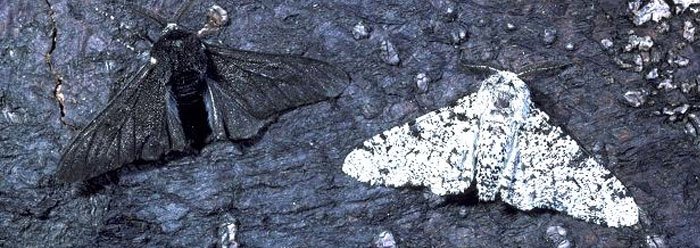
The trees these moths used to live on were white, but have been covered in soot from coal factories. Which moth will be more successful in this new, darker environment?
Dark moth
Light moth
Both will be equally successful
Neither will be successful

A mutation causes a new fur color variation to appear in a mouse population. In which of the situations described below would the new fur color become more common than the old color in the mouse population?
If plenty of food is available in the mouse habitat.
If the new fur color gene is a recessive allele.
If the amount of reproduction in the mouse population stays the same.
If the new fur color gene is helpful in the survival of mice and their offspring.

What is the advantage of an organism being able to reproduce by sexual and asexual reproduction?
produce fewer offspring
increase variation among its offspring
avoid having to find a mate
produce clones of itself
Which level of classification contains organisms that share the most characteristics?
species
class
domain
order

