Wayground logo

Free Printable Worksheets

Font size

S
M
L
XL
Worksheets

Gr7 Ch1

Total questions: 156

Worksheet time: 4hrs 35mins

Name
Class
Date
1.
How fast or slow an object is moving.
a)
Direction
b)
Position
c)
Distance
d)
Speed
2.

An object is _____ if its position changes.

a)

in motion

b)

at reset

c)

a frame of reference

d)

magical

3.

Unit of Distance

a)

Litres

b)

Tonnes

c)

Kilogram

d)

Kilometers

4.

Unit of Speed

a)

Kilogram

b)

Litre

c)

Meter

d)

Kilometer / Hour

5.

Displacement is the difference between your

a)

reference point and reference direction

b)

total distance traveled

c)

starting position and your final position

d)

average speed

6.

You ride your bike 10 miles East but then head West for 6 miles. What is your displacement?

a)

16 miles East

b)

4 miles East

c)

4 mile West

d)

6 miles West

7.

Suppose you travel 10 miles East on your bike from your house and then 6 miles West. If the reference direction is East, then what is final position relative to your house?

a)

+4 miles

b)

-4 miles

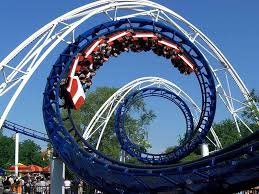
c)

+16 miles

d)

-6 miles

8.

An object's location or _______________ is the distance from a reference point.

a)

distance

b)

position

c)

acceleration

d)

displacement

9.

Which line on the graph represents the fastest constant speed?

a)

A

b)

B

c)

C

d)

They are all moving at the same speed.

10.

How would a distance-time graph appear for an object that is not moving?

a)

A line that curves upward

b)

A straight vertical line

c)

A straight horizontal line

d)

A line that goes up and to the right

11.

If the reference point is your home and you travel 5 miles to get to Quaker Steak and then come back home, what is the total distance traveled?

a)

5 miles

b)

10 miles

c)

0 miles

d)

25 miles

12.

An object that keeps getting faster away from a reference point on a distance-time graph will appear as a line that

a)

is straight and moves up and to the right.

b)

is straight and horizontal.

c)

curves downward (down and to the right).

d)

curves upward (up and to the right).

13.

How can you tell if an object is getting closer to a reference point using a distance-time graph?

a)

You cannot tell if an object is getting closer to a reference point.

b)

The line approaches the y-axis (distance decreases).

c)

The line approaches the x-axis (distance decreases).

d)

The line curves upward.

14.

What is a reference point?

a)

A place or object that is staying still, that is used to determine if something else is moving.

b)

A place or spot where something is located

c)

The action of moving or being moved

d)

Shortest distance between starting position and ending position

15.

Motion can be described through a change in _____.

a)

temperature

b)

distance

c)

position

d)

speed

16.

In order to determine an object’s location, you need a _____.

a)

time

b)

displacement

c)

speed

d)

reference point

17.

To determine if an object has changed position, you need to know its position relative to another object. _______________

a)

True

b)

False

18.

If you ask a friend to meet you somewhere, you will need to __________________ your location.

a)

specify

b)

relative

c)

reference point

d)

motion

19.

__________________ is the difference between the initial position and the final position of an object.

a)

Distance

b)

Displacement

c)

Dimension

d)

Position

20.

Your distance and direction from a reference point will define your ______________.

a)

motion

b)

displacement

c)

position

d)

dimension

21.

Comparing your location to a starting point, or _______________, helps describe where you are.

a)

position

b)

relative

c)

specify

d)

reference point

22.

To describe the position of your school on a map, you need to describe its location in two ______________.

a)

displacement

b)

motion

c)

dimension

d)

position

23.

The people on a bus are not moving in relation the seats inside the bus, but they are in _______________ compared to the streets outside.

a)

position

b)

displacement

c)

reference point

d)

motion

24.

For the field trip, the buses will park three blocks east of the museum; this describes the position of the parking spot ____________________ to the museum.

a)

specify

b)

relative

c)

reference point

d)

displacement

25.

Directing someone to walk north and west is describing a position in two dimensions.

a)

True

b)

False

26.

Displacement does not require movement.

a)

True

b)

False

27.

The starting point describing the location of an object.

a)

displacement

b)

reference point

c)

positive direction

d)

negative direction

28.

The direction opposite the reference direction is negative direction.

a)

True

b)

False

29.

Distance and direction are two ways to describe a position.

a)

True

b)

False

30.

Distance and displacement are equal only if the motion is in

one direction.

a)

True

b)

False

31.

Any change in position.

a)

Speed

b)

Velocity

c)

Motion

d)

Acceleration

32.

What is a reference point?

a)

A place or an object position.

b)

A place or an object position that is used to determine if something is moving

c)

An action of moving or being moved.

d)

Shortest distance between starting point and end point.

33.

How far do you go if you drive for 3 hours at a speed of 60 miles per hour?

a)

20 miles

b)

180 miles

c)

20 mph

d)

180 mph

34.

You drive for 4 hours a distance of 1600 kilometers. What is your speed?

a)

40 mph

b)

400 km/hr

c)

400 km

d)

6400 km

35.

What is the displacement of the runner from home to second base?

a)

180 ft

b)

307 ft

c)

90 ft

d)

127 ft

36.

What does the horizontal line represent in this graph?

a)

Resting, not moving

b)

a constant speed

c)

acceleration

d)

velocity

37.

What is represented in this graph?

a)

Return to origin

b)

negative acceleration

c)

constant speeding up

d)

change in direction

38.
What is the formula to calculate speed?
a)
S = t/d
b)
S = d/t
c)
S = d x t
d)
S = t x d
39.
What is speed?
a)
how far you go
b)
how much distance is covered over a period of time
c)
how fast you accelerate
d)
the change in the location of a object
40.
What is velocity?
a)
the quickness of an object
b)
the location of an object
c)
acceleration
d)
speed in a specific direction
41.
A runner races in the 100 meter dash (distance).  It takes her 10 seconds to finish (time).  What is her average speed?
a)
10 m/s
b)
1000 m/s
c)
100 seconds
d)
10 seconds
42.
Juan rode his bike at a speed of 5 miles per hour.
a)
Speed
b)
Velocity
43.
Juan rode his bike west at a speed of 5 miles per hour.
a)
Speed
b)
Velocity
44.
The car was traveling at a speed of 45 miles per hour.
a)
Speed
b)
Velocity
45.
The airplane flew at a speed of 300 miles per hour.
a)
Speed
b)
Velocity
46.
The airplane flew toward Dallas at a speed of 300 miles per hour.
a)
Speed
b)
Velocity
47.
Which of the following is a unit of speed?
a)
km/hr
b)
hr
c)
km
d)
s
48.
Velocity is both ____ and _____. 
a)
speed , direction 
b)
direction, mass
c)
volume, density 
d)
direction, magnitude 
49.
Km (kilometers) is a unit for ___. 
a)
Speed
b)
Distance
c)
Time
d)
Direction
50.
What is speed?
a)
how far you go
b)
how much distance is covered over a period of time
c)
how fast you accelerate
d)
the change in the location of a object
51.
Cole is learning physics vocabulary. He knows that displacement means which of the following?
a)
distance 1/2 way between starting and ending points
b)
2 times the speed of a nonmoving object
c)
his change in position
d)
the distance between starting and ending point
52.
 A runner races in the 100 meter dash.  It takes her 10 seconds to finish.  What is her average speed?
a)
10 m/s
b)
1000 m/s
c)
100 seconds
d)
10 seconds
53.
65 miles per hour North is an example of an objects what?
a)
Speed
b)
Velocity
c)
Average Speed
d)
Constant Speed
54.
How long would it take for you to swim across a lake that is 900 meters across if you swim at 1.5 m/sec?
a)
600 sec
b)
600 m/sec
c)
0.00167 sec
d)
0.00167 m/sec
55.
You walk 10 meters to math class in 20 seconds. Your average speed is
a)
2 m/s
b)
0.5 m/s
c)
200 m/s
d)
5 m/s
56.
What is the speed of an object that travels 60 meters in 4 seconds?
a)
240 m/s
b)
15 m/s
c)
0.067 m/s
d)
15 mph
57.
David walks 3 km north, and then turns east and walks 4 km. What is the distance?
a)
7 km
b)
3 km
c)
4 km
d)
1 km
58.
When you look at the speedometer of your car, it tells you your....
a)
Average speed
b)
Instantaneous speed
59.

How can you describe whether an object is in motion or not?

a)

If it changes in size

b)

If it changes its color

c)

If it changes its position relative to a reference point

60.

The SI unit for measuring speed is the ---

a)

m/s

b)

m

c)

s

61.

the unit of acceleration is

a)

(m/s2)

b)

jouls

c)

m

d)

s

62.

A negative acceleration means that your object is  

a)

constant

b)

speeding up

c)

at rest

d)

slowing down

63.

A positive acceleration means that your object is

a)

at rest

b)

speeding up

c)

moving

d)

slowing down

64.

Acceleration: is the rate of change in

a)

velocity

b)

speed

c)

displacement

d)

direction

65.

When is an object under uniform acceleration?

a)

none of the following

b)

when the direction is straight

c)

when the velocity change is constant per unit time

d)

when the time is constant

66.

As the ball falls towards the ground, its velocity

a)

zero

b)

decreases

c)

at rest

d)

increases

67.

which isn't an example of acceleration

a)

When the car is speeding up.

b)

When the car slows down.

c)

When you fall off a bridge.

d)

no change in velocity

68.
a car traveled from rest until it reached 100 m/s in 20 sec so the acceleration is ------m/s2
a)
100
b)
2000
c)
5
d)
50
69.
accelration is a vector quantity
a)
true
b)
false
70.
accelration is the change of speed i time interval
a)
true
b)
false
71.
in slowing down motion the acceleration is always opposite direction to the velocity
a)
true 
b)
false
72.
acceleration can be either positive or negative
a)
true
b)
false
73.
acceleration depends on --------
a)
velocity only
b)
velocity change and direction
c)
direction only
d)
time
74.
A box sliding down an inclined plane attains a velocity of 27 m/s in 3 seconds from rest.  Find the acceleration.
a)
30 m/s
b)
24 m/s2
c)
9 m/s2
d)
81 km/hr
75.
A roller coasters accelerates from an initial velocity of of 6.0 m/s to a final velocity of 70 m/s over 4 seconds.  What's the acceleration?
a)
24 m/s2
b)
18 m/s2
c)
16 m/s2
d)
16 m/s
76.
A dog runs with an initial speed of 7.5 m/s on a waxed floor.  It slides to a stop in 15 seconds.  What is the acceleration?
a)
-7.5 m/s
b)
-7.5 m/s2
c)
-0.5 m/s2
d)
7.5 mi//hr
77.
The picture of the position vs. time graph shows an object that is...
a)
accelerating/speeding up
b)
moving at a constant speed 
c)
not moving 
d)
accelerating/slowing down. 
78.
A car starts from rest at a stop light and reaches 20 m/s in 3.5 s. Determine the acceleration of the car.
a)
2.2m/s2
b)
7.0m/s2
c)
5.7m/s2
d)
70m/s2
79.
Acceleration is defined as the CHANGE in 
a)
time it takes for one place to move to another place. 
b)
velocity of an object.
c)
distance divided by the time interval 
d)
velocity divided by the time interval 
80.
Why does a car accelerate as it round a corner at a constant speed?
a)
Its direction changes
b)
It doesn't
c)
It slows down
d)
Its speeds up  
81.
Acceleration only takes place when things speed up. 
a)
True
b)
False
82.
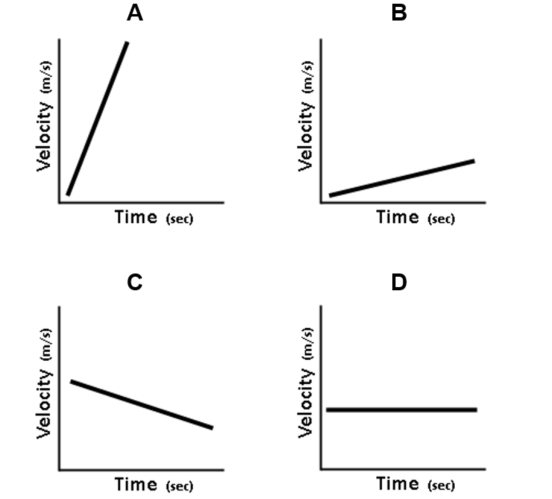
Which graph represents zero acceleration (constant velocity)?
a)
A
b)
B
c)
C
d)
D
83.
Which graph represents the greatest acceleration?
a)
A
b)
B
c)
C
d)
D
84.
Which of the following is a unit for acceleration?
a)
km/s
b)
m/s2
c)
mi/hr
d)
ft
85.
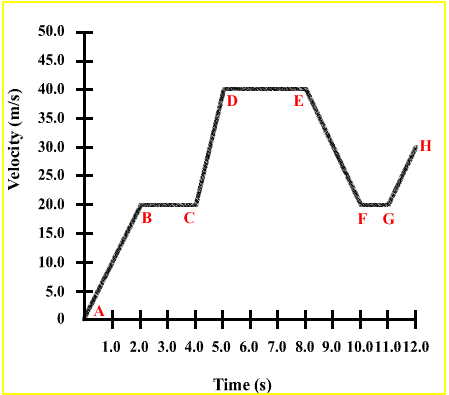
Which section of the graph shows acceleration?
a)
AB
b)
BC
c)
EF
d)
FG
86.
What happened during C to D point?
a)
not moving
b)
increasing speed at a constant rate
c)
moving at a constant speed
d)
moving at 0 m/s2 acceleration
87.

A car turns right without slowing down. Is this an example of acceleration?

a)

No, acceleration is the increase or decrease in speed.

b)

Yes, because the car changed directions.

c)

Yes, because the car increased it's speed.

d)

No, because the car did not change directions.

88.
A drag racer accelerated from 0 m/s to 200 m/s in 5 s.  What was the acceleration?
a)
0 m/s
b)
40 m/s2
c)
-40 m/s2
d)
40 m/s
89.

What kind of motion is taking place between points A and B?

a)

constant acceleration

b)

constant de

c)

changing acceleration

d)

constant speed

90.

What kind of motion is taking place between points C and D?

a)

constant acceleration

b)

constant deceleration

c)

not moving

d)

constant speed

91.

Force between two surfaces that are sliding is known as

a)

magnetism

b)

friction

c)

electric force

d)

I don't know

92.

If you kick a soccer ball, it goes up to a certain distance and stops. This happens due to

a)

gravity

b)

magnetism

c)

friction

d)

weight

93.

On which surface would a ball move slowly?

a)

carpet

b)

marble floor

c)

wooden floor

d)

I don't know

94.

Rough surfaces have

a)

more friction

b)

less friction

c)

same level of friction

d)

I don't know

95.
What is gravity?
a)
A force
b)
Energy
c)
A push
d)
All of them
96.
Which objects have a STRONG force of gravity?
a)
Objects with GREATER mass, like elephants
b)
Objects with LESS mass, like mice
97.
Why a ball falls to the ground?
a)
Earth's force of gravity is GREATER than the ball's, so the ball gets attracted to the ground. 
b)
Earth's force of gravity is LESS than the ball's, so the ball gets attracted to the ground. 
98.
Friction is a force that acts in a(n) ___________ direction relative to a moving object.
a)
similar
b)
opposite
c)
parallel
d)
perpendicular
99.
 What is the unit that measures force?
a)
Weight
b)
Net force
c)
Newton
d)
Kilogram
100.
What type of friction acts on an object that is not yet moving?
a)
Static
b)
Dynamic
c)
kinetic
d)
Rolling
101.
These swimmers are most likely experiencing _________.
a)
Rolling Friction
b)
Sliding Friction
c)
Fluid Friction
d)
Static Friction
102.
Two factors effecting the magnitude of the force of gravity between 2 objects are...
a)
mass and distance 
b)
mass and volume
c)
distance and weight 
d)
weight and mass
103.
As mass increases, what happens to the gravitational force?
a)
It increases.
b)
It decreases.
c)
It stays the same.
d)
It acts as a 3rd degree derivative function.
104.
As the distance between 2 objects increases, what happens to gravitational force?
a)
It increases.
b)
It decreases.
c)
It stays the same.
d)
Only Mr. Silvio knows what will happen.
105.
Which of the following will not change in different gravitational fields?
a)
weight
b)
force
c)
mass
d)
pounds
106.
The force of gravity acting on an object is the object's ______.
a)
Mass
b)
Matter
c)
Weight 
d)
Terminal velocity 
107.
Imagine you travel to another planets. What will change as you walk around the surface of the planet- your mass or your weight?
a)
Mass
b)
Weight 
c)
Both 
d)
Neither 
108.

Friction between solid surfaces is mostly caused by roughness on a ____ scale.

a)

exoscopic

b)

endoscopic

c)

microscopic

d)

macroscopic

109.

Friction can also be caused by ___ attraction between particles.

a)

electrical

b)

static

c)

fluid

d)

plumbing

110.

Friction between solid surfaces can be reduces with ___.

a)

sand

b)

lubricants

c)

gravity

d)

weight

111.

Gravity is one type of ___.

a)

frictional force

b)

contact force

c)

gravitational force

d)

noncontact force

112.

The amount of matter in an object is the object's ___.

a)

volume

b)

mass

c)

density

d)

area

113.
The force that two surfaces exert on each other as they rub against each other.
a)
gravity
b)
friction
c)
mass
d)
weight
114.
The force that pulls objects towards each other.
a)
gravity
b)
friction
c)
mass
d)
weight
115.
The amount of matter in an object
a)
gravity
b)
friction
c)
mass
d)
weight
116.
The measure of the force of gravity on an object.
a)
gravity
b)
friction
c)
mass
d)
weight
117.
Two factors that affect gravity
a)
mass and distance
b)
types of surfaces and how hard they are pushed together
c)
force and distance
d)
mass and direction
118.
The force that fluids apply to a solid object
a)
sliding friction
b)
rolling friction
c)
fluid friction
d)
static friction
119.
The force of friction acts in the ___________ direction of the motion
a)
opposite
b)
same
120.

The SI unit to measure the mass is

a)

Newton

b)

gram

c)

kilogram

d)

none

121.

Force has both strength and ...............

a)

size

b)

shape

c)

direction

d)

none

122.

Choose the contact force from below

a)

friction

b)

magnetic force

c)

electric force

d)

gravity

123.

1. a push or a pull on an object

a)

noncontact force

b)

magnetic force

c)

force

d)

newton

124.

2. push or pull on one object by another objetc

a)

friction

b)

noncontact force

c)

lubricant

d)

contact force

125.

3. applied without touching

a)

noncontact force

b)

kilogram

c)

newton

d)

contact force

126.

4. makes hair stand on end

a)

gravity

b)

magnetic force

c)

electric force

d)

newton

127.

5. keeps you from floating away

a)

magnetic force

b)

gravity

c)

friction

d)

lubricant

128.

6. makes a compass needle point north

a)

contact force

b)

electric force

c)

friction

d)

magnetic force

129.

9. resists the motion of two surfaces that are touching

a)

gravity

b)

noncontact force

c)

friction

d)

electric force

130.

10. reduces friction

a)

contact force

b)

lubricant

c)

force

d)

gravity

131.

Which is the first law?

a)

Law of gravity

b)

Law of inertia

c)

Law of motion

132.

What is the second law about?

a)

how much an object will accelerate for a given net force

b)

Every object that goes up will go down again because of gravity

133.

Who created the three laws of motion?

a)

Albert Einstein

b)

Stephen Hawking

c)

Isaac Newton

d)

Kendall Jenner

134.

What is F = ma?

a)

Force, motion, action

b)

Force, mass, acceleration

c)

Force, muscle, action

135.

“For every action, there is an equal and opposite reaction”.

a)

First law

b)

Second law

c)

Third law

d)

All of the above

136.

I move a chair, the chair stops moving if I stop moving it

a)

First law

b)

Second law

c)

Third law

d)

Choclos

137.

Which of Newton's three laws does the following example illustrate? If you have a hockey puck sliding along a table, it will eventually come to a stop.

a)

first law

b)

second law

c)

Third law

138.

What is this picture about?

a)

3rd law of motion

b)

2 girls diving

c)

1st law of motion

d)

Choclos

139.

Force is measured in...

a)

pounds

b)

Strongness

c)

Newtons

d)

FLOCCINAUCINIHILIPILIFICATION

140.

the absolute unit of force

a)

Newtons

b)

Hulk

c)

kg

d)

Shaq

141.

Why do we have to wear seatbelts?

a)

Inertia

b)

Gravity

c)

Force

d)

acceleration

142.

How long will an object remain in rest?

a)

Until a force acts on it

b)

Until god wants

c)

Its not moving anyway....

d)

5 minutes more

143.

Why is it hard to move a bed from one side to another?

a)

Friction

b)

Gravity

c)

Deceleration

d)

Bad luck

144.

Why do you move left when a car moves right?

a)

Inertia

b)

Gravity

c)

Force

145.

A force is a ________________________ that acts on an object.

a)

push

b)

pull

c)

push or pull

146.
A quantity that has both magnitude and direction is called a scalar quantity.
a)
True
b)
False
147.
What is magnitude?
a)
The direction that describes a quantity.
b)
A numerical value
c)
A unit of force
148.
In the free-body diagram shown above, which of the following is the gravitational force acting on the balloon?
a)
5120
b)
4050
c)
950
d)
1520
149.

A contact force is from

a)

objects physically touching

b)

far apart objects

c)

not touching object

d)

always a pull

150.

A non-contact force is between

a)

two objects that aren't touching

b)

two objects that are touching

c)

the ground and wheels

d)

you and me

151.

The force between the phone and the mount is a

a)

contact force

b)

non-contact force

152.

The force between the two people through the rope is

a)

Contact Pull

b)

Non-contact Pull

c)

Contact Push

d)

Non-contact Push

153.

Gravity is a

a)

Contact Force

b)

Myth

c)

Non-contact Force

154.

Friction is a

a)

Contact Force

b)

Myth

c)

Non-contact Force

155.

______________ is a force that always acts in the direction opposite of motion.

a)

applied

b)

friction

c)

gravity

d)

normal

156.
the tendency of an object to resist a change in its motion
a)
acceleration
b)
inertia
c)
mass
d)
frame of reference