wayground logo

Free Printable Worksheets

Font size

S
M
L
XL
Worksheets

Review April 4

Total questions: 152

Worksheet time: 5hrs 47mins

Name
Class
Date
1.

Why does a compass needle point north?

a)

Because it is being attracted to the Magnetic South Pole

b)

Because north is up

c)

Because it is being attracted to the Magnetic North Pole

d)

Because north is down

2.

These magnetic domains are:

a)

strongly magnetized

b)

slightly magnetized

c)

unmagnetized

3.
Where is the force of attraction the strongest on a magnet?
a)
at the poles
b)
in the middle
c)
above the magnet
d)
below the magnet
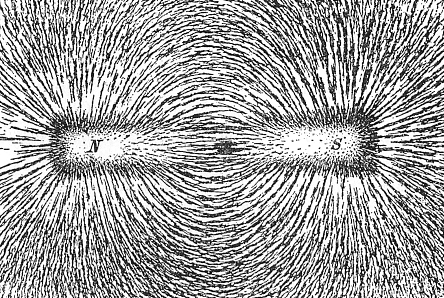
4.
Where are the magnetic force the strongest in this picture?
a)
Location 1
b)
Location 2
c)
Location 3
d)
Location 4
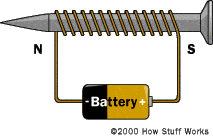
5.

To make this electromagnet stronger you could:

a)

use less wire

b)

have fewer wire coils around the nail

c)

have more wire coils around the nail

d)

use a plastic core

6.
Magnets cannot be made from
a)
cobalt
b)
nickel
c)
iron and steel
d)
wood
7.
What happens if you drop a magnet?
a)
becomes stronger
b)
becomes weaker
c)
stays the same
8.
If two magnets come together what is it called?
a)
Repel
b)
Force
c)
Attract
d)
None of the Above
9.
Protons are ______ charged and neutrons have ______ charged.
a)
Positive, negative
b)
Positive, neutral
c)
Negative, Positive
d)
Neutral, negative
10.
Electrons have a:
a)
Negative charge
b)
Neutral charge
c)
Positive charge
11.
What does the force of gravity depend on?
a)
Mass of the object
b)
Speed of the object
c)
Shape of the object
d)
Density of the object
12.
The closer the charges, the ___________ the force between them
a)
closer
b)
further
c)
stronger
d)
weaker
13.
What types of charges repel?
a)
Positive and Positive
b)
Positive and Neutral
c)
Negative and Neutral
d)
Neutral and Neutral
14.
Magnets have a north and a south ___________
a)
shape
b)
color
c)
pole
d)
region
15.
The amount of matter in an object
a)
weight
b)
force
c)
gravity
d)
mass
16.
The more force an object has, the __________ it travels??
a)
less
b)
farther
c)
slower
d)
person's position.
lower
17.
What pulls a ball back to earth?
a)
Gas
b)
Gravity
c)
Friction
d)
Molecules
18.

Why do socks stick together when they come out of the dryer?

a)

One has a negative charge and the other has a positive charge

b)

Both have negative charges

c)

Both have positive charges

19.

A balloon has a negative charge. A glass rod has a positive charge. What will happen when the rod is brought near the balloon?

a)

the balloon will be attracted to the rod

b)

the balloon will remain in place

c)

the balloon will be repelled by the rod

d)

the balloon will spin in circles

20.
Which part of the atom is positively charged?
a)
Proton
b)
Neutron
c)
Electron
21.

A push or a pull

a)

force

b)

compress

c)

acceleration

d)

gravity

22.

compress

a)

to squeeze or press

b)

A push or a pull

c)

a change to an object's speed

d)

the natural attraction between masses.

23.

Gravity

a)

The natural attraction between masses.

b)

A change to an object's speed

c)

A force acting between surfaces in contact.

d)

To squeeze or press

24.

A change to an object's speed

a)

Acceleration

b)

Interaction

c)

Compress

d)

Magnet

25.

Net force

a)

The sum of all the forces acting on a mass

b)

The standard unit for measuring force in the metric system

c)

A force acting between surfaces in contact.

d)

A push or a pull

26.

The standard unit for measuring force in the metric system

a)

Newton

b)

Net force

c)

Spring scale

d)

Gravity

27.

Spring scale

a)

An instrument used to measure force

b)

The force of gravity on a mass

c)

A force acting between surfaces in contact.

d)

A push or a pull

28.

The force of gravity on a mass

a)

Weight

b)

Magnet

c)

Gravity

d)

Compress

29.
What is the net force?
a)
40 N left
b)
0 N Balalnced
c)
400 N right
d)
40 N right
30.
How will this object move? 
a)
It won't move. 
b)
It will move to the right. 
c)
It will move to the left. 
d)
It will move in both directions. 
31.
Which could be an example of an unbalanced force?
a)
A plate sitting on a dining table
b)
A ball at the top of a hill that is not moving
c)
Earth orbiting the Sun 
d)
A baseball that has been thrown to home plate.
32.
The sum of all forces acting on an object and direction
a)
Contact Force
b)
Balanced Force
c)
Unbalanced Force
d)
Net Force
33.
8 N to the left , and 4 N to the right. Find the net force. Is this balanced 
a)
12 N Right  No
b)
4 N Left  No
c)
12 N Right  Yes
d)
4 N Left  Yes
34.
(T or F?) A balanced force is only an object that is not moving. 
a)
True 
b)
False
35.
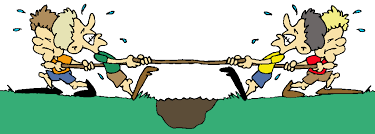
If these teams are pulling with the same amount of force what will happen?
a)
The boy in blue will win.
b)
They will not move at all.
c)
The boy in red will win.
d)
Both will fall down.
36.
Is this and example of a balanced or unbalanced force?
a)
balanced
b)
KITTIES!
c)
unbalanced
d)
pshhh
37.

Select the correct order of waves on the EMS from low to high energy

a)

Radio, Micro, Infra, Visible, Ultra, X-ray, Gamma

b)

Gamma, X-ray, Ultra, Vis, Infra, Micro, Radio

c)

Vis, Micro, Infra, Ultra, X-ray, Gamma, Radio

d)

Micro, Radio, Vis, Infra, Ultra, X-ray, Gamma
38.

How are electromagnetic waves different from other waves?

a)

They have very short wavelengths

b)

They transmit energy instead of matter

c)

They can travel through the vacuum of space (without particles)

d)

They can change direction by reflection

39.

Which of the following electromagnetic waves has the lowest frequency?

a)

gamma ray

b)

infrared wave

c)

visible light wave

d)

microwave

40.

The _______________ determines the color of visible light.

a)

wavelength (and frequency)

b)

speed

c)

amplitude

d)

particles of the medium

41.

All electromagnetic waves are...

a)

transverse waves and have the same frequency

b)

transverse waves and have the same speed

c)

mechanical waves and have the same wavelength

d)

longitudinal waves and have the same energy

42.

Put the visible light colors in order from SHORTEST wavelength (highest frequency) to longest wavelength (lowest frequency)

a)

Violet, Indigo, Blue, Green, Orange, Yellow, Red

b)

Red, Yellow, Green, Orange, Violet, Blue, Indigo

c)

Red, Orange, Yellow, Green, Blue, Indigo, Violet
43.
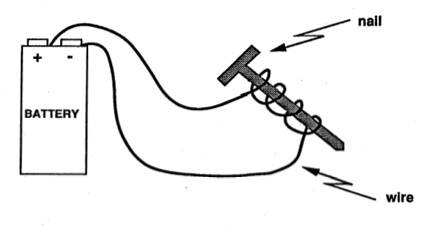
This is a picture of a simple electromagnet. How can the electromagnet be made stronger?
a)
Add more coils of wire to the nail.
b)
Use a smaller battery.
c)
Reverse the poles of the magnet.
d)
Remove all the coils and the nail.
44.
What kind of magnet can be turned on and off?
a)
refridgerator magnet
b)
electromagnet
c)
magnetite
d)
iron
45.
Surrounding every magnet is a __________  __________.
a)
magnetic field
b)
electrical current
c)
another magnet
d)
an enemy
46.
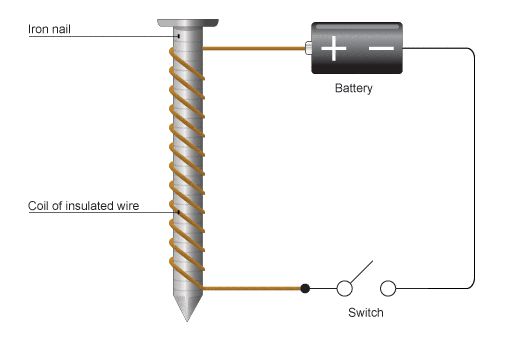
What is most likely to happen when the switch is closed?
a)
A magnetic field should be produced
b)
The nail will rust
c)
The battery will explode
d)
The wire will catch on fire
47.
How do electromagnets differ from regular magnets? 
a)
A. They  can be turned off and on 
b)
B. Their polarity can be reversed
c)
C. Their strength can be changed
d)
D. All of the above
48.

Which law states that for every action there is an equal and opposite reaction?

a)

1st Law

b)

2nd Law

c)

3rd Law

49.

Which law states that the acceleration of an object depends on the force exerted on it and its mass?

a)

1st Law

b)

2nd Law

c)

3rd Law

50.

Henry sees a basketball and decides to put in motion. What kind of force does Henry use to move the ball?

a)

small

b)

balanced

c)

equal

d)

unbalanced

51.

Which activity would BEST demonstrate Newton's law of Inertia?

a)

A plate sits on a table top.

b)

A lady pushes a grocery cart.

c)

A child jumps on a trampoline.

d)

A boy swings a baseball bat.

52.

Which activity would BEST demonstrate the Law of Action/Reaction?

a)

A car traveling down the road.

b)

A rocket launching to space.

c)

A soccer ball sitting on the ground.

d)

A lady pushing a grocery cart.

53.

What is the name of Newton's 2nd Law of Motion?

a)

Law of Force and Acceleration

b)

Law of Inertia

c)

Law of Action / Reaction

54.

When there is an INCREASE in MASS of an object you will have a DECREASE in ______________.

a)

friction

b)

acceleration

c)

force

d)

gravity

55.

Mary is riding in a car when the driver suddenly slams on the brakes. Mary is jerked forward out of her seat. This is an example of which law of motion?

a)

2nd Law

b)

1st Law

c)

3rd Law

56.

A jellyfish swims through the water by pulling in water and then pushing the water back out in the opposite direction. This is an example of which law of motion?

a)

1st Law

b)

2nd Law

c)

3rd Law

57.

Billy pushes his little brother on a sled through the snow. He then tries to push his father on the the same sled. He noticed that it was much harder to push his father. Which law is this an example of?

a)

1st Law

b)

2nd Law

c)

3rd Law

58.

Which law is this picture an example of?

a)

Law of Inertia

b)

Law of Action / Reaction

c)

Law of Force and Acceleration

59.

Which law is this picture an example of?

a)

Law of Inertia

b)

Law of Force and Acceleration

c)

Law of Action / Reaction

60.

Which law is this picture an example of?

a)

Law of Inertia

b)

Law of Force and Acceleration

c)

Law of Action / Reaction

61.

Beth's bike remains stopped at the intersection until she begins pedaling again. Which law is this an example of?

a)

1st Law

b)

2nd Law

c)

3rd Law

62.

What type of structures are shown?

a)

Homologous

b)

Analogous

c)

Vestigial

d)

Heterologous

63.

What type of structures are shown?

a)

Homologous

b)

Analogous

c)

Vestigial

d)

Heterologous

64.

The "Best" form of evidence for evolutionary relationships is-

a)

Molecular- DNA

b)

Fossils

c)

Homologous Structures

d)

Analogous Structures

65.

What is shown ?

a)

embryology

b)

fetalology

66.
Some organisms that share a common ancestor have features that have different functions, but similar structures.  These are known as
a)
vestigial structures
b)
analogous structures
c)
homologous structures
d)
fossil structures
67.
the hind leg bones in a whale are examples of
a)
homologous structures
b)
analogous structures
c)
fossils
d)
vestigals
68.
Remains of ancient organisms are called
a)
Extinctions
b)
Fossils
c)
Mutations
d)
Variations
69.
Change over time...
a)
Evolution
b)
Nucleotide 
70.

What does it mean when organisms share a common ancestor?

a)

They evolved from 1 species that lived in the past

b)

They are the same species

c)

The organisms have exactly the same traits

d)

The organisms are very different from one another

71.
Which layer is the oldest?
a)
1
b)
2
c)
3
d)
4
72.
Who started the theory of evolution?
a)
Allen Wallace
b)
Charles Darwin
c)
Albert Einstein
73.
If an organism has a vestigial structure, that structure likely once had a function in a(n)
a)
close relative
b)
early ancestor
c)
unrelated organism
d)
embryological stage
74.
Where would the oldest fossils be found?
a)
Bottom
b)
Top
c)
Middle
75.
The fossil record provides evidence that 
a)
Fossils cannot be dated.
b)
All species were formed during Earth’s formation and have changed little since then.
c)
The fossilized species have no connection to today’s species.
d)
Older species gave rise to more-recent species.
76.
Individuals that are better able to cope with the challenges of their environment tend to  
a)
Decrease in population over time.
b)
Leave more offspring than those less suited to the environment.
c)
Leave fewer offspring than those less suited to the environment.
77.
European rabbits were introduced to Australia in 1859. The rabbits reproduced rapidly in their new habitat, displaced other animals, and overgrazed vegetation. In an attempt to reduce the rabbit population, a virus was introduced in 1951. This virus is usually deadly to European rabbits. When the virus was first introduced, the rabbits died in large numbers, but the death rate decreased over time. Which of the following best explains the decrease in the rabbit death rate? 
a)
Young rabbits learned to avoid being infected with the virus.
b)
The lifespan of the virus was too short to affect rabbits over a long period of time.
c)
Natural selection favored rabbits that were resistant to the virus. 
d)
No correct choices.
78.
Which of the following statements gives the most likely explanation for the presence of two very similar species of squirrels living on opposite sides of the Grand Canyon?
a)
One squirrel traveled across the canyon and started a new population on the other side.
b)
One squirrel traveled across the canyon and interbred with a different population on the other side.
c)
Members of one single squirrel species were geographically separated by the formation of the canyon.
d)
Members of two different squirrel species migrated from two different places to opposite sides of the canyon. 
79.
The Asian shore crab invaded parts of the eastern coast of the United States about 15 years ago. The Asian shore crab preys on blue mussels. In the time since the Asian shore crab arrived, the average shell thickness of the blue mussel population has increased. Which of the following is the most likely reason that this increase in shell thickness has occurred? 
a)
Blue mussels with thick shells attract more crabs that mussels without thick shells.
b)
Blue mussels with thick shells grow in larger colonies than mussels without thick shells.
c)
Blue mussels with thick shells catch more food per day than mussels without thick shells.
d)
Blue mussels with thick shells survive and reproduce more successfully than mussels without thick shells.
80.
Structures that share a common ancestry or are similar because they are modified versions of structures from a common ancestor that contain the same basic bone structure are
a)
Not related.
b)
Not homologous. 
c)
Homologous.
d)
Young in origin.
81.
What is the term for a feature that allows an organism to survive better in its environment?
a)
variation
b)
adaptation
c)
homologous structure
d)
vestigial structure
82.
As you travel from the inner core to the crust, how would temperature, pressure and density of the material change?
a)
The would all increase
b)
The would all decrease.
c)
Nothing, the layers are made of the same material throughout
d)
Temperature would decrease, but pressure and density would increase
83.
The deepest borehole ever drilled was the Kola Superdeep Borehole located in Russia.  It's depth is approximately 12 Km.  To reach the center of Earth, we would need to drill over 6,000 Km.  How do scientists study the deepest part of Earth if we've only drilled a fraction of the way through the crust? 
a)
By sending humans directly into the inner core
b)
By visiting deep mines that go deep into the inner core 
c)
Sending robots deep into the inner core
d)
By recording and studying seismic waves (earthquake P and S waves) 
84.
Scientists think that convection currents that move the plates flow in Earth's
a)
Continental crust
b)
oceanic crust
c)
Asthenosphere
d)
Lithosphere
85.
When the heat source is removed from a fluid, the convection current will
a)
stop immediately
b)
change directions
c)
eventually stop
d)
speed up
86.
Where does molten material from the mantle rise up during the process of sea-floor spreading?
a)
Along the mid-ocean ridge
b)
At the north and south poles 
c)
Along the edges of all the continents near the shoreline and beaches
d)
at the equator
87.
In the early 1900's Alfred Wegener found evidence of identical rock types, identical fossils, and matching mountain ranges on different continents that are on opposite sides of an ocean.  What could be the explanation for these observations?
a)
All animals can swim extremely long distances 
b)
These observations have no significant meaning.
c)
In the past, continents were not located where they are today but were joined together 
d)
mountains are made through the same processes therefore they are very similar in their structure throughout the entire world.
88.
How does sea floor spreading occur? 
a)
It is a myth and does not occur.
b)
At mid-ocean ridges, magma is forced upward and slowly spreads the plates 
c)
Organic material forms limestone on the ocean 
d)
The pressure from the ocean water  forces down on the sea floor and moves it 
89.
Why was Alfred Wegener's hypothesis of Continental Drift not accepted by the scientific community of his time?
a)
Because he was a meteorologist and only a geologist could make such a claim.
b)
Because he had no evidence to help support his hypothesis.
c)
Because he had too much evidence to support his claim which made his hypothesis confusing.
d)
because he could not effectively describe the force that caused the continents to move.
90.
Which layer does the lithosphere (the outer most layer plus the crust) float on top of?
a)
the crust
b)
lithosphere
c)
asthenosphere
d)
outer core
91.
Where can the youngest rocks on Earth be found?
a)
along the coastlines of continents
b)
in the tallest mountain ranges on Earth
c)
at deep-ocean trenches where subduction occurs
d)
along the center of the mid-ocean ridges where sea-floor spreading occurs.
92.
This layer of Earth is solid Iron and Nickel
a)
Outer Core
b)
Mantle
c)
Inner Core
d)
Crust
93.
What is the name of the layer that contains the uppermost mantle and crust
a)
Asthenosphere
b)
Mesosphere
c)
Lithosphere
d)
Transosphere
94.
This layer of Earth is the thickest part
a)
crust
b)
outer core
c)
mantle
d)
inner core
95.
California, Japan, Chile, Nepal, and India have all experienced earthquakes before. What type of plate boundary must be near
a)
Reform
b)
Divergent
c)
Convergent
d)
Transform
96.
Evidence to support continental drift included ______________.
a)
remains of human beings on a number of continents
b)
similar fossils found on different continents
c)
how the continents drifted
d)
written records
97.
A break or crack in the Earth's crust is called a...
a)
plate
b)
fault
c)
fold
d)
crack
98.

Which of Earth's layers is best described as liquid metal?

a)

crust

b)

mantle

c)

outer core

d)

inner core

99.

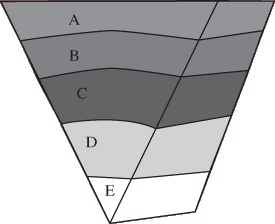
What does layer D show?

a)

upper mantle

b)

lower mantle

c)

outer core

d)

inner core

100.

Which of the following correctly lists the layers from innermost to outermost?

a)

inner core, outer core, lower mantle, upper mantle, crust

b)

lower mantle, upper mantle, crust, inner core, outer core

c)

lower mantle, inner core, upper mantle, outer core, crust

d)

crust, inner core, lower mantle, upper mantle, outer core

101.
Name this boundary
a)
Convergent
b)
Divergent
c)
Transform
d)
Sergent
102.
Name the boundary
a)
divergent
b)
convergent
c)
transform
d)
sergent
103.
Plate movement is caused by _____
a)
The rotation of the Earth
b)
Ocean tides
c)
Convection current in the mantle
d)
The moon's gravity
104.
Which of the following is associated with transform boundary?
a)
volcanoes
b)
mountains
c)
trenches
d)
earthquakes and fault line
105.
Sand Andreas Fault formed at this type of boundary-
a)
Transform Boundary
b)
Convergent Boundary
c)
Divergent Boundary
d)
Hot Spot
106.
 A land feature that is produced at a convergent boundary is
a)
a valley
b)
an ocean
c)
a canyon
d)
a volcano
107.
What was the name given to all the continents when they were joined as one super continent?
a)
Supreme Continent
b)
Eurasia
c)
Plate tectonics
d)
Pangea
108.

Plates move apart at _________ boundaries.

a)

volcanic

b)

divergent

c)

convergent

d)

transform

109.
The area where two tectonic plates meet
a)
mantle
b)
focus
c)
faults
d)
convection
110.
Which type of rock results from melting and cooling of magma?
a)
Igneous
b)
Metamorphic
c)
Sedimentary
d)
Extrusive
111.
Which type of rock forms from extreme heat and pressure?
a)
Igneous
b)
Sedimentary
c)
Organic
d)
Metamorphic
112.
True/False: Igneous rocks can only turn into metamorphic rocks.
a)
True
b)
False
113.
When sediments are pressed together tightly, this is called ____________.
a)
Compaction
b)
Cementation
c)
Weathering
d)
Erosion
114.
What are the 3 major types of rocks?
a)
Igneous, Metamorphic, Sedimentary
b)
Metamorphic, Igneous, Cementation
c)
Brown, Red, Gray
d)
Streak, Hardness, Breakage
115.
This rock started as lava that cooled and then was heated and put under pressure over time. What type of rock is this?
a)
Sedimentar
b)
Igneous
c)
Metamorphic
116.
This rock was molten magma that slowly cooled under the ground. What type of rock is this?
a)
Sedimentar
b)
Igneous
c)
Metamorphic
117.
After lots of time, pressure, and heat, you get this kind of rock. What type of rock is this?
a)
Sedimentary
b)
Igneous
c)
Metamorphic
118.
What is molten or liquid rock material that is deep beneath the Earth's surface?
a)
grain
b)
lava
c)
magma
d)
rock
119.
What is small pieces of rock material?
a)
grain
b)
lava 
c)
magma
d)
sediment
120.
From your knowledge of Earth's crust, where would you most likely find igneous rocks like basalt? 
a)
Within mountain ranges
b)
In my backyard
c)
On the ocean floor
d)
Sandy Beaches 
121.
_________________ is the breaking down of rock into smaller pieces of rock.
a)
erosion
b)
weathering 
c)
deposition
122.
The ___________   _______________ is the process of one type of rock transforming into a different type of rock.
a)
Weathering
b)
Erosion
c)
The Rock Cycle
123.
What type of rock are fossils often found in?
a)
igneous
b)
metamorphic
c)
sedimentary
d)
magma
124.
When you watch a volcano erupt molten rock, you are seeing _____
a)
Lava
b)
Magma
c)
Mineral Crystals
d)
Igneous Rocks
125.
The process when rocks break into smaller pieces due to exposure to natural elements is called
a)
erosion
b)
weathering
c)
sediments
126.
What is the mass of this mineral?
a)
5 grams
b)
10 grams
c)
15 grams
d)
20 grams
127.
What units do we use to measure length?
a)
meters (m)
b)
milliliters (mL)
c)
grams (g)
d)
cubic centimeters (cm3)
128.
What units do we use to measure mass?
a)
milliliters (mL)
b)
liters (L)
c)
centimeters (cm)
d)
grams (g)
129.
The unit of measurement for volume is: 
a)
Meter
b)
Gram
c)
Liter
d)
Pounds
130.
What is the length of this object?
a)
5.0 cm
b)
5.5 cm
c)
5.3 cm
d)
5.1 cm
131.
What do we call these instruments?
a)
buret
b)
erlenmeyer flask
c)
graduated cylinder
d)
beaker
132.
What is the name of this piece of lab equipment?
a)
beaker
b)
flask
c)
graduated cylinder
d)
test tube
133.
What happens to frequency when the energy increases?
a)
it increases
b)
it decreases
c)
it stays the same
134.
What does a wave carry?
a)
boats
b)
matter
c)
energy
d)
water
135.
What is the frequency of this wave?
a)
3 Hertz
b)
4 Hertz
c)
5 Hertz
d)
6 Hertz
136.
When wavelength increases, what happens to the frequency?
a)
it increases
b)
it decreases
c)
it stays the same
137.
Which wave has a longer wavelength?
a)
wave C
b)
wave D
138.
Which wave has a greater frequency?
a)
wave B
b)
wave C
139.
Which wave has the most energy?
a)
top wave
b)
bottom wave
140.
Which travels faster, light or sound?
a)
light
b)
sound
141.
What is the top of a wave?
a)
trough
b)
crest
142.
What is the top of a wave?
a)
trough
b)
crest
143.
Sound travels fastest in:
a)
solids
b)
liquids
c)
gases
144.
What is the height of a wave?
a)
amplitude
b)
wavelength
145.
When you yell under water, what is the medium that sound travels through?
a)
air
b)
water
146.
What type of wave move a slinky back and forth?
a)
longitudinal
b)
transverse
147.
What travels faster, light or sound
a)
Light
b)
Sound
148.
When light hits the shirt in the picture, which color will bounce off?
a)
Blue
b)
Indigo
c)
Orange
d)
Violet
149.

What is the process called for the bending of light?

a)

Reflection

b)

Refraction

c)

Transmission

d)

Scattering

150.

Which type of wave does sunscreen protect you from?

a)

Radio

b)

Infrared

c)

Ultraviolet

d)

Gamma

151.

Which type of wave does sunscreen protect you from?

a)

Radio

b)

Infrared

c)

Ultraviolet

d)

Gamma

152.

Which of the following colors have the longest wavelength?

a)

Orange

b)

Yellow

c)

Blue

d)

Green