wayground logo

Free Printable Worksheets

NEW

Font size

S
M
L
XL
Worksheets

Karyotypes and Chromosomal Disorders

Total questions: 53

Worksheet time: 36mins

Name
Class
Date
1.

Female with impacted growth and sexual development complications including fold on back of neck, lack of menstruation, brown spots on body, and lack of breast development.

a)

Turner

b)

Down

c)

Klinefelter's

d)

Edward's

e)

Colorblindness

2.

Individuals develop as males. Subtle charactistics become apparent at puberty when extra breast tissue develops, musculature in body doesn't develop and testes are also impacted.

a)

Turner

b)

Down

c)

Klinefelter's

d)

Edward's

e)

Colorblindness

3.

A person with Cri-du-Chat Syndrome is

a)

missing chromosome # 5

b)

trisomy 13

c)

trisomy 21

d)

missing part of chromosome # 5

4.

Another name for trisomy 13 is

a)

Patau Syndrome

b)

Down syndrome

c)

Edward syndrome

d)

Turner syndrome

5.

Klinefelter’s Syndrome is caused by the presence of

a)

an extra Y-chromosome (XYY)

b)

an extra X-chromosome (XXY)

c)

a missing X-chromosome ( _X)

d)

trisomy 21

6.

Amniocentesis was performed on a woman. The withdrawn fluid underwent biochemical analysis and the fetal cells were cultured. A karyotype was done.

The child was discovered to have an extra #21 chromosome. What is the diagnosis?

a)

Patau syndrome

b)

Edward syndrome

c)

Down syndrome

d)

Turner syndrome

7.

The karyotype shows an individual with Edward's Syndrome. What is the name of the specific disorder?

a)

monomy 18

b)

trisomy 18

c)

deletion of 18

d)

translocation 18;21

8.
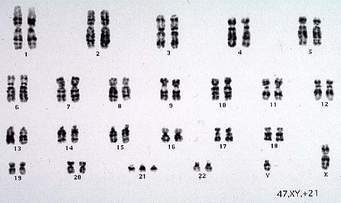
The following karyotype illustrates an example of which syndrome?
a)
Turner's Syndrome
b)
Klienfelter's Syndrome
c)
Edward's Syndrome
d)
Down Syndrome
9.
Which sex chromosomes would indicate a typical human male?
a)
XX
b)
X
c)
XY
d)
XXY
10.

A normal human zygote should have _____ chromosomes inside.

a)

46

b)

23

c)

92

d)

64

11.
What is the gender of the individual whose karyotype is seen in the image?
a)
Male
b)
Female
12.
Is this Karyotype human?
a)
Yes
b)
No
c)
Impossible to Determine
13.

Based on the karyotype, what is the sex of this baby?

a)

Male

b)

Female

14.
Which structure is labeled as A in the diagram?
a)
Centromere
b)
Chromosome
c)
Sister chromatids
15.
Which structure is labeled as B in the diagram?
a)
Centromere
b)
Chromosome
c)
Sister chromatids
16.
Which structure is labeled as C in the diagram?
a)
Centromere
b)
Chromosome
c)
Sister chromatids
17.
A pair of identical chromosomes shown in a karyotype, one inherited from mom, and one inherited from dad are called
a)
sister chromotids
b)
centromeres
c)
homologous chromosomes
d)
autosomes
18.
Based on the Karyotype shown, at which chromosome pair can we identify a genetic disorder? 
a)
Chromosome pair 5
b)
sex chromosomes
c)
Chromosome pair 21
d)
There are no chromosomal disorders
19.
Photograph of chromosomes grouped in ordered pairs
a)
pedigree
b)
Punnett Square
c)
Venn Diagram
d)
Karyotype
20.
Autosomes can be defined as:
a)
chromosomes that help express physical traits
b)
chromosomes that express gender
c)
cells that express traits
d)
cells that express gender
21.

Chromosome mutation involving loss of a piece of chromosome.

a)

Deletion

b)

Inversion

c)

Translocation

d)

Removal

22.
When can a mutation be passed on to offspring?
a)
only when the mutation is present during or occurs during mitosis
b)
only when the mutation is present during or occurs during meiosis
c)
when the mutation occurs during mitosis or meiosis
d)
when the mutation occurs in somatic cells
23.
What process occurs during meiosis that can result in chromosomal disorders?
a)
crossing over
b)
non-disjunction
c)
anaphase I
d)
prophase II
24.
Nondisjunction can result in 
a)
trisomy conditions
b)
monosomy conditions
c)
additional sex chromosomes
d)
all of these
25.
A sperm contains
a)
Both an X and a Y chromosome
b)
Two X chromosomes
c)
An X OR a Y chromosome
d)
only a Y chromosome
26.

Chromosome pairs 1-22 are referred to as

a)

sex chromosomes

b)

sister chromatids

c)

a karyotype

d)

autosomes

27.
Which of the following statements about homologous chromosomes is correct?
a)
Each gene is at the same locus on both chromosomes.
b)
They are two identical copies of a parent chromosome which are attached to one another at the centromere.
c)
They come from the same parent.
d)
They are chromosomes that have identical genes and alleles.
28.

Which statement is NOT true about Karyotypes

a)

Chromosomes (pairs 1-22) are arranged by size

b)

Sex chromosomes are found at the end

c)

A normal karyotype has 46 chromosomes or 23 pairs

d)

Having missing or extra chromosomes does not indicate a disorder

29.
An abnormality in which homologous chromosomes fail to separate properly is called
a)
glue syndrome
b)
sticky-osis
c)
nondisjunction
d)
telophase
30.

If a gene is found only on the X chromosome and not the Y chromosome or any other chromosome, it is said to be what?

a)

sex-linked trait

b)

polygenic trait

c)

codominant trait

d)

incomplete dominance trait

31.

If a gene is found on any chromosome in pairs 1-22 , it is said to be what?

a)

sex-linked trait

b)

polygenic trait

c)

codominant trait

d)

Autosomal

32.

Milestones are

a)

Stages in development as humans grow

b)

Another type of Chromosomal abnormality

c)

A disease caused by a virus

d)

Miles you have to run with stones attached to your ankles.

33.
What are the two ways that genetic disorders can be inherited?
a)
Through blood transfusions and meiosis.
b)
Mutations in DNA and changes in structure or number of chromosomes.
c)
Missing chromosomes or premature egg splitting.
d)
Unhealthy environments and heredity.
34.
A doctor may use a _________ to examine the chromosomes in a cell.
a)
x-ray
b)
blood test
c)
karyotype
d)
hemoglobin
35.
In order to trace occurrence of a trait through several generations of a family, you could create a ____________.
a)
karyotype
b)
hemoglobin
c)
pedigree
d)
chromosomal map
36.
a)
Not affected Female
b)
Not affected Male
c)
Affected Male
d)
Affected Female
37.
a)
Not Affected Male
b)
Not Affected Female
c)
Affected Male
d)
Affected Female
38.
In the second generation-how many people are carriers of the trait?
a)
2
b)
3
c)
5
d)
6
39.
What is the gender of the individual whose karyotype is seen in the image?
a)
Male
b)
Female
40.
Which of the following is true of your sex chromosomes?
a)
I have two Y chromosomes.
b)
I have at least one X chromosomes.
c)
They aren't developed until I turn 13.
d)
They are afraid of one another.
41.

A rare, inherited disorder that destroys nerve cells in the brain and spinal cord. Four years life expectancy.

a)

tay-sachs

b)

klinefelter syndrome

c)

huntington's disease

d)

down syndrome

42.

Which type of genetic disorder is much rarer because even just 1 defective gene will create the disease?

a)

dominant disorder

b)

recessive

c)

codominant

d)

sex-linked

43.

Which of the following is a dominant disorder?

a)

ALD

b)

huntington's disease

c)

sickle cell

d)

Turner Syndrome

44.

This disorder changes the shape of the hemoglobin molecule. Causes moon shaped cells to get stuck in blood vessels, may damages organs.

a)

sickle cell anemia

b)

muscular dystrophy

c)

SCID

d)

color-blindness

45.

Why do sex-linked disorders affect men more than women?

a)

males only have 1 X chromosome

b)

males do not have an X chromosome

c)

girls always have 2 defective X chromosomes

d)

males only have Y chromosomes

46.

How does one get extra or missing chromosomes?

a)

nondisjunction of chromosomes during meiosis

b)

nondisjunction of chromosomes during mitosis

c)

mutations on a chromosome

d)

some cells start producing more chromosomes

47.

_________ is an experimental technique that uses genes to treat or prevent disease. In the future, this technique may allow doctors to treat a disorder by inserting a gene into a patient's cells instead of using drugs or surgery

a)

gene therapy

b)

chromosomal therapy

c)

gene mapping

d)

DNA fingerprinting

48.

Any change in the sequence of DNA is...

a)

transgenic shift

b)

Single Genotype

c)

Monohybrid Trait

d)

Mutation

49.

How are mutations passed on to offspring?

a)

Any mutation that an organism acquires in its life can be passed on to the offspring

b)

Only mutations that occur to the gametes can be passed on to the offspring

c)

Mutations are not usually passed on to the offspring. A mutation stays within the original organism.

d)

Mutations are not passed to offspring. They only occur within developing embryos.

50.

Nondisjunction is related to a number of serious human disorders. How does nondisjunction cause these disorders?

a)

alters the number of zygotes

b)

alters the chromosome structure

c)

alters the number of gametes

d)

alters the number of chromosomes

51.
What disease is characterized by abnormally shaped red blood cells?
a)
hemophilia
b)
sickle cell anemia
c)
phenylketonuria
d)
Huntington's 
52.
If a gene is found only on the X chromosome and not the Y chromosome, it is said to be 
a)
sex-linked trait
b)
polygenic trait
c)
codominant trait
d)
incomplete dominance trait
53.

How many individuals are there in the 3rd generation?

a)

1

b)

2

c)

4

d)

6