wayground logo

Free Printable Worksheets

Font size

S
M
L
XL
Worksheets

American Independence and Constitution

Total questions: 109

Worksheet time: 2hrs 4mins

Name
Class
Date
1.
What are the first ten amendments to the Constitution? 
a)
the Preamble
b)
 the Articles of Confederation
c)
the Declaration of Independence
d)
 the Bill of Rights
2.
The fact that each branch of government must be separate from the others and function on its own is known as the principle of _______.
a)
popular sovereignty
b)
separation of powers
c)
rule of law
d)
 checks and balances
3.
A word which means to change, correct or improve a law.
a)
amend
b)
propose
c)
principle
d)
compromise
4.
How does the system of Checks and Balance protect people?
a)
it keeps any of the branches from over powering the other so as not to destroy the rights of people
b)
it keeps any of the branches from fighting so the people are safe
c)
it keeps one branch in power and destroys the rights of people
d)
it keeps all branches in power so as to destroy the rights of  people
5.

The branch of government that suggests laws and carries out the laws made by Congress. Its leader is the president.

a)

Judicial

b)

Legislative

c)

Executive

6.

The branch of government that makes laws for the country. It is made up of the Congress.

a)

Judicial

b)

Legislative

c)

Executive

7.

This branch of government makes sure laws are constitutional. It is made up of the Supreme Court with 9 justices and many other courts.

a)

Judicial

b)

Legislative

c)

Executive

8.
Which group wanted to keep the Articles of Confederation and give more power to the states?
a)
Federalists
b)
Anti-Federalists
c)
Judiciary
d)
Legislature
9.
Central and national are two words that mean the same thing as - 
a)
state
b)
federal
c)
local
d)
regional
10.
What government existed before the Constitution? 
a)
British Monarchy
b)
state constitutions 
c)
Articles of Confederation
d)
Confederate States of America 
11.
“Governments are instituted among Men, deriving their just powers from the consent of the governed.”  This quote from the Declaration of Independence illustrates the concept of
a)
Popular sovereignty
b)
Judicial review
c)
Federalism
d)
Separation of powers
12.
What is the introduction to the Constitution called? 
a)
Articles of Confederation
b)
Declaration of Independence
c)
Bill of Rights
d)
Preamble
13.
In the Preamble, what does it mean when it says, "We the people..."?
a)
The constitution was written for all the people of the United States.
b)
The constitution was only written for the delegates at the Constitutional Convention.
c)
Referring to "the people" who authored the constitution.
d)
The people of Massachusetts.
14.
State governments have the power to pass gambling laws within their states.
a)
Federalism
b)
Individual Rights
c)
Checks and Balances
d)
Separation of Powers
15.
This is the idea that everyone, citizens and powerful leaders alike, must obey the law
a)
Limited Government
b)
Republicanism
c)
Individual Rights
d)
Federalism
16.
Which principle split the power of the government into three branches?
a)
Self-government
b)
Republicanism
c)
Separation of Powers
d)
Limited government
17.
Which of the following is NOT one of the principles included in the Constitution?
a)
popular sovereignty
b)
rule of law
c)
equality of the races
d)
separation of powers
18.
The fact that each branch of government must be separate from the others and function on its own is known as the principle of _______.
a)
popular sovereignty
b)
separation of powers
c)
rule of law
d)
 checks and balances
19.
How did Roger Sherman's compromise settled the differences between the large and small states ?
a)
giving slaves the right to vote
b)
dividing the Congress into two separate houses
c)
 charging larger states higher taxes than smaller states
d)
allowing the small states to control the courts
20.
Another word for basic truth
a)
compromise
b)
principle
c)
propose
d)
amend
21.
to give up on something in order to come to an agreement
a)
compromise
b)
propose
c)
principle
d)
amend
22.
Why did King George III tax the colonists so heavily?
a)
He hated the colonist
b)
He wanted more money for himself
c)
The national debt increase from the French and Indian War
d)
To make money for the colonies
23.
After colonist threw rocks, sticks and snowballs at British forces, this event happened leading to tense relations between the British military and colonists.
a)
firing on Lexington and Concord
b)
Boston Tea Party
c)
Boston Massacre
d)
Battle at Bunker Hill
24.
Authored by Thomas Jefferson, this harshly criticized King George III and proclaimed colonial sovereignty
a)
The Constitution
b)
The Declaration of Independence
c)
Common Sense
25.
What problem did the French and Indian War cause England?
a)
They lost the war.
b)
They gained land.
c)
They had a large debt.
d)
They lost land.
26.
How did England decide to solve the problem caused by the war?
a)
They left the colonies.
b)
They taxed the colonist.
c)
They taxed the French.
d)
They did nothing.
27.
How did most colonist feel about the taxes they were being made to pay to England?
a)
They were proud to pay taxes to their mother country.
b)
They felt the taxes were fair and paid them willingly.
c)
They felt the taxes were unfair and began boycotting.
d)
They did not have any feelings one way or the other.
28.
What kinds of things did the Stamp Act require merchants (sellers) to purchase the stamps for?
a)
Tea, milk, and drinks
b)
Newspapers, playing cards, and things made of paper
c)
Shirts, shoes, and items people wear
d)
Beef, cheesse, and food people ate
29.

This disease killed more Native Americans than any other during the Colonial Era

a)

Malaria

b)

Smallpox

c)

Hepatitis

d)

Yellow fever

30.

The American colonists began to resent British officials for suddenly increasing these

a)

interest rates

b)

tax rates

c)

lawsuits

d)

colonial militias

31.

True or False: African Americans fought for both the American and British sides during the Revolutionary War.

a)

True

b)

False

32.

True or False: Native Americans lost a great deal of land after the Revolution because many tribal nations sided with the British instead of with the Americans.

a)

True

b)

False

33.
This document forced Great Britain to recognize the United States as an independent country.
a)
The Articles of Confederation
b)
The U.S. Constitution
c)
The Treaty of Paris, 1783
d)
The House of Burgesses
34.
The first political parties were formed mainly in response to disagreements over---
a)
taxation without representation
b)
extent of federal power
c)
judicial review
d)
power of the military 
35.
When the Senate approves a Treaty initiated by the President of the United States, this principle of government is demonstrated.
a)
Individual Rights
b)
Checks and Balances
c)
Federalism
d)
Popular Sovereignty 
36.
What did the Declaration of Independence say about the necessary role of government?
a)
Protect the rights of the people
b)
Provide harsh punishment for crimes
c)
Create a President that would rule like a king
d)
Offer an olive branch to Great Britain
37.
When a government no longer serves its purpose of protecting the rights of the people, what should the people do according to The Declaration of Independence?
a)
Alter or abolish that government
b)
Just tolerate that government
c)
Have the government raise taxes
d)
Suspend elections and have military rule
38.
According to the Declaration of Independence, where does government derive its power?
a)
From the majority serving in government
b)
From the nobles and the king
c)
From the consent of the governed
d)
From the reading of tea leaves
39.
Patriots were people who -
a)
Supported the Revolution
b)
Supported the British
c)
Supported neither the British or the Revolution
d)
Supported abolishing all government
40.
Loyalists or Tories were people who -
a)
Supported the Revolution
b)
Supported the British
c)
Supported neither the British or the Revolution
d)
Supported abolishing all government
41.
Neutrals were people who -
a)
Supported the Revolution
b)
Supported the British
c)
Supported neither the British or the Revolution
d)
Supported abolishing all government
42.
The Commander in Chief of the Continental Army was -
a)
John Adams
b)
Thomas Jefferson
c)
George Washington
d)
Robert E. Lee
43.
The most important alliance that gave the colonists military support in the Revolutionary War was with the country of - 
a)
Spain
b)
Germany
c)
Italy
d)
France
44.

Look at the painting of the Siege of Yorktown. Then answer the question that follows.


How did other countries contribute to the outcome of this battle between the United States and Great

Britain?

a)

French ships prevented US ships from reinforcing or supplying US ground troops, leading to a British

victory.

b)

French ships prevented British ships from reinforcing or supplying British ground troops, leading to a US

victory.

c)

Spanish ships prevented British ships from reinforcing or supplying British ground troops, leading to a US

victory.

d)

Spanish ships prevented US ships from reinforcing or supplying US ground troops, leading to a British

victory.

45.

Look at the map illustrating transatlantic trade during the Colonial Era. Then answer the question that

follows.


Numeral III is the Middle Passage. What occurred on the Middle Passage?

a)

Manufacturers shipped finished goods to be sold in the Americas

b)

African slaves were transported from their homes to the Americas.

c)

Cash crops and raw goods were shipped to Africa from the Americas.

d)

Spanish missionaries traveled to spread their religion in the Americas

46.

What was LaFayette's MOST important contribution to the US victory in the American Revolution?

a)

He commanded the powerful Spanish Armada.

b)

He secured French support for the United States.

c)

He acted as a spy while serving in the British Army.

d)

He wrote pamphlets encouraging Americans to revolt.

47.

The terms of the Proclamation of 1763 convinced many American Indians that supporting the British was in

their best interests during the American Revolution. What terms did the American Indians hope the British

would uphold?

a)

Colonists were forbidden from using American Indians for labor without paying them fair wages for their

services.

b)

Colonists were forbidden from settling land west of the Appalachians to prevent conflicts with American

Indians.

c)

Colonists were required to expand trade with American Indians in an effort to improve the health of their

communities.

d)

Colonists were required to transfer ownership of land east of the Appalachians to their original American

Indian occupants.

48.

What are unalienable rights?

a)

Rights that government cannot take away

b)

Rights that government takes away

c)

rights for aliens

d)

Government is needed to promote equality

49.
What are the three inalienable rights that all people have?
a)
Food, Shelter, and Clothing
b)
Life, Liberty and Death
c)
Life, Liberty and the Pursuit of Happiness
50.
According to the Declaration,  what causes a government to be just? 
a)
powerful institutions
b)
a Bill of Rights 
c)
ease of altering 
d)
Consent of the people being governed
51.
From whom did the signers of the Declaration of Independence receive their authority to declare independence? 
a)
From the King of England
b)
From the European nations. 
c)
From the people of the American colonies.
d)
They needed no authority.
52.
How could the British have prevented the American Revolution? 
a)
By forcing King George III to give up the throne  
b)
By overruling the decisions of the colonial legislatures 
c)
By increasing taxes on the colonists 
d)
By allowing colonists to elect representatives to Parliament
53.

What is the purpose of the following lines from the declaration?

"He has dissolved our legislative assemblies"

“ He has kept among us, in times of peace, standing armies ” “For imposing taxes on us without consent”

“ For depriving us in many cases, of the benefits of trial by jury”

a)

To justify independence by giving examples of complaints about rights violated by King George and the British government

b)

To give examples of complaints against the American government, asking King George III to fix them

c)

To request that the king protect certain rights and complain about rights that colonists didn't have

54.

Why were the colonists being taxed so heavily?

a)

To pay for the French and Indian War

b)

Because the King felt like it

c)

Because they wanted a revolution

d)

They owed a lot of money to China

55.

An effect of the French and Indian War

a)

Quartering Act

b)

Colonists taxed to pay for the war

c)

Boycott of imported goods

d)

Boston Tea Party

56.
Which document was based on the Enlightenment ideals and established the separation of the colonies from Britain?
a)
English Bill of Rights
b)
US Constitution
c)
Declaration of Independence
d)
Declaration of the Rights of Man
57.
What was added to the U.S.Constitution to guarantee that people's individual freedoms would be protected under the law?
a)
Bill of Rights
b)
Petition of Right
c)
Habeas Corpus
d)
Preamble
58.

The Bill of Rights was added to the Constitution primarily to - - -

a)

Provide the President with power in times of emergency.

b)

Establish fair and impartial elections.

c)

Protect individual liberties.

d)

Guarantee voting privileges to minorities.

59.
Which principle was adopted in the US Constitution to ensure that no one branch of the federal government became too powerful?
a)
republican government
b)
popular sovereignty
c)
judicial review
d)
checks and balances
60.
What has been the impact of the First Amendment's separation of church and state on the American way of life?
a)
It has brought about an end to religious differences.
b)
It has helped to promote religious freedom.
c)
It has increased American interest in religion.
d)
It has fostered inequality between religious groups.
61.
Which branch of government established in the original US Constitution was designed to be elected directly by citizens?
a)
President
b)
Supreme Court
c)
House of Representatives
d)
the Presidents Cabinet
62.
The phrase "No Taxation without Representation" was shouted by colonist who felt what?
a)
They needed a tax collector
b)
That they had no voice in Parliment
c)
That they wanted their tax check
d)
That Parliament had heard them
63.
We hold these truths to be self-evident, that all men are created equal, that they are endowed by their Creator with certain _______, that among these are Life, Liberty and the pursuit of Happiness. — The Declaration of Independence, July 4, 1776
Which of the following best completes this excerpt?
a)
unalienable rights
b)
equalities of opportunity
c)
duties and responsibilities
d)
repeated injuries and abuses
64.
What was the purpose of the Declaration?
a)
to declare independence from France.
b)
to declare independence from Germany.
c)
to declare independence from Cuba.
d)
to declare independence from England
65.
What are the three inalienable rights that all people have?
a)
Food, Shelter, and Clothing
b)
Life, Liberty and Death
c)
Life, Liberty and the Pursuit of Happiness
66.
What is the main purpose of government?
a)
To protect the rights of the people
b)
To protect the life of people's things
c)
To give people things
67.
Congress is made up of two houses, which one has equal representation of 2 representatives per state?
a)
House of Burgesses
b)
Senate
c)
House of Representatives
d)
Continental Congress
68.
Which monarch ruled Great Britain during the 1770's?
a)
King James
b)
King Charles II
c)
Queen Elizabeth
d)
King George III
69.
Who won the French & Indian War?
a)
The French who wanted to increase its holding in North America.
b)
The Indians who wanted their land returned to them.
c)
The British who wanted to remain a world power.
d)
The Spanish who wanted revenge on the British.
70.
The Proclamation of 1763 restricted--
a)
colonists from moving back to Great Britain.
b)
the western movement of settlers.
c)
the control of colonial legislatures.
d)
the amount of tea imported from Europe.
71.
Colonists opposed taxes from Great Britain because the--
a)
colonies had no representation in Parliament.
b)
taxes were too high.
c)
British people had no representation in Parliament.
d)
colonists wanted American Indians and French to pay all the taxes.
72.
When did the Second Continental Congress sign the document creating "free and independent states."
a)
March 5, 1770
b)
December 16, 1773
c)
April 19, 1775
d)
July 4, 1776
73.
What does the Declaration of Independence state people have a right to do if a government violates their personal rights?
a)
Replace the President with a king
b)
Re-write the Constitution
c)
Change the government
d)
Hold a new election
74.
Great Britain eventually recognized American independence by signing the--
a)
Treaty of Paris in 1783
b)
Declaration of Independence in 1776.
c)
Proclamation of 1763
d)
Stamp Act of 1765
75.

Signed in 1776 by US revolutionaries; it declared the United States as a free state.

a)

Common Sense

b)

U.S. Constitution

c)

Articles of Confederation

d)

Declaration of Independence

76.

Jefferson's political ideas were influenced by the ______________________, a movement that emphasized science and reason as guides to help see the world more clearly.

a)

Enlightenment

b)

Scientific Revolution

c)

Great Awakening

d)

French Revolution

77.

Basic rights of the people that may not be taken away.

a)

Unalienable Rights

b)

Human Rights

c)

Natural Rights

d)

Bill of Rights

78.

This document ends the American Revolution, and recognizes the former British colonies as an independent nation.

a)

Treaty of Paris (1783)

b)

Treaty of Paris (1763)

c)

Declaration of Independence

d)

Common Sense

79.
According to the Declaration of Independence, what truth was "self-evident"?
a)
All men are created equal
b)
Rights are given by good kings
c)
Government exists to protect us from ourselves
d)
Only a democracy can protect our rights
80.
The Preamble is...
a)
in the beginning of the Declaration...
b)
the conclusion.
c)
in the middle.
d)
not in the Declaration.
81.
Why was the Declaration of Independence written?
a)
To stop taxes from the British Empire.
b)
To make a United States army.
c)
To gain independence from the British Empire
d)
To install their own king in America
82.
The List of Grievances were the part of the Declaration that
a)
detailed the colonists' complaints with King George.
b)
listed a man's natural rights.
c)
introduced the Declaration.
d)
concluded the Declaration, declaring America a free country.
83.
Why is July 4, 1776 an important date in U.S. history?
a)
Common Sense was published.
b)
The Olive Branch Petition sent to King George III.
c)
The American Revolution ends.
d)
The Declaration of Independence is signed.
84.
What country did The United States declare independence from?
a)
Britain
b)
France
c)
Spain
d)
Belgium
85.
The paper that said the colonies would become a separate country called the U.S.A.
a)
Declaration of Independence
b)
Constitution
c)
Representatives
d)
American Revolution
86.
The Bill of Rights is part of which document?
a)
Treaty of Paris
b)
US Constitution
c)
Declaration of Independence
d)
Articles of Confederation
87.
The date July 4, 1776 should be important to every U.S. citizen because-
a)
It was the year Jamestown was founded as the first permanent English settlement in America.
b)
It was the year the Virginia House of Burgesses was established.
c)
It was the year we bought the Louisiana Purchase from France.
d)
It was the year the 13 colonies declared their independence from Great Britain and signed the Declaration of Independence.
88.
The year 1787 is important to every U.S. citizen because-
a)
It was the year that the Declaration of Independence was signed.
b)
It was the year the Louisiana Purchase was bought from France.
c)
It is the year that the U.S. Constitution was drafted and signed.
d)
It was the year Jamestown, Virginia was founded.
89.
According to the social contract theory, where does the government get its power?
a)
"the legislature"
b)
"the laws of nature"
c)
"the consent of the governed"
d)
the King of England
90.

Political parties are not mentioned in the Constitution

a)

True

b)

False

91.

Factors that keep the U.S. from becoming a (true) multi party system

a)

Other parties aren't allowed to form

b)

Winner-takes-all electoral system

c)

The U.S. has only ever had the Democratic Party and the GOP

d)

It's harder for a third party candidate to get on the ballot

e)

Most incumbents are either Democrats or Republicans

92.

Since the Constitution was ratified, it has only been amended 27 times

a)

True

b)

False

93.

the first branch which creates laws

a)

legislative branch

b)

executive

c)

judicial

94.

The 2 parts of Congress

a)

The Pentagon & the Senate

b)

Executive & Legislature

c)

House of Reps & US Senate

95.

citizens may own guns

a)

1st

b)

2nd

c)

3rd

d)

4th

96.
Why was the Declaration of Independence written?
a)
to explain why the colonies were separating from Great Britain
b)
the start the American Revolution
c)
to offer a peace settlement to Great Britain.
d)
to instruct how a county wins its freedom.
97.

What are examples of Civic responsibility?

a)

Voting

b)

Protesting

c)

Community service

d)

Paying taxes

98.

What is civic duty?

a)

responsibilities of a citizen

b)

responsibilities of a non-citizen

c)

going to court

d)

becoming a lawyer

99.

They thought the states should have more power than a national (federal) government.

a)

Federalist

b)

Anti-federalist

100.

This group was in favor of a strong central government to protect the nation.

a)

Anti-Federalists

b)

Patriots

c)

Federalists

101.

Who may have said this? A strong President is necessary to protect the country against foreign attack and make sure laws are carried out properly.

a)

Anti-Federalist

b)

Federalist

102.

Who may have said this? I would like a weak central (Federal) Government.

a)

Federalist

b)

Anti-Federalist

103.

Who believed a strong President was necessary to protect the country against foreign attack and make sure laws are carried out properly.

a)

Federalist

b)

Anti - Federalist

104.

Who may have said this? The President created by the Constitution is really just a king.

a)

Federalist

b)

Anti - Federalist

105.

Who may have said this? The USA is too large to have a central government. People won't know their leaders and will lose control of the government.

a)

Federalist

b)

Anti-Federalist

106.

What was a belief of the Anti-Federalists?

a)

states should have more power than the federal government

b)

a strong federal government

c)

one single president ruling the country

107.

Who wanted to ratify (pass) the Constitution?

a)

Federalists

b)

Anti-Federalists

108.

What was the compromise the Anti-Federalists agreed to in order to ratify the Constitution?

a)

Bill of Rights

b)

Shay's Rebellion

c)

Declaration of Independence

d)

English Bill of Rights

109.

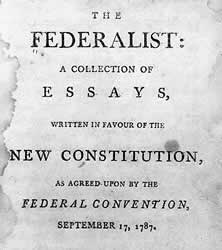
The "Federalist Papers" were written to:

a)

Explain and convince the people into supporting the new U.S Constitution.

b)

spark a new revolution among the American people against their government.

c)

oppose a strong centralized government.

d)

create a new monarchy.