
 Worksheets
coordination and response igcse
Total questions: 34
Worksheet time: 34mins
Which type of cells do all sense organs contain?
ciliated
effector
mesophyll
receptor
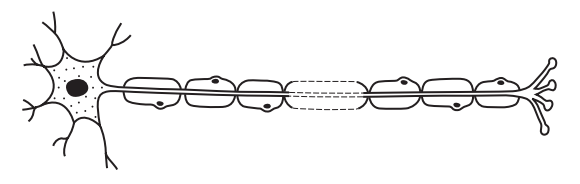
The diagram shows a cell.
What type of cell is shown?
ciliated cell
motor neurone
relay neurone
sensory neurone
When a bright light is shone into the eye, the diameter of the pupil decreases.
What is this an example of?
accommodation
a simple reflex
photosynthesis
voluntary response

The diagram shows a neurone carrying an impulse.
Which row describes the type of neurone and the direction of impulse?
Which choice describes the type of neurone and the direction of impulse?
type of neurone = motor; direction of impulse = towards the spinal cord
type of neurone = motor; direction of impulse = away from the spinal cord
type of neurone = sensory; direction of impulse = towards the spinal cord
type of neurone = sensory; direction of impulse = away from the spinal cord

The diagram shows some of the muscles and bones of the human arm.
When muscle X contracts, what happens to the arm and what happens to muscle Y?
arm bends; muscle Y contracts
arm bends; muscle Y relaxes
arm straightens; muscle Y contracts
arm straightens; muscle Y relaxes

The diagram shows a section through part of the human eye.
When a person looks at an object which is close to their eye, which of the following takes place?
suspensory ligaments slacken; lens becomes fatter
suspensory ligaments slacken; lens becomes thinner
suspensory ligaments tighten; lens becomes fatter
suspensory ligaments tighten; lens becomes thinner
A bright light suddenly shines into a person’s eyes.
What happens?
The lenses become more concave.
The lenses become more convex.
The pupils become larger.
The pupils become smaller.
When a person is frightened, adrenalin is released by the adrenal glands.
What are the effects of the adrenalin?
breathing rate decreased; heart beat rate decreased
breathing rate decreased; heart beat rate increased
breathing rate increased; heart beat rate decreased
breathing rate increased; heart beat rate increased
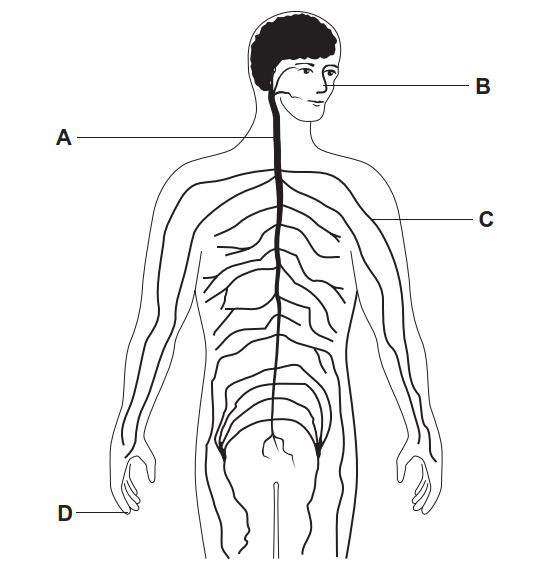
The diagram shows the human nervous system.
Which letter indicates a part of the central nervous system?
A
B
C
D

The diagram shows the muscles which control the size of the pupil in an eye.
How do the muscles make the pupil larger?
circular muscles contract; radial muscles contract.
circular muscles contract; radial muscles relax.
circular muscles relax; radial muscles contract.
circular muscles relax; radial muscles relax.
Which list describes the correct sequence of a simple reflex arc?
A receptor, relay neurone, motor neurone, sensory neurone, effector
B receptor, relay neurone, sensory neurone, motor neurone, effector
C receptor, sensory neurone, motor neurone, relay neurone, effector
D receptor, sensory neurone, relay neurone, motor neurone, effector
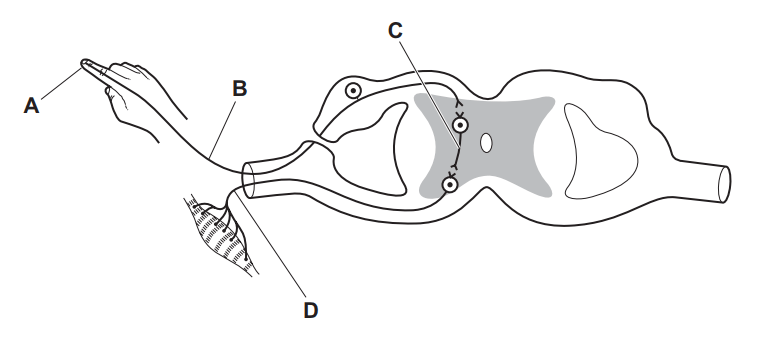
The diagram shows a simple reflex arc.
Which labelled part is the sensory neurone?
A
B
C
D
Some structures in the eye are listed.
1 cornea
2 iris
3 lens
4 retina
Which structures contain light receptors?
1, 2 and 3
2, 3 and 4
2 and 4 only
4 only
Which statement about light receptors in the retina of a normal human eye is correct?
The cones only work in dim light
The rods are found in the fovea.
There are three types of cone.
There are three types of rod.
How can we best describe a nerve impulse?
An electrical signal that passes along nerve cells called neurones
A chemical signal that is transferred to an electrical signal
An electrical charge that travels in nerve endings
Brain's response to an unfavourable change
What is CNS?
Central Neurone System
Brain and spinal cord
Peripheral neurones
Synapses that connect neurones
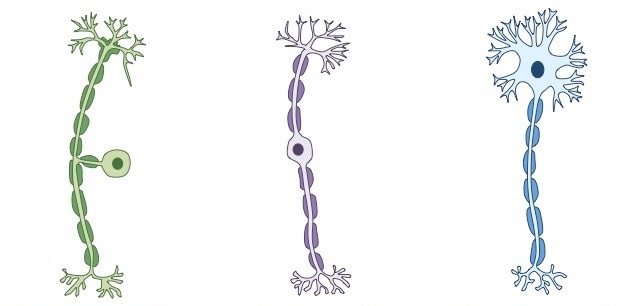
What type of neurone is shown on this picture as green?
Sensory
Relay
Motor
Synapse
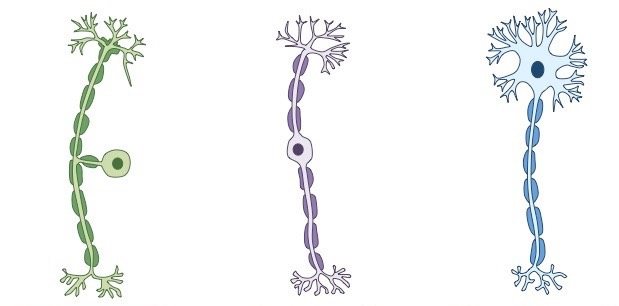
What type of neurone is shown on this image as purple?
Sensory
Motor
Relay
Synapse
Which structure of the eye contains light receptor cells?
Retina
Lens
Cornea
Iris
How does lens help us see objects that are far?
It stays the same
It becomes fatter
It becomes flatter
It becomes more spherical
What is a pupil?
Black dot
Empty space
Colourful part of the eye
Jelly
What is the job of optic nerve?
To carry nerve impulses to the brain
To convert light to electrical signal
To react to too much light
To help bending light
What do we refer to when we say "accommodation"?
How eye is adapted for converting light
How eye is protected from too much light
How eye reacts to too little light
How eye is adapted to see near or far
What is the main advantage of nervous response over chemical response?
Nervous response is safer
Nervous response lasts longer
Nervous response is unconscious
Nervous response is quicker
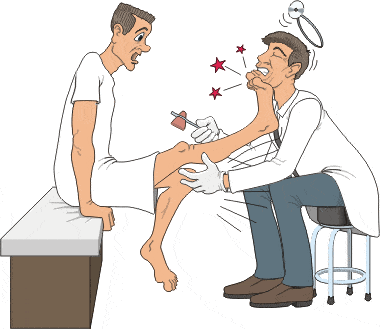
A doctor taps on a patient's knee. What is the response?
The patient kicks
The doctor taps on the patient's knee
Which of the following is NOT TRUE about the synapse?
At the synapse, neurotransmitters are released at the postsynaptic membrane.
At the synapse, chemical signals are converted into electrical signals.
Small gap between neuron is called synaptic cleft
Neurotransmitter binds to ligand-gated ion channel on post-synaptic membrane

Stucture that contain neurotransmitter is....
B
A
D
E

Name an organelle which can be found in structure A.
vesicle
mitochondrion
nucleus
receptor
Neurotransmitters are released from the
Dendrites
Post-synaptic neuron
Presynaptic neuron
Schwann Cells
What is the chemical used by a neuron to transmit an impulse across a synapse to another nerve cell?
Neurotransmitters
Synapse
Threshold
Impulse

Diagram 24 shows the structure of a motor neurone. Which part labelled A, B, C or D conducts nerve impulses away from the cell body?
A
B
C
D

