
 Worksheets
Identifying Exponential Functions
Total questions: 51
Worksheet time: 2hrs 42mins
Name
Class
Date
1.
If f(x)=2(3x)+1 , then what does f(2) =
a)
25
b)
16
c)
19
d)
18
2.
If f(x)=3x+1 , then what does f(2) =
a)
5
b)
6
c)
7
d)
8
3.

Does the graph represent an exponential growth or an exponential decay function?
a)
Exponential Growth
b)
Exponential Decay
4.

What does the y-intercept of the graph represent?
a)
The amount of grams the material is gaining.
b)
The amount of grams the material is losing.
c)
The amount of grams remaining after so many years.
d)
The initial amount of grams.
5.
Which of the following is an increasing exponential function whose y-intercept is 50?
a)
y = 50(.05)x
b)
y = 50x - 4
c)
y = (2)x + 50
d)
y = 50(1.4)x
6.
The amount of ants in a colony, f, that is decaying can be modeled by f(x) = 800(.87)x, where x is the number of days since the decay started. By what percentage is the colony decaying?
a)
87%
b)
13%
c)
800%
d)
8.7%
7.
The amount of ants in a colony, f, that is decaying can be modeled by f(x) = 800(.87)x, where x is the number of days since the decay started. Suppose f(20) = 49. Which of the following is true?
a)
After 20 days, there are 49 ants in the colony.
b)
After 49 days there are 20 ants in the colony.
c)
The amount of ants times 20 is 49.
d)
After 20 days the amount of ants remaining decreases by 49.
8.
The amount of downloads for an album on iTunes, g(d), where d is the number of days since the album was first uploaded can be represented as
g(d) = 51.5d
How many downloads will the album have after 3 days?
g(d) = 51.5d
How many downloads will the album have after 3 days?
a)
125
b)
11
c)
1398
d)
140
9.
A collectible car has been going up in price by 10% each year. If the car is already worth $29,000, how much will the car be worth in 5 years?
a)
$0.29
b)
$2,900,000,000
c)
$46,704.79
d)
$145,000
10.
The expression 12(1.015)t models the population of elephants in a wildlife refuge after t years since 1975.
Is the population of elephants increasing or decreasing?
Is the population of elephants increasing or decreasing?
a)
Increasing
b)
Decreasing
11.
The expression 12(1.015)t models the population of elephants in a wildlife refuge after t years since 1975.
What does the value 12 represent?
What does the value 12 represent?
a)
The predicted increase in number of elephants in the refuge each year.
b)
The predicted decrease in number of elephants in the refuge each year.
c)
The number of years it will take for the elephant population to stop increasing.
d)
The initial amount of elephants in the park.
12.
The expression 12(1.015)t models the population of elephants in a wildlife refuge after t years since 1975.
What does the value 1.015 represent?
What does the value 1.015 represent?
a)
The number of elephants was 1,015 in 1975.
b)
The number of elephants increases by 1.5% each year.
c)
The number of elephants increases by 101.5% each year.
d)
The number of elephants is multiplied by 1.015 each year.
13.
The amount of ibuprofen (medicine for headaches) breaks down by 30% each hour. If a person took a 200 milligram ibuprofen, how much will be left after 3 hours?
a)
5.4 mg
b)
68.6 mg
c)
.0054 mg
d)
2,400,000 mg
14.

Is the graph exponential growth or decay?
a)
Exponential growth
b)
Exponential decay
15.
Is the following function exponential growth, exponential decay, linear, or none of the above.
g(x) = 740(.001)3x
g(x) = 740(.001)3x
a)
Exponential growth
b)
Exponential decay
c)
Linear
d)
None of the above
16.
Is the following function exponential growth, exponential decay, linear, or none of the above?
p(x) = 13x - 5
p(x) = 13x - 5
a)
Exponential growth
b)
Exponential decay
c)
Linear
d)
None of the above
17.
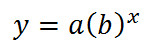
In an exponential function, what does the 'a' represent?
a)
SLOPE
b)
RATE OF CHANGE
c)
Y-INTERCEPT
d)
COMMON RATIO
18.
What is a, the starting term, for the function: f(x) = 300(1.16)x?
a)
300
b)
1.16
c)
.16
d)
x
19.

Is the pictured graph growth, decay, or linear or none?
a)
Exponential Growth
b)
Exponential Decay
c)
Linear
d)
None
20.
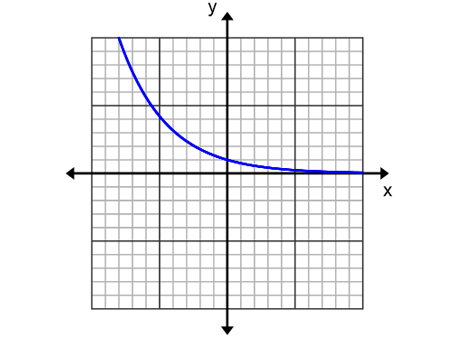
Is this exponential growth or decay?
a)
Growth
b)
Decay
21.
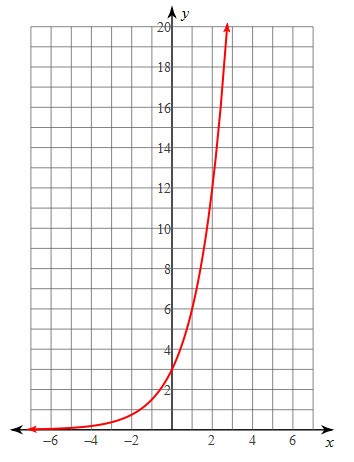
What is the y-intercept of the function?
a)
2
b)
3
c)
1
d)
-2
22.

Is the pictured graph growth, decay, or linear or none?
a)
Growth
b)
Decay
c)
Linear
d)
None
23.
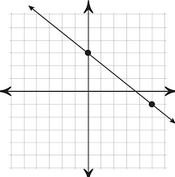
Is the graph linear, exponential or neither?
a)
Linear
b)
Exponential
c)
Neither
24.
Given y=3x determine the y-intercept
a)
(0,1)
b)
(0,3)
c)
No Y-intercept
d)
y=1
25.
What type of function is f(x)=2(1/7)x ?
a)
Exponential Growth
b)
Linear
c)
Exponential Decay
d)
None of the Abovee
26.
Write an equation that models the following situation:
Samantha's hair was known to grow very rapidly. It began at a length of 6 in and grew at a rate of 14% a week.
Samantha's hair was known to grow very rapidly. It began at a length of 6 in and grew at a rate of 14% a week.
a)
y=6(0.14)x
b)
y=6(1+14)x
c)
y=6(1.14)x
d)
y=6(0.86)x
27.
What type of function is y = 7(5/4)x?
a)
Exponential Growth
b)
Exponential Decay
c)
Linear
d)
None of the above
28.
Which of the following functions shows an initial amount of $15 and an increase of 35% each year?
a)
y = 15(35)x
b)
y = 15(1.35)x
c)
y = 15(0.35)x
d)
y = 35(1.15)x
29.
Identify the y-intercept (initial value) in the function f(x)=13(.27)x
a)
(.27)x
b)
.27
c)
13
d)
3.51
30.
Identify the y-intercept (initial value) of the function f(x)=2(4)x.
a)
2
b)
4
c)
(2)x
d)
8
31.
Identify the common ratio (multiplier) of the function f(x)=2(4)x.
a)
2
b)
4
c)
(2)x
d)
8
32.
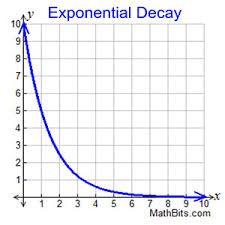
Is the pictured graph growth, decay, or linear or none?
a)
Growth
b)
Decay
c)
Linear
d)
None
33.
Is the pictured graph growth, decay, or linear or none?
a)
Growth
b)
Decay
c)
Linear
d)
None
34.
This function has a pattern of multiplying or dividing the same number from one y-value to the next y-value as the x-value increases by one.
a)
Linear
b)
Exponential
c)
Neither
35.
This function has the same average rate of change on every interval.
a)
Linear
b)
Exponential
c)
Neither
36.
The graph of this function is a curve going up really fast or down really fast.
a)
Linear
b)
Exponential
c)
Neither
37.
The graph of this function is a curve going up really fast or down really fast.
a)
Linear
b)
Exponential
c)
Neither
38.
This function does not change by the same rate on every interval.
a)
Linear
b)
Exponential
c)
Neither
39.
What type of function is this equation:
y= -3x + 12
y= -3x + 12
a)
Linear
b)
Exponential
c)
Neither
40.
The graph of this function is a straight line.
a)
Linear
b)
Exponential
c)
neither
41.

Which function describes the graph?
a)
Linear
b)
Exponential
c)
neither
42.

Which function describes the table?
a)
Linear
b)
Exponential
c)
Neither
43.

Which function describes the table?
a)
linear
b)
exponential
c)
neither
44.
What type of function is this equation:
y= 4x+1
y= 4x+1
a)
Linear
b)
Exponential
c)
Neither
45.

What type of function describes the table?
a)
Linear
b)
Exponential
c)
Neither
46.

What function describes this graph?
a)
Linear
b)
Exponential
c)
neither
47.

What type of function is present?
a)
linear
b)
exponential decay
c)
non-function
d)
exponential growth
48.

Which function has the greatest y-intercept?
a)
f(x)
b)
h(x)
c)
g(x)
49.
What type of function is present?
a)
linear
b)
exponential decay
c)
non-function
d)
exponential growth
50.
Which of the following represent exponential decay?
a)
A=P(1+r/n)nt
b)
A=Pert
c)
y=a(1-r)x
d)
y=a(1+r)x
51.
Which of the following represent exponential growth?
a)
A=P(1+r/n)nt
b)
A=Pert
c)
y=a(1-r)x
d)
y=a(1+r)x
100 %

