wayground logo

Free Printable Worksheets

Font size

S
M
L
XL
Worksheets

Gas Exchange - Mammals, Fish and Insects

Total questions: 50

Worksheet time: 30mins

Name
Class
Date
1.
Mechanical movement to inhale and exhale air
a)
Gas Exchange
b)
Respiration
c)
Breathing
d)
Transport
2.

Gas exchange is needed to supply _____________ to cells and remove __________________

a)

carbon dioxide; oxygen

b)

oxygen; food

c)

oxygen; carbon dioxide

d)

carbon dioxide; water

3.
The movement by diffusion of oxygen and carbon dioxide across a membrane
a)
Ventilation
b)
Breathing
c)
Gas exchange
d)
Respiration
4.
Respiration is the 
a)
Intake of oxygen and release of carbon dioxide over a membrane
b)
Release of energy from food inside cells
c)
Mechanical movement to inhale and exhale air
d)
Feature that enable an animal to survive in its habitat
5.

What is the main function of the respiratory system?

a)

to provide oxygen and remove carbon dioxide from the body

b)

to bring oxygen to the body

c)

to break down food and absorb nutrients

d)

to remove oxygen from the body and deliver carbon dioxide

6.
a)
A
b)
B
c)
C
d)
D
7.
Which of the following are features of the alveoli that adapt them to gas exchange?

I. High surface area
II. Thin walls
III. Dry surfaces
a)
I and II only
b)
I only
c)
II and III
d)
I, II, and III
8.
The trachea leads to the...
a)
Bronchioles
b)
Bronchi
c)
Esophagus
d)
Pulmonary Vessel
9.

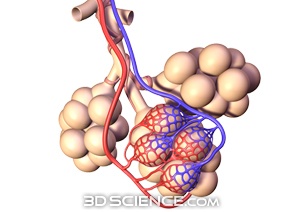
The air sacs that are covered with capillaries where gas exchange takes place.

a)

Bronchi

b)

Trachea

c)

Oxygen

d)

Alveoli

10.
Letter D is pointing to which Respiratory organ?
a)
Alveoli
b)
Diaphragm
c)
Lung
d)
Bronchi
11.

Name the structure through which gases enter and leave the body of an insect.

a)

tracheoles

b)

alveoli

c)

lungs

d)

spiracles

12.
Which of the following is a feature of exchange surfaces?
a)
High surface area
b)
Low surface area
13.
Which of the following is a feature of exchange surfaces?
a)
They are thin
b)
They are thick
14.
Which of the following is a feature of exchange surfaces?
a)
They are permeable
b)
They are impermeable
15.
Which of the following is a feature of exchange surfaces?
a)
They are moist
b)
They are desiccated
16.
Which of the following is a feature of exchange surfaces?
a)
They are ventilated
b)
They are unventilated
17.
What lines the tracheae of insects?
a)
Chitin
b)
Cartilage
c)
Lignin
d)
Collagen
18.
What does this graph show?
a)
Parallel flow in cartilaginous fish
b)
Counter current flow in bony fish
19.
What does this graph show?
a)
Parallel flow in cartilaginous fish
b)
Counter current flow in bony fish
20.
What is the principal exchange surface of larval amphibians?
a)
Skin
b)
Lungs
c)
Gills
21.
What is the gas exchange surface of mammals?
a)
Alveoli
b)
Bronchioles
c)
Trachea
d)
Pleural fluid
22.
What reduces friction between the lungs and the ribs in mammals?
a)
Diaphragm
b)
Bronchioles
c)
Trachea
d)
Pleural fluid
23.
What is the volume of air normally breathed in and out called?
a)
Residual volume
b)
Tidal volume
c)
Vital capacity
24.
What is the exchange surface in leaves?
a)
Spongy mesophyll
b)
Palisade mesophyll
c)
Lower epidermis
d)
Upper epidermis
25.
What is the main photosynthetic layer in leaves?
a)
Spongy mesophyll
b)
Palisade mesophyll
c)
Lower epidermis
d)
Upper epidermis
26.
What layer contains the most stomata?
a)
Spongy mesophyll
b)
Palisade mesophyll
c)
Lower epidermis
d)
Upper epidermis
27.
What is the correct description of the cause of stomatal opening?
a)
K+ ions actively pumped into guard cells, water potential drops.
b)
K+ ions diffuse out of guard cells, water potential rises.
28.
With an increase of surface area to volume ration.....
a)
the rate of gas exchange increases
b)
gas exchange decreases
c)
fish breathe faster
d)
diffusion of oxygen decreases
29.
the three parts of a gill
a)
filament, lamellae, gill arch
b)
filament, lamellae, operculum
c)
surface area, filaments, gill
30.
when particles move from area of high concentration to area of low concentration
a)
osmosis
b)
diffusion
c)
concentration gradient
31.
lower S:A ratio...
a)
decreases the rate of gas exchange
b)
increases the rate of gas exchange
c)
none of the above
32.
the evolution of lamellae helped 
a)
increase surface area
b)
decrease surface area
33.
What is the function of gills in fish?
a)
absorbing carbon dioxide
b)
assisting in food digestion
c)
protecting a fish's lungs
d)
taking in dissolved oxygen
34.
True of False?
The gill cover is called the Operculum.
a)
True
b)
False
35.

What is the percentage dissolved oxygen in water?

a)

1%

b)

5%

c)

10%

d)

20%

36.
All cells need nutrients and _____ to survive.
a)
gills
b)
capillaries
c)
lungs
d)
oxygen
37.
When you breathe, your lungs take in ___ and remove ___. 
a)
air/oxygen
b)
oxygen/carbon dioxide 
c)
carbon dioxide/waste 
d)
waste/air 
38.
The movement of a gas or liquid from regions of higher concentration to regions of lower concentration
a)
active transport
b)
endocytosis
c)
exocytosis
d)
diffusion
39.
Which of the following are features of the alveoli that adapt them to gas exchange?
I. High surface area
II. Thin walls
III. Dry surfaces
a)
I and II only
b)
I only
c)
II and III
d)
I, II and III
40.
The air sacs that the oxygen goes through after it has left the bonchiolis are called what?
a)
bronchi
b)
lungs
c)
oxygen
d)
alveoli
41.
Enable aquatic animals to diffuse oxygen
a)
gills
b)
spiracles
c)
crop
d)
nerve net 
42.
In Insects these branch out like the tributaries of a river to deliver oxygen
a)
tracheal tubes
b)
wings
c)
filter feeders
d)
circulation 
43.
Which is not important for respiratory surfaces to have a large surface area?
a)
To maximise gas exchange
b)
Increase rate of oxygen diffusion
c)
Alveoli use active transport
d)
Multicellular organisms have high energy demands
44.
Which is NOT a part of the respiratory system?
a)
bronchioles
b)
alveoli
c)
trachea
d)
capillaries
45.

True or false:

Tracheoles have rings of chitin

a)

true

b)

false

46.

To prevent moisture loss Insects have a?

a)

permeable exoskeleton

b)

impermeable exoskeleton

47.

Which adaptations help reduce water loss in insects? (tick all that apply)

a)

guard cells that open and close the spiracles

b)

valves that open and close the spiracles

c)

hairs around the spiracles

48.

The flow of oxygen (in order) into the cells of an insect is

a)

spiracles - trachea - tracheole fluid - cells - tracheole

b)

spiracles - cells - trachea - tracheole - tracheole fluid

c)

cells - tracheole fluid - tracheole - trachea - spiracles

d)

spiracles - trachea - tracheole - tracheole fluid - cells

49.
All living things do which of the following?
a)
Chemosynthesis
b)
Respiration
c)
photosynthesis
d)
all of the answers
50.
Which type of respiration occurs in the presence of oxygen?
a)
Aerobic
b)
Anaerobic