Wayground logo

Free Printable Worksheets

Font size

S
M
L
XL
Worksheets

final revision g 8 q 3

Total questions: 79

Worksheet time: 2hrs 36mins

Name
Class
Date
1.

Burning wood is a

a)

chemical change

b)

physical change

2.

Broken glass is a

a)

chemical change

b)

physical change

3.

Melting butter for popcorn is a

a)

chemical change

b)

physical change

4.

A change in the size, shape, or state of matter.

a)

chemical change

b)

physical change

5.

Which of the following is NOT an example of a physical change?

a)

crumpling paper

b)

sharpening a pencil

c)

clothes shrinking

d)

sour milk

6.

A change in which NEW substances are formed.

a)

Chemical change

b)

Physical change

7.

Which of the following is NOT an example of chemical change?

a)

sour milk

b)

burning wood

c)

breaking a pencil

d)

rust

8.

Salt dissolved in water is a

a)

physical change

b)

chemical change

9.

Chewing food is a

a)

physical change

b)

chemical change

10.

Describes how matter reacts with other matter. Examples: flammability and toxicity.

a)

physical properties

b)

chemical properties

11.

if there is a change in color, production of light, production of heat, production of gas, production of smell or formation of a new substance.

a)

physical change

b)

chemical change

12.

What does it mean when there is a physical change?

a)

Matter has change from one substance into another.

b)

Matter has change on the molecular level

c)

A new substance has been formed.

d)

Matter has changed size, shape or form.

13.

What is an example of a physical change that happens inside your body?

a)

Food being broken down by acids in your stomach.

b)

Food being broken down into small pieces by your teeth.

c)

Food being moved to your stomach.

d)

Water being absorbed inside your large intestine.

14.

Which phrase most accurately describes a chemical change?

a)

A change on the molecular level.

b)

A change in appearance.

c)

A change in taste.

d)

A change in size.

15.

A teacher is demonstrating physical and chemical changes to her class. Which action should she use to demonstrate a chemical change?

a)

cutting a piece of paper

b)

folding a piece of paper

c)

tearing a piece of paper

d)

burning a piece of paper

16.

A cup of water is left outside for two days. When it was checked there was only half a cup left. What happened?

a)

evaporation; chemical change

b)

condensation; physical change

c)

evaporation; physical change

d)

condensation; chemical change

17.

Rust on a bike is an example of chemical change.

a)

True

b)

False

18.

Rotting fruit produces a bad smell. This happens because the fruit is experiencing a

a)

physical change

b)

chemical change

19.

What is an example of a chemical change that happens inside your body?

a)

Food being broken down by acids in your stomach.

b)

Food being broken down into small pieces by your teeth.

c)

Food being moved to your stomach.

d)

Water being absorbed inside your large intestine.

20.
Which of the following is a sign that a chemical reaction has occurred?
a)
change in shape
b)
melting
c)
formation of a gas
d)
dissolving
21.
A change where one or more new substances are created.
a)
Physical Change 
b)
Chemical Change 
22.

When you break a cracker into pieces it is a...

a)

Chemical change

b)

Physical change

23.
Photosynthesis is an example of a
a)
physical change
b)
chemical change
24.
Digesting your food is an example of 
a)
chemical change
b)
physical change
25.
What characteristic defines all chemical changes?
a)
There is a change of state.
b)
Electricity is produced.
c)
A new material is formed.
d)
Bubbles are produced. 
26.
Which of the following is a chemical property of water?
a)
Reacts with pure sodium.
b)
Boils at 100 oC.
c)
Dissolves sugar easily. 
d)
Has a density of 1 gm/mL
27.

A homogeneous mixture is

a)

a mixture in which individual substances are not evenly mixed

b)

a mixture in which multiple substances are mixed

c)

a mixture in which the individual substances are evenly mixed

28.

A heterogeneous mixture is

a)

a mixture in which individual substances are not evenly mixed

b)

a mixture in which multiple substances are mixed

c)

a mixture in which the individual substances are evenly mixed

29.

The atom is the building block of matter.

a)

true

b)

false

30.

A compound is

a)

anything that takes up space

b)

a substance made up of atoms of only one kind

c)

two or more different elements in exact proportion

31.

An element is

a)

anything that takes up space

b)

a substance made up of atoms of only one kind

c)

two or more different elements in exact proportion

32.

This is an example of a _______ change.

a)

physical

b)

chemical

33.

Sweet Tea, everything is mixed evenly and looks the same.

a)

Heterogeneous Mixture

b)

Homogeneous Mixture

34.

H2 is an example of a(n)...

a)

Element

b)

Compound

c)

Molecule

d)

Heterogeneous Mixture

35.
a)

Element

b)

Compound

c)

Homogeneous Mixture

d)

Heterogeneous Mixture

36.

2 or more different elements that are bonded together is called...

a)

A. element

b)

B. compound

c)

C. mixture

d)

D. solution

37.
A substance that contains only one type of atom is a(n)
a)
compound
b)
element
c)
heterogeneous mixture
d)
homogeneous mixture
38.
Is salt (NaCI) a compound or a element
a)
Compound
b)
element
39.

What is CO2 and example of?

a)

element

b)

molecule

c)

compound

40.
Which of the following lists only elements?
a)
H2O + OH, MgCl2
b)
H2O, KF, Ne
c)
KCl, Ag, Au
d)
K, Cl, N
41.

Jay combines water, sugar, and lemon juice to form lemonade. What type of substance was made?

a)

Element

b)

Molecule

c)

Mixture

42.
Which of the following is an example of a heterogenous mixture?
a)
soap
b)
a salad with lettuce, olives, and tomatoes
c)
cup of coffee
d)
water
43.
Which of the following selections are the different types of mixtures?
a)
heterogenous, homogenous
b)
acid, base
c)
metal, nonmetal
d)
element, compound
44.
This type of mixture looks the same throughout. 
a)
Homogenous
b)
Heterogeneous
45.

The chemical formula: N2 would represent what type of substance?

a)

Element

b)

Compound

c)

Mixture

d)

Molecule

46.
Are made from a combination of 2 or more elements...
a)
Molecules
b)
Pure Substances
c)
Compounds
d)
Elements
47.
A combination that can be separated by physical processes is a .....
a)
Pure Substance
b)
Glucose
c)
Element
d)
Mixture
48.
A mixture that is NOT evenly distributed is called ....
a)
Compounded
b)
Homogenous
c)
Heterogenous
d)
Salty
49.
This picture represents: 
a)
Element
b)
Compound
c)
Mixture of Elements
d)
Mixture of Compounds
50.
Substance with atoms that are all alike.
a)
element
b)
compound
c)
homogeneous mixture
d)
heterogeneous mixture
51.
This picture represents: 
a)
Element
b)
Compound
c)
Mixture of Elements
d)
Mixture of Compounds
52.
This picture represents: 
a)
Element
b)
Compound
c)
Mixture of Elements
d)
Mixture of Compounds
53.
All matter is made up of .....
a)
Compounds
b)
Atoms
c)
Molecules
d)
Sunshine
54.
This picture represents which of the following?
a)
element
b)
compound
c)
mixture
55.
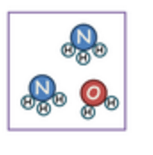
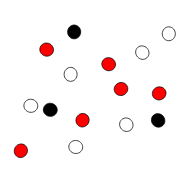
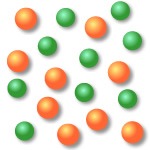
Which one of these pictures represents a pure substance? 
a)
1 and 2
b)
1 and 3
c)
2 and 3
d)
1, 2 and 3
56.
Blue Color: Chemical or Physical Property
a)
Chemical Property
b)
Physical Property
57.
Flammability (burns): Chemical or Physical Property
a)
Chemical Property
b)
Physical Property
58.
Solubility (dissolves): Chemical or Physical Property
a)
Chemical Property
b)
Physical Property
59.
Which one of these is a chemical property?
a)
melting point
b)
boiling point
c)
color
d)
flammability
60.
Ability to rust is this type of property:
a)
Physical property
b)
Chemical property
61.
Which is NOT a physical property?
a)
odor
b)
reacts with acid
c)
ability to conduct electric current
d)
hardness
62.
Physical properties are
a)
properties that can be observed without changing the identity of the substance
b)
properties that describe how a substance changes into a completely different substance
63.
which one is the definition of chemical property?
a)
a property or characteristic of a substance that is observed during a reaction where the chemical composition of a substance is changed
b)
any change that results in the formation of new chemical substances
c)
combustibility
64.
Brittleness: Chemical or Physical Property
a)
Chemical Property
b)
Physical Property
65.

The ability to hammered into a thin sheet or be bent is

a)

Ductility

b)

Solubility

c)

Density

d)

Malleability

66.

When an object has the ability to be stretched into a thin wire this is

a)

Density

b)

Ductility

c)

Dirtability

d)

Dissovility

67.
Is copper tarnishing a physical or chemical change?
a)
Physical 
b)
Chemical
68.

Mass divided by volume is the formula for calculating----

a)

Mass

b)

Volume

c)

Density

d)

Matter

69.

The melting point in degrees Celsius is---

a)

100

b)

32

c)

0

d)

212

70.
Which state of matter has molecules that move fastest and spread to fill the space they are in?  They do not form any pattern.
a)
solid 
b)
liquid 
c)
gas
71.
What is matter?
a)
a pure substance
b)
anything that occupies space and possesses mass
c)
an element
d)
a compound
72.
A measure of the amount of matter in an object. 
a)
Weight
b)
Mass
73.
Which of the following is not a chemical property? 
a)
rusting 
b)
boiling 
c)
rotting 
d)
burning 
74.
What is the measure of how much space an object takes up?
a)
matter
b)
volume
c)
substance
d)
properties
75.
What is weight?
a)
the measure of the amount of gravitational pull on an object reaction, either by itself or with other materials
b)
the ability of a substance to undergo a physical change either by itself or with other materials
76.
What kind of properties can only be observed when a substance changes into a different substance?
a)
physical properties
b)
chemical properties
c)
liquid properties
d)
real properties
77.
Jack has a rock. The rock has a mass of 14g and a volume of 2cm3. What is the density of the rock?
a)
7 mL
b)
7 g/cm3
c)
28 g/cm3
d)
1/7 g/cm3
78.
Frank has an eraser. It has a mass of 4g, and a volume of 2cm3. What is its density?
a)
8 g/cm3
b)
2 g/cm3
c)
1/2 g/cm3
d)
24 g/cm3
79.
Frank has a paper clip. It has a mass of 9g and a volume of 3cm3. What is its density?
a)
3 g/cm3
b)
1/3 g/cm3
c)
27 g/cm3
d)
39 g/cm3