
 Worksheets
Unit 1-4 REVIEW
Total questions: 84
Worksheet time: 21hrs 0mins
Read each observation about water. 1. Water droplets attract one another and form a larger pool of water. 2. Water sticks to your hands after you wash them. 3. Water sticks to a spiderweb after a rainstorm. 4. Water from a fountain forms droplets. Choose the option that correctly identifies which observations are a result of cohesion and which observations are a result of adhesion.
Cohesion: 1, 4; Adhesion: 2, 3
Cohesion: 2, 3; Adhesion: 1, 4
Cohesion: 1, 2, 3; Adhesion: 4
Cohesion: 3, 4; Adhesion: 1, 2
Fill in the blank: Water droplets attract one another and form a larger pool of water due to ____.
A. Adhesion
B. Cohesion
C. Evaporation
D. Condensation
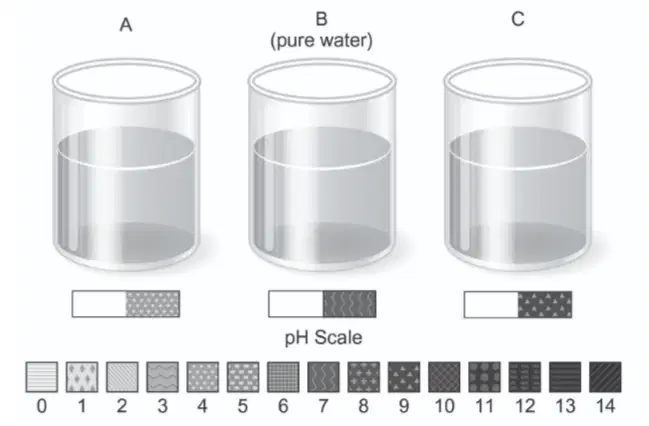
Which jar has a pH level that indicates it is a base?
Jar A
Jar B
Jar C
None of the jars.
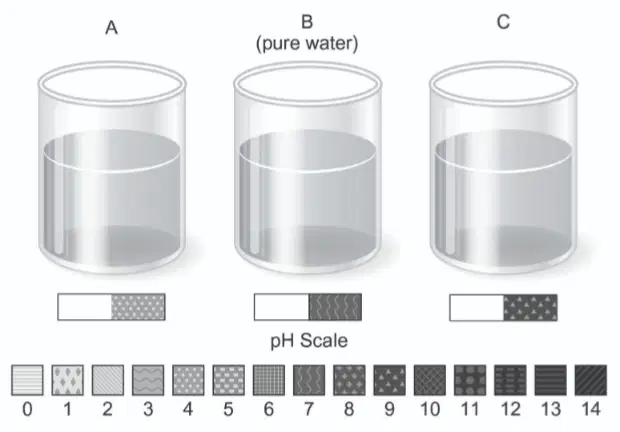
Fill in the blank: A substance with a pH level lower than 7 is considered an ______.
Acid
Base
Neutral
Alkaline
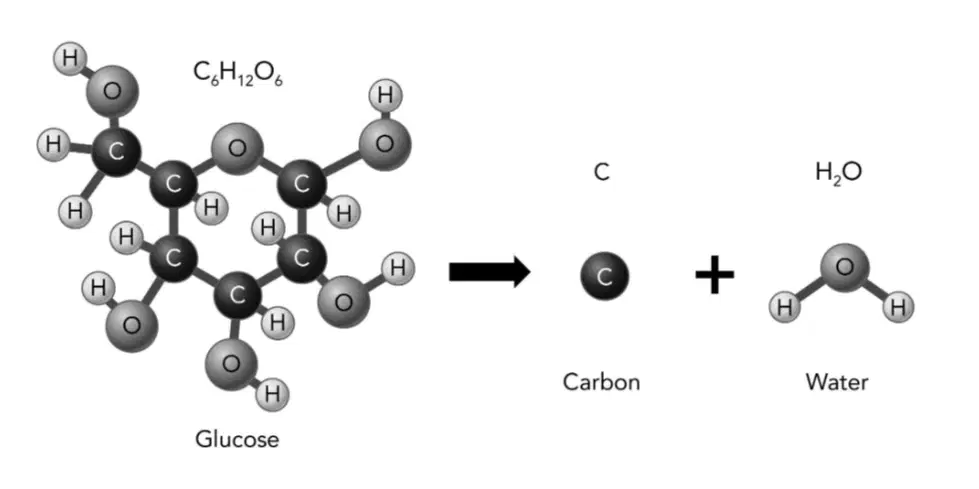
What are the products formed when glucose (C6H12O6) is heated and broken down?
Carbon and Oxygen
Carbon and Water
Carbon and Hydrogen
Water and Oxygen
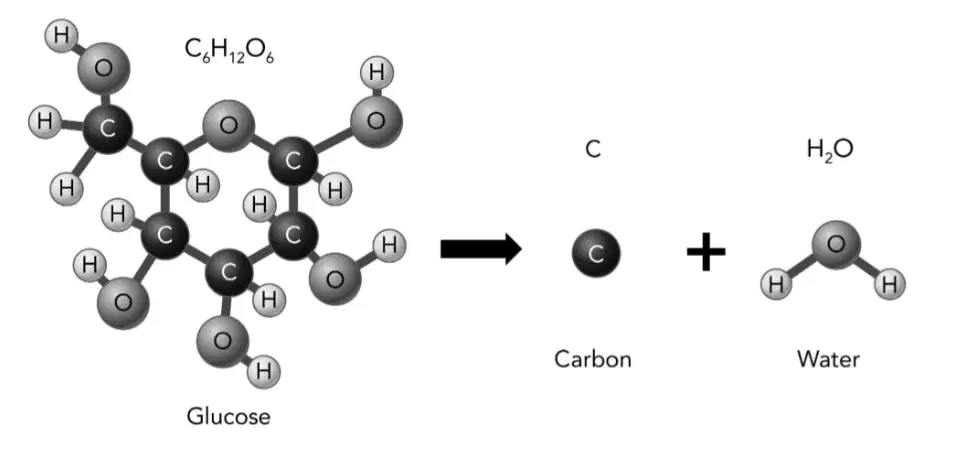
Fill in the blank: When glucose is heated, it breaks down into carbon and ____.
Oxygen
Hydrogen
Water
Nitrogen
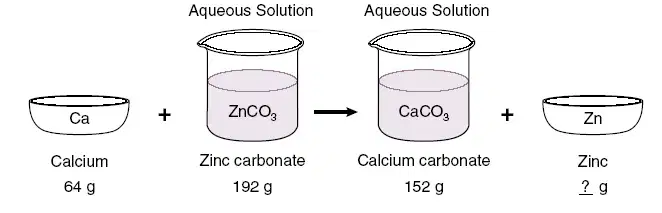
Based on the data that the students collected, how many grams of zinc were produced from the reaction?
50 grams
104 grams
150 grams
204 grams
The pH of acids is _______________ than pure water while the pH of bases is _______________ than pure water. When a strong acid is added to pure water, the pH will change and become _______________ than the pH of the pure water. When a strong base is added to pure water, the pH will change and become _______________ than the pH of the pure water. Choose the option that identifies the missing terms, in order of appearance in the sentences.
lower; higher; lower; higher
lower; lower; higher; higher
higher; lower; higher; lower
higher; higher; lower; lower
Which phenomenon does not occur due to adhesion?
Water droplets forming on a waterproof jacket
A puddle of water evaporating at a slower rate
Dew forming on a leaf in the early morning
A wet, plastic tablecloth sticking to a table
An atomic-level model of an element would have ______, while a model of a compound would have ______. Mixtures differ from elements and compounds because the components in a mixture are not ______. However, some mixtures have a uniform composition and appearance. This type of mixture is classified as a ______. Choose the option that identifies the missing terms and phrases, in order of appearance in the sentences.
1 type of atom; 2 or more different atoms; chemically bonded together; homogeneous
2 or more different atoms; 1 type of atom; mixed together; heterogeneous
2 or more different atoms; 1 type of atom; able to be physically separated; heterogeneous
1 type of atom; 2 or more different atoms; chemically bonded together; heterogeneous
Which of the following best describes a compound?
A substance made of one type of atom
A mixture of different substances
A substance made of two or more different atoms chemically bonded together
A uniform mixture of substances
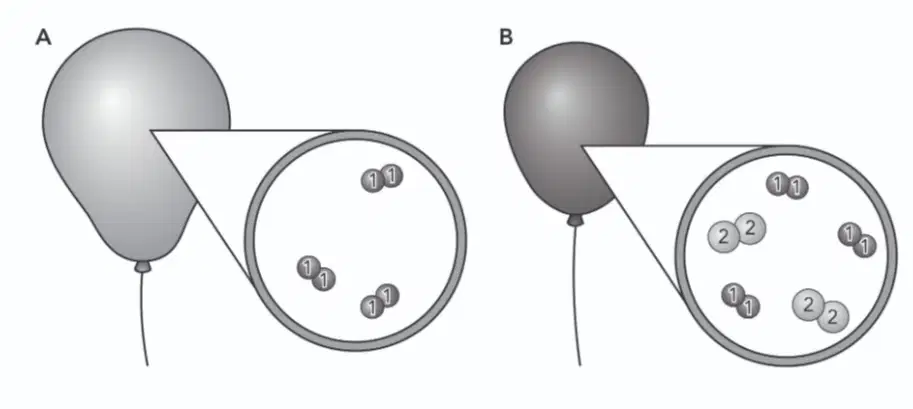
Which statement correctly identifies the type of matter in Balloon A?
Balloon A contains an element because there is only one type of atom.
Balloon A contains a compound because there are two atoms bonded together.
Balloon A contains a mixture because there are different types of atoms.
Which student has the best explanation for why an insect can sit on the surface of water? A. Destiny: "Cohesion makes water molecules push each other away, which makes the water very stable for insects to walk on. This is why cohesion causes surface tension." B. Rosa: "The attraction between water molecules is what causes cohesion. Cohesion is the force that pushes up on the surface of the water to counteract the force of the insect." C. Franklin: "Surface tension happens when water molecules stick to the insect. Water at the surface sticks to the insect, so surface tension is caused by adhesion." D. Paolo: "Molecules at the surface have stronger cohesion with the molecules around them, so the surface acts like a thin film. This is why cohesion causes surface tension."
Destiny: "Cohesion makes water molecules push each other away, which makes the water very stable for insects to walk on. This is why cohesion causes surface tension."
Rosa: "The attraction between water molecules is what causes cohesion. Cohesion is the force that pushes up on the surface of the water to counteract the force of the insect."
Franklin: "Surface tension happens when water molecules stick to the insect. Water at the surface sticks to the insect, so surface tension is caused by adhesion."
Paolo: "Molecules at the surface have stronger cohesion with the molecules around them, so the surface acts like a thin film. This is why cohesion causes surface tension."
Fill in the blank: Surface tension is primarily caused by the _______ between water molecules.
adhesion
cohesion
repulsion
attraction

When people exercise, a chemical reaction occurs in the body. Cells conduct a reaction to break down sugar and use oxygen to generate energy. This reaction is shown in the following chemical equation: C₆H₁₂O₆ + 6O₂ → 6CO₂ + 6H₂O + Energy. Which of the following is true of the equation?
A. The number of atoms is more in the products than the reactants because energy is released in the products.
B. The number of atoms is less in the products than the reactants because energy is produced in the products.
C. The number of atoms is the same in the reactants and the products; the atoms simply rearrange to form a new substance.
D. The number of atoms is less in the products than the reactants because energy is absorbed in the reaction.

Fill in the blank: During exercise, the chemical reaction in the body involves breaking down sugar and using oxygen to generate ____.
A. Water
B. Energy
C. Carbon Dioxide
D. Glucose
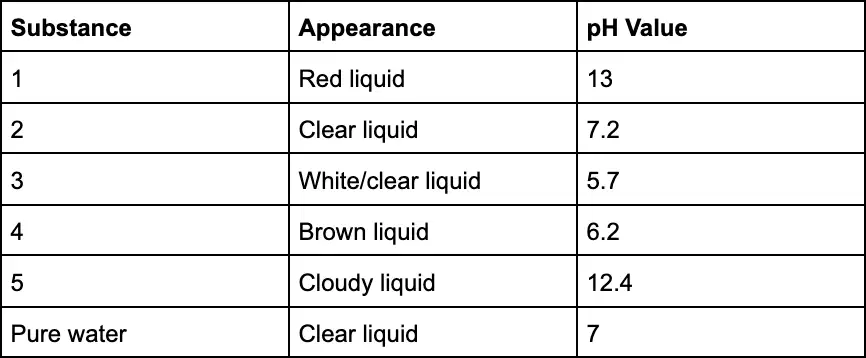
Which of the substances are considered acids?
1 and 5, because the substances have a pH higher than 12
3 and 4, because the substances have a pH that is closest to pure water
5 and 2, because the substances have a pH that is higher than pure water
4 and 3, because the substances have a pH lower than pure water
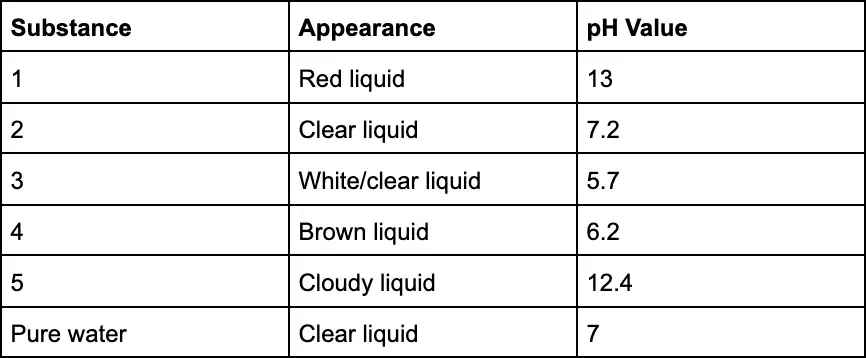
Fill in the blank: Substance 5 is considered a(n) ______ because it has a pH of 12.4.
Acid
Base
Neutral
Salt
Marsha is investigating the following chemical reaction: 2Al + 3CuCl₂ → 3Cu + 2AlCl₃. She wants to use the equation to predict the mass of the products that will form. What does this equation indicate about the atoms before and after the reaction?
A. The mass of the products will be the same as the mass of the reactants because there will be 2 atoms of Al, 3 atoms of Cu, and 6 atoms of Cl before and after the reaction.
B. The mass of the products will be the same as the mass of the reactants because there will be 2 atoms of Al, 6 atoms of Cu, and 6 atoms of Cl before and after the reaction.
C. The mass of the products will be greater than the mass of the reactants because 2 atoms of Cl will change into 3 atoms of Cl in the products.
D. The mass of the products will be greater than the mass of the reactants because 2 atoms of Al in the reactants will change into 6 atoms of Al in the products.
Fill in the blank: Students are comparing models of homogeneous and heterogeneous mixtures. Which three descriptions accurately describe a model of a homogeneous mixture?
The atoms in the model are all different sizes.
The substances are evenly distributed throughout.
There is more than one type of atom in the model.
The substances are all chemically bonded to each other.
The substances are not chemically bonded to each other.
On the way back, the sack of flour increases the overall mass of Alejandro and his bike. How does this affect his acceleration as he rides his bike?
His acceleration increases.
His acceleration decreases.
There is no change to his acceleration.
His acceleration decreases then increases.
Alejandro wants to be extra careful and does not apply as much force to the pedals to prevent the flour from falling. How does this affect his acceleration?
His acceleration increases.
His acceleration decreases.
There is no change to his acceleration.
His acceleration increases then decreases.
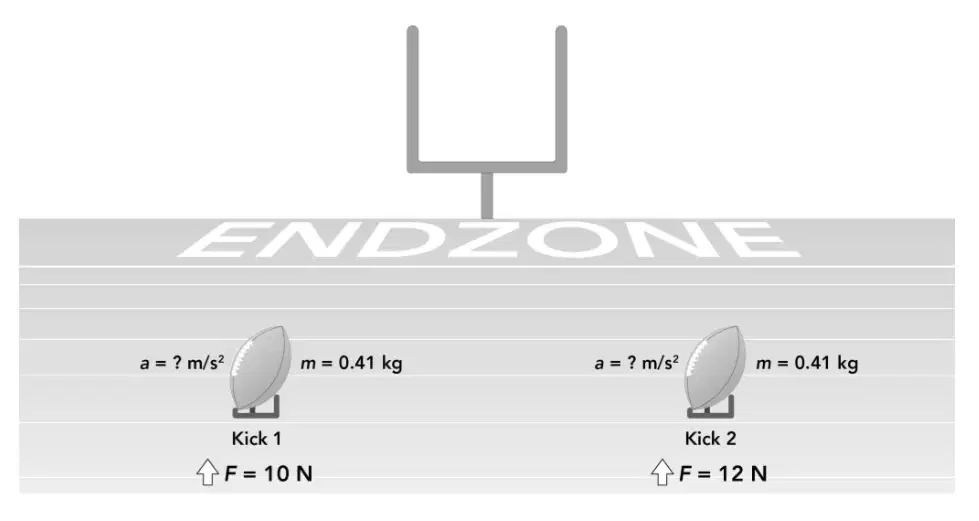
What is the acceleration of the football for kicks 1 and 2?
Kick 1: 0.041 m/s²; Kick 2: 0.034 m/s²
Kick 1: 4.1 m/s²; Kick 2: 4.92 m/s²
Kick 1: 24.39 m/s²; Kick 2: 29.27 m/s²
Kick 1: 27.90 m/s²; Kick 2: 29.30 m/s²
Which of the following options will help the students achieve their goal of increasing the acceleration of their bike?
The students must choose parts that decrease the overall force of the bike because a decrease in force will increase the acceleration of the bike.
The students must choose parts with a smaller mass because objects with a smaller mass can accelerate more quickly.
The students must choose parts with a greater mass because objects with a greater mass will accelerate more quickly.
The students must choose parts that maintain the same overall force of the bike because a constant force will change the acceleration of the bike.
The students finished rebuilding the bike, and two students are ready to ride it. Rider 1 has a mass of 60 kg and rider 2 has a mass of 80 kg. The bike has a mass of 98 kg. Each rider takes a turn riding the bike. Rider 1 rides the bike with a forward force of 2100 N and rider 2 rides the bike with a forward force of 2190 N. What is the acceleration of the bike for each rider?
Rider 1: 0.040 m/s²; Rider 2: 0.036 m/s²
Rider 1: 13.29 m/s²; Rider 2: 12.30 m/s²
Rider 1: 21.32 m/s²; Rider 2: 22.34 m/s²
Rider 1: 35.00 m/s²; Rider 2: 27.36 m/s²
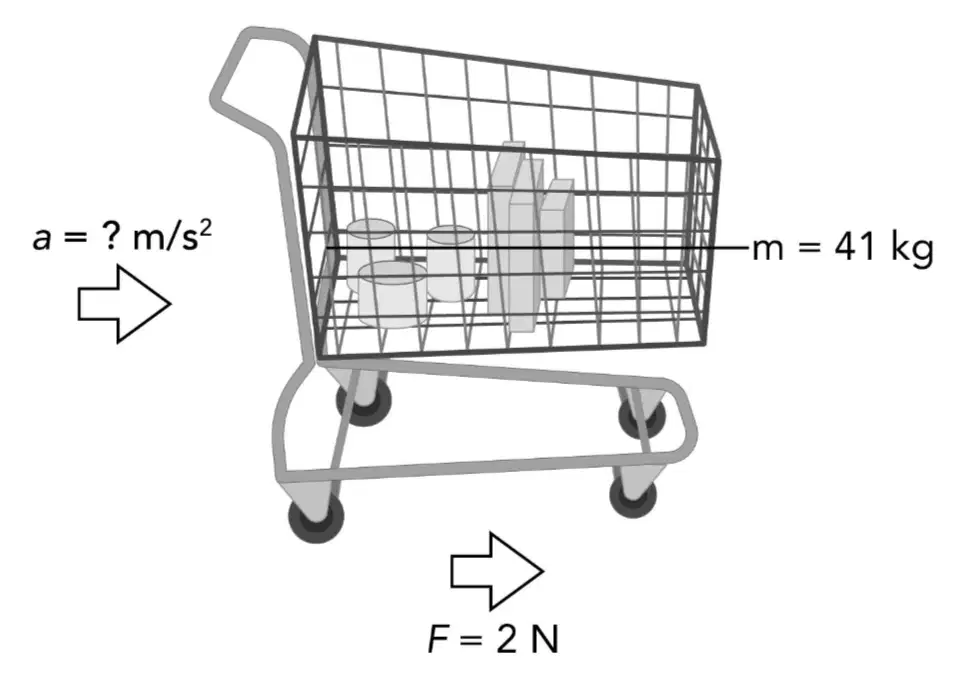
Scenario 1: A man grocery shopping pushes his cart with a force of 2 N. The cart has a mass of 41 kg. What is the cart's acceleration?
0.0588 m/s²
0.0488 m/s²
0.2 m/s²
0.5 m/s²
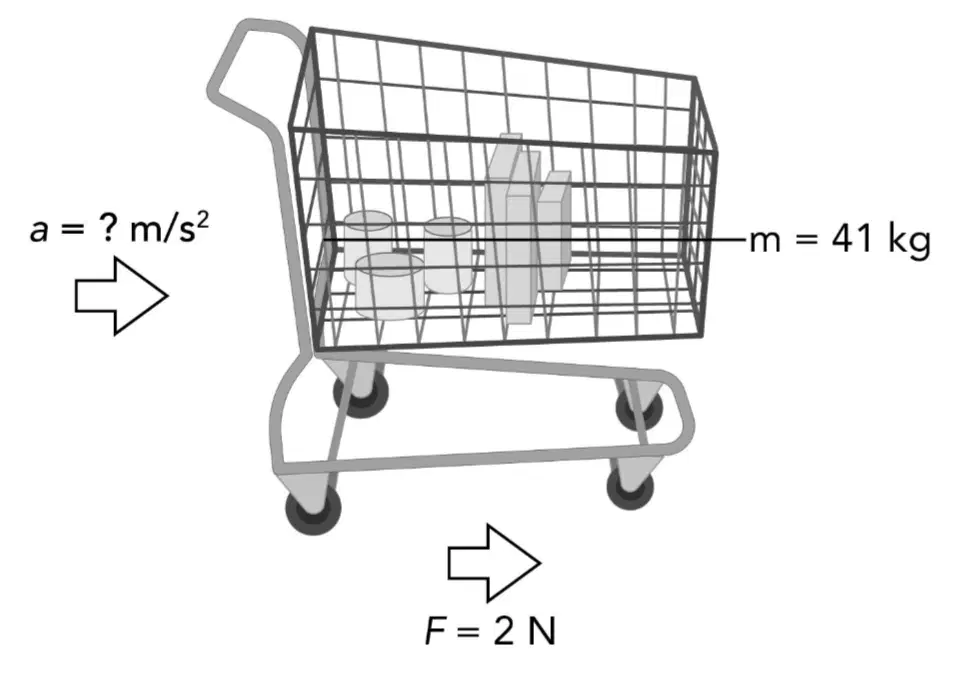
He adds one gallon of milk weighing 4 kg to the cart. Calculate the cart’s acceleration with the added mass.
0.04 m/s²
0.08 m/s²
0.1 m/s²
0.2 m/s²
A mover is pushing a cart with a mass of 68 kg. She pushes with a force of 3 N. The mover places another box with a mass of 25 kg inside the cart. This increase in mass would ______ the acceleration of the cart. She pushes the cart with more force to ______ the cart’s acceleration. This makes mass ______ proportional to acceleration and force ______ proportional to acceleration. Choose the option that identifies the missing terms, in order of appearance in the sentences.
A. increase; decrease; indirectly; directly
B. decrease; increase; indirectly; directly
C. decrease; increase; directly; indirectly
D. increase; decrease; directly; indirectly
In Newton’s Third Law, force is generated by the rocket when fuel is ______.
released
stored
ignited
compressed
What happens to the crash test dolls inside the car as it decelerates? Select all that apply.
The crash test dolls with seat belts continue traveling at the same acceleration as the car before deceleration.
The crash test dolls with seat belts decelerate at the same rate as the car.
The crash test dolls without seat belts continue traveling at the same acceleration as the car before deceleration.
The crash test dolls without seat belts decelerate at the same rate as the car.
The crash test dolls without seat belts accelerate at the same rate as the car.
Fill in the blank: The force of the crash test doll on the restraint is _______ and opposite to the force of the restraint on the crash test dummy.
greater than
equal to
less than
Water molecules like to stick to each other. Which word describes this?
cohesion
adhesion
capillary action
specific heat
What is it called when water sticks to water?
Cohesion
Adhesion
Capillary Action
Xylem
Water molecules "stick" to other water molecules.
specific heat
volume
adhesion
cohesion
Droplets of water sticking to the side of a glass.
cohesion
universal solvent
adhesion
specific heat

tendency of molecules of the same kind to stick to one another
cohesion
adhesion
solution
polar molecule

Water droplets take a spherical shape (as pictured) because of ____________
adhesion
cohesion
capillary action
solubility
What is the term for the ability of water to climb up a narrow tube against gravity?
Surface Tension
Adhesion & Surface Tension
Cohesion & Surface Tension
Capillary Action (cohesion and adhesion)
Fill in the blank: The process of water molecules sticking to a plant's roots is an example of _______.
Evaporation
Cohesion
Adhesion
Condensation
Which of the following best explains why ice floats on water?
Ice has a lower specific heat than water.
Ice has a higher specific heat than water.
Ice is denser than water.
Ice is less dense than water.
What property of water allows it to move through the roots of plants and up into the stems and leaves?
Surface Tension
Adhesion & Surface Tension
Cohesion & Surface Tension
Capillary Action (cohesion and adhesion)
Fill in the blank: The property of water that allows it to resist external force is known as _______.
Viscosity
Cohesion
Surface Tension
Adhesion
Fill in the blank: The force required to accelerate a 10 kg object at 5 m/s² is ___ N.
65
60
55
50

As you added drops to the coins, each drop stuck to the other water because of ________________.
adhesion
cohesion
capillary action
specific heat
How is surface temperature represented on the X-axis?
Surface temperature is on the Y-axis and is read from top to bottom from highest to lowest luminosity.
Surface temperature is on the Y-axis and is read from bottom to top from lowest to highest luminosity.
Surface temperature is on the X-axis and is read from left to right from highest to lowest temperature.
Surface temperature is on the X-axis and is read from right to left from lowest to highest temperature.
Upon further reading, the students find out that gamma rays are used in some medical imaging and treatments. Which student can say that this new evidence supports their claim?
A. Student B, because gamma rays have the longest wavelengths and largest amplitudes of EM waves.
B. Student A, because gamma rays have the shortest wavelengths and the highest frequencies among EM waves.
When a golf club hits a ball, the ball applies a force back on the club. This is an example of which of Newton's laws?
First Law
Second Law
Third Law
Law of Gravitation
What happens to the ball's speed if the force applied by the club is doubled?
It halves.
It doubles.
It remains the same.
It decreases.
Which of the following best describes the relationship between force and acceleration according to Newton's Second Law?
Force is inversely proportional to acceleration.
Force is directly proportional to acceleration.
Force is unrelated to acceleration.
Force is equal to acceleration squared.
Which type of electromagnetic wave has the lowest energy?
Radio waves
Gamma rays
Microwaves
Infrared waves

What is the Hertzsprung-Russel Diagram?
A map which tells the approximate location of stars in the Milky Way galaxy and their distance from Earth.
A table that alphabetically lists stars by name and includes dates of when the star was first charted.
A chart which organizes stars into categories based on the amount of Hydrogen they burn.
A graph used to classify stars according to their luminosity, color, temperature, and stage.

Which of these observations of Barnard’s Star is most likely accurate?
Barnard's star is less bright than sun and cooler
Barnard's star is brighter than the sun but hotter
Barnard's star is less bright than our sun but hotter
Barnard's star is equal in brightness and temperature to the sun


Which best describes stars located in area A
Bright and Hot
Cooler and bright
Dim and hot
Dim and colder

Which description best describes area B
Brighter and Hotter
Brighter and Cooler
Dimmer and cooler
Dimmer and Hotter

Which best describes stars in area C
Brighter and Hotter
Brighter an Cooler
Dim and Hotter
Dim and Cooler

Which best describes area D?
Brighter and Cooler
Brighter and Hotter
Dimer and Cooler
Dimmer and Hotter
Force=Mass x Acceleration
Newton's First Law
Newton's Second Law
Newton's Third Law
While you’re ice-skating with your friends, you push off from one end of the rink and slide forward. Based on Newton’s first law of motion, what is true?
You will lose your balance and fall over before your reach the middle of the ice rink.
You will continue to slide across the ice until a force makes you stop or change direction.
The force of gravity will make you keep your velocity until your friends make you stop.
The size of your ice skates will determine how quickly or slowly you travel across the ice.
Every time your cat’s paw hits her toy string, it swings away from her. How does this demonstrate Newton’s third law of motion?
Objects with mass, such as your cat's paw and toy string, will require inertia.
Objects in action, such as the string toy, will experience force.
For every motion from your cat's paw, there is unbalanced inertia from the string.
For every action your cat makes, there is an equal and opposite reaction from the string.

Which of the waves has a higher amplitude?
(The low energy wave has an amplitude of 1 cm and the high energy wave has an amplitude of 5 cm)
The Low Energy Wave
The High Energy Wave
Transverse waves move in a (a) direction.
Longitudinal waves move in a (a) direction.

Which of the following is an example of Longitudinal waves?
Water Wave
Seismic Waves
Sound Waves
Light Waves

Which of the following is an example of Transverse waves?
Sounds Waves
Light Waves
Water Waves

Does Wave A or Wave B have more frequency?
(Wave A has 3 waves and Wave B has 5 waves)
Wave A
Wave B

What is the name of the part labeled 1 (the highest point)?
Crest
Trough
Wavelength
Amplitude

What is the name of the part labeled 2 (the lowest part)?
Crest
Trough
Wavelengh
Amplitude

What is the name of the part labeled 3 (the distance - trough to trough or crest to crest)?
Crest
Trough
Wavelength
Amplitude

What is the name of the part labeled 4 (the height)?
Crest
Trough
Wavelength
Amplitude
12 lb bowling ball goes faster down the lane than a 15 lb bowling ball
Newton's 1st Law
Newton's 2nd Law
Newton's 3rd Law
None of the above
feet push down on the floor & the floor pushes up at feet while you walk
Newton's 1st Law
Newton's 2nd Law
Newton's 3rd Law
None of the above
seatbelt stops you from hitting the windshield if you hit the brakes quickly
Newton's 1st Law
Newton's 2nd Law
Newton's 3rd Law
None of the above

Which galaxy type is the oldest?
Elliptical
Spiral
Lenticular
Irregular

Which type of galaxy lacks a well-defined shape?
Elliptical
Lenticular
Spiral
Irregular

Which type of galaxy is the Milky Way?
Elliptical
Irregular
Spiral
Lenticular
Which of the following is not a type of galaxy?
Irregular
Circular
Elliptical
Spiral
Fill in the blank: The force required to accelerate a 15 kg object at 3 m/s² is ___ N.
45
50
55
60
Which of the following best explains why a paperclip can float on water?
Adhesion between the paperclip and water is strong.
The paperclip is less dense than water.
The paperclip is more dense than water.
Surface tension allows the paperclip to float.

Element
Compound
Homogeneous Mixture
Heterogeneous Mixture

Homogeneous Mixture
Heterogeneous Mixture

Heterogeneous or Homogeneous?
Heterogeneous
Homogeneous

Heterogeneous or Homogeneous?
Heterogeneous
Homogeneous

